
Go | New | Find | Notify | Tools | Reply | |
Member |
Maybe we go about running ships through the straight, looking for mines whatever. Let the Iranians be the 1st to fire a few drones at our warships, then it’s ’game On’ again. The main angle initially is to get safe passage going again. Before long they will likely fire at us. With the intel, we may even know when they are getting ready to fire. | |||
|
| The success of a solution usually depends upon your point of view |
We have the ability to provide safe transit through the straits at will. We've done it before. That we are not currently doing it is a political decision based on strategic goals. I'm not sure what exactly those goals are, but I bet "protecting the oil supply for the rest of the world" is not one of them. “We truly live in a wondrous age of stupid.” - 83v45magna "I think it's important that people understand free speech doesn't mean free from consequences societally or politically or culturally." -Pranjit Kalita, founder and CIO of Birkoa Capital Management | |||
|
| Lawyers, Guns and Money  |
It’s no secret that for weeks I have suggested the Trump Administration might not actually want to re-open the Strait very quickly. Recently, other commenters have begun to suspect the same thing. A closed Strait hurts Asia and Europe, but promotes US oil and natural gas sales, and all right at a critical inflection point in the historic AI arms race, which demands energy above all. On Wednesday, commenting on the new cease-fire arrangement, Iranian foreign minister Abbas Araghchi, said that the strait would be open to traffic “with due consideration of technical limitations.” At the time, nobody noticed those two weasel words. But now, ‘technical limitations’ is obviously a euphemism for, we forgot where we left our high explosives. Sorry. Not our fault. According to the Times, during the conflict, Iran used swarms of small boats to mine the Strait. Apparently, it never wrote down where it left them. Worse, some of them are drifting around the Strait like chocolate nuggets floating in the public pool. “As with land mines,” the Times dryly explained, “removing nautical mines is far more difficult than placing them.” Well, duh. Further complicating this already troubling scenario, “the U.S. military lacks robust mine removal capabilities.” Our mine-clearing capabilities are “not robust.” We’d love to get those mines out of there for you, but we just don’t have the right gear. It’s on order. Meanwhile, all we have is this cordless metal detector and a couple reusable Aldi bags. It’s a double sandbag! Despite everyone’s good intentions, the Strait must remain closed. The Iranians are sandbagging by claiming “technical limitations” qua bad memory. President Trump is also sandbagging. He can say he would happily de-mine the Strait if he could, but what can he do? Minesweeper is no longer supported on the App Store. In other words, it won’t happen overnight. Please be patient while sweeping is in progress. Sorry about that energy crisis. This morning, after I’d already drafted this segment, President Trump tweeted words confirming the thesis. Behold: 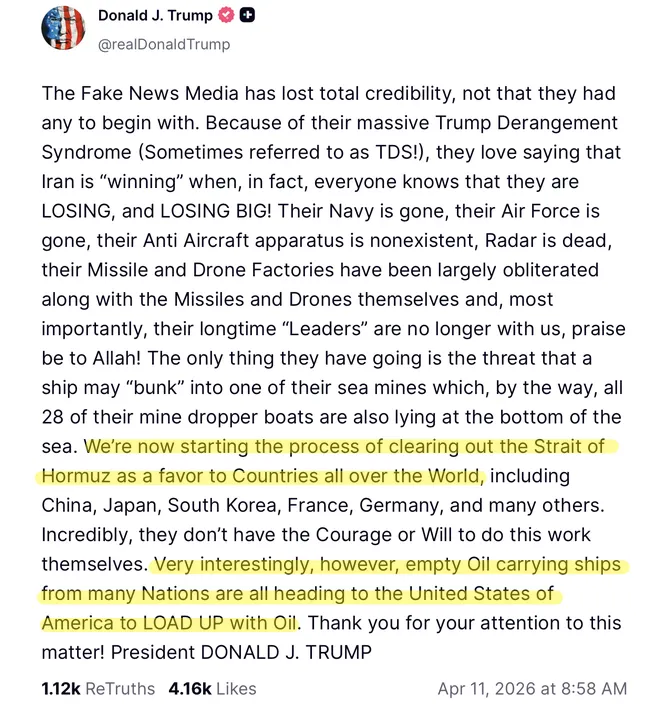 “We’ve now started the process of clearing (mines) out (of) the Strait of Hormuz as a favor to Countries all over the World,” the President said. Clearing them slowly. Now consider his very next sentence: “Very interestingly, however, empty Oil carrying ships from many Nations are all heading to the United States of America to LOAD UP with Oil.” In other words, the US benefits from the mines. It couldn’t be clearer. But it’s terrible for the fair-weather allies in Europe. https://www.coffeeandcovid.com...ne-saturday-april-11 "Some things are apparent. Where government moves in, community retreats, civil society disintegrates and our ability to control our own destiny atrophies. The result is: families under siege; war in the streets; unapologetic expropriation of property; the precipitous decline of the rule of law; the rapid rise of corruption; the loss of civility and the triumph of deceit. The result is a debased, debauched culture which finds moral depravity entertaining and virtue contemptible." -- Justice Janice Rogers Brown "The United States government is the largest criminal enterprise on earth." -rduckwor | |||
|
| Savor the limelight |
YES!!! The WAR CRIMES are back on! | |||
|
| Member |
Let me give you a little insight into an Insurgency War. A few months ago, the Iranian people were fighting AGAINST THEIR GOVERNMENT. Like “normal people” trying to get out from under an oppressive regime. Oppressed in many ways- including political and religious. People just looking for a better way of life. Let’s look at America circa the past few years. Let’s say Droolin Joe and The Ho were Dictators of America. People like US, (you, me and a lot of other RIGHT thinking Americans) are sick of this Liberal, DEI, Democrat bullshit. We decide we have had enough, and start protesting in the streets. Droolin Joe’s government doesn’t like dissent, and he sends out his police, secret police and military to stop the protests. We don’t have access to guns and cool shit to fight back. There’s other countries out there that are sympathetic to OUR cause. They decide to help us out. Yayyyy us! Country “X” takes out key leadership in the Government. (Smart bombs are cool!) The next round of leadership steps up, they get zapped as well. 3rd round draft picks are next- adios to them as well. 4th round ones are smart and can predict the future, and don’t want to get blown up real good. 5th round just quit the team. Things are looking good for us, we have a shot at really turning this place into something Great Again, and elect a real president… bla bla bla. The cool thing is, OUR ass whoopin from the police and military has stopped! The military is now getting their asses whooped by Country “X”. Country “X” starts dropping bombs all over the place now! Power stations, dams, churches, schools… On the surface, we’re gonna be mad because there’s no electricity. And all the messed up things that happen because of no electricity. Here’s a little secret when it comes to bombs being dropped: People die! Read that again, real closely- People Die. It doesn’t say “bad people”, or “military people” or “oppressive government people”. It says “people”. People as in your brother who works at the power plant. People as in my kid that’s in college, or high school… even worse- ones that are in grammar schools. Ya want a quick way to get real pissed at Country “X”? Have your brother working at the power plant, or a kid in school or a wife in church when a bomb gets dropped! See, Country “X” NEEDS to win and keep those “hearts and minds”! Especially if America has strategic resources not only for Country “X”, but a lot of other countries too. Think about it! Look at your wife, kids, family, then let us know how you’re doing after a bomb gets dropped on them. The people here on Sig Forum that know, unfortunately know. You have no idea what “HATE” really is until you look into some teenagers - twenty- thirty something year olds eyes whose parents, brother, little sister was smoked by a round coming from Country “X”. Because THAT, my friend, is pure fuckin HATE. See, America really isn’t good at winning wars like this. Oh sure, we can bomb the ever-lovin shit out of a place! We’re awesome at that! Not soo good at the large scale insurgency stuff. Take a look at Iraq and Afghanistan. We made a lot of enemies over there unnecessarily. Let’s try and not do that shit again. Sooner or later that stuff is going to bite us in the ass. ______________________________________________________________________ "When its time to shoot, shoot. Dont talk!" “What the government is good at is collecting taxes, taking away your freedoms and killing people. It’s not good at much else.” —Author Tom Clancy | |||
|
| Freethinker |
“Wise men talk because they have something to say; fools, because they have to say something.” — Plato | |||
|
| Member |
Poor Tom Friedman, Sr. Prick at the NYT’s, must have a beaches worth of sand clogging and irritating his vagina. https://x.com/BrentHBaker/status/2043048290523005341 __________ "I'd rather have a bottle in front of me than a frontal lobotomy." | |||
|
| Green grass and high tides  |
Maybe someone can link the interview Mark Levine did with retired General Jack Keane tonight. It was two segments and he covered a lot things and was very specific. Gave a very detailed analysis on what is going on. It was excellent. If you think we are not in the right in this fight or have reservations I would encourage you to take a few minutes to listen to what he has to say. I have heard the General many times. I do not always agree with him. In this case I do completely. "Practice like you want to play in the game" | |||
|
| Freethinker |
It is possible to support this war, or any war, without supporting everything that could be done to wage it. Hopefully the people who actually make the decisions will understand why there should be limits. “Wise men talk because they have something to say; fools, because they have to say something.” — Plato | |||
|
| Green grass and high tides |
If when fighting wars you are worried about what everyone else is thinking ( opponents second guessing it) you are not going to win. Plain and simple. Fwiw, I quit giving a shit what others think a long time ago. "Practice like you want to play in the game" | |||
|
Member |
As with many things in life, there is more than one way to "win" a war. Given a choice between one which alienates those whom you're ostensibly fighting to liberate and one which doesn't, it makes sense to choose the latter. A Pyrhhic victory is a win in name only. | |||
|
| No More Mr. Nice Guy |
People are missing several important strategic aspects here. 1) Iran's ability, or at least the threat, to close the Strait of Hormuz is not leverage if they can't militarily dominate those who want it open. Their threat is a liability because so much of the world depends on it being open. 2) Trump needed to be seen to give Iran's leadership a legitimate fair chance at a negotiated peace. It was a near certainty they would not agree to terms and/or would quickly violate any agreement they made. They had their chance, so now we can resume more destructive actions. Trump's peace offer was rejected, which helps domestic politics here. But it also helps in Iran. The population can see that their government failed them by rejecting reasonable terms. Had there been no peace talks and we'd gone directly to bombing infrastructure (which will kill people as Sigfreund points out), the citizens would complain we went too far too fast. I see this as a pre-planned step in a larger Teump strategy. | |||
|
| Lawyers, Guns and Money |
I hope the word gets out in Iran and I hope they rise up against this evil regime. But... How does the population of Iran know anything about the peace talks or their government failed them by rejecting reasonable terms? I thought their government shut down access to the internet? They only have Baghdad Bob, or the Iranian equivalent. "Some things are apparent. Where government moves in, community retreats, civil society disintegrates and our ability to control our own destiny atrophies. The result is: families under siege; war in the streets; unapologetic expropriation of property; the precipitous decline of the rule of law; the rapid rise of corruption; the loss of civility and the triumph of deceit. The result is a debased, debauched culture which finds moral depravity entertaining and virtue contemptible." -- Justice Janice Rogers Brown "The United States government is the largest criminal enterprise on earth." -rduckwor | |||
|
| Staring back from the abyss  |
I'm a tad concerned about this blockade. I think it'd be a brilliant move...if we didn't have the midterms to worry about. Gas remaining at ~$5/gallon will NOT be good for Republicans. Another question I have is, if we are supposedly self -sufficient WRT gas/oil and produce more than anyone, why are our prices so fargin high? We don't rely on the middle east as we've got our own (and Venezuela's). ________________________________________________________ It is long past time for a Convention of States. The Founding Fathers gave us this tool to fix an out of control government and we need to use it. | |||
|
| Member |
Because oil is a global commodity and US based gas/oil companies sell to the open global market, they're vulnerable to the cost fluctuations like everyone else. | |||
|
| Staring back from the abyss |
Then we should stop selling to the global market and ship direct to the refineries here and out to the gas stations from there. ________________________________________________________ It is long past time for a Convention of States. The Founding Fathers gave us this tool to fix an out of control government and we need to use it. | |||
|
Drill Here, Drill Now |
We aren't oil self-sufficient. If you include Canada and call it North American oil independence then we're ~90% self-sufficient. I broke it down about 3 weeks ago in this post. Same link as above, I also posted the other first in my 30 year career phenonmen that this Iran war has brought on is the crude oil trading hubs in ME and Asia have been trading ~50% higher than WTI (US's crude) and Brent (UK's crude). More on this below in post. The US is in even better shape on the gas side. Iran is a shockingly small gas or LNG exporter so that's why natural gas hasn't been on the news. Some of it is geography related. For example, if Alaska produces more crude than Washington state and California refineries can refine then it's in US interest to sell on world open market. Some of it is Trump wants to export and the aforementioned ME/Asia oil price disparity is making it interesting to rest of world. Ego is the anesthesia that deadens the pain of stupidity DISCLAIMER: These are the author's own personal views and do not represent the views of the author's employer. | |||
|
Optimistic Cynic |
I would also question why we continue to sell crude rather than refined products? Seems like the profit margin would be far higher on the latter, sort of like selling cars rather than iron ore. I suspect there is a shortage of refining capability in the US because of misguided so-called environmental policies, but still, wouldn't it be more to our benefit if those super tankers were loaded with kerosene/diesel rather than crude? And were does Venezuela fit into all this? Are we selling our crude to China, but denying the Venzies any customers except ourselves? Yes, I am aware that the quality and consistency of crude varies from source to source, and a refinery has to match its capabilities to its raw material. Is this what is responsible for this seeming disparity? Does anyone have a link that (non-politically) explains the realities of the world's oil markets? | |||
|
| Savor the limelight |
Tatortodd’s post right above yours has links to his explanation. As I recall, he explained the types of crude, various refinery’s abilities to process different types of crude, various ship size and canal capacities affecting the ability to get crude where it needs to be. | |||
|
| Thank you Very little  |
| |||
|
| Powered by Social Strata | Page 1 ... 58 59 60 61 62 63 64 ... 113 |
 | Please Wait. Your request is being processed... |
|
© SIGforum 2026