
Go | New | Find | Notify | Tools | Reply | |
Member |
Yes I know, didn't intend to communicate the entire population was like that, my mistake. I'm overdue to learn about that history. Lover of the US Constitution Wile E. Coyote School of DIY Disaster | |||
|
Member |
I guess nuking Mecca and Medina followed by complete occupation on the ground is right out. Worked 80 years ago. Bet Lindsay would back that kind of action. | |||
|
| Lawyers, Guns and Money  |
I detect a bit of sarcasm... 
Yeah, he would. We weren't designed to be an empire... but we kind of picked up where the Brits left off, unfortunately. But I think Donald Trump's instinct is to pull back to focus on the American hemisphere. Hopefully, we can accomplish our limited goals of 1. NO NUKES and 2. Open shipping through the international waters of the Strait of Hormuz and both gulfs. And then get out of there. "Some things are apparent. Where government moves in, community retreats, civil society disintegrates and our ability to control our own destiny atrophies. The result is: families under siege; war in the streets; unapologetic expropriation of property; the precipitous decline of the rule of law; the rapid rise of corruption; the loss of civility and the triumph of deceit. The result is a debased, debauched culture which finds moral depravity entertaining and virtue contemptible." -- Justice Janice Rogers Brown "The United States government is the largest criminal enterprise on earth." -rduckwor | |||
|
| Partial dichotomy |
https://www.theepochtimes.com/...SzX8GOeoUjTEfOecs%3D Iran Halts Talks With US Over Israeli Escalation in Lebanon Tehran is suspending indirect negotiations with Washington and is threatening to expand military pressure across key regional shipping routes: Iran state media. Iran has halted indirect negotiations with the United States over what it describes as Israel’s escalating military campaign in Lebanon, according to a report by Iran’s semi-official Tasnim News Agency, raising fresh doubts about efforts to transform a fragile ceasefire into a broader agreement that would end the war. Tasnim reported on June 1 that Iran’s negotiating team will stop talks—including the exchange of messages through a mediator—because Israel had continued military operations in Lebanon despite what Tehran considers a ceasefire that applies across all fronts. The report said Iran considers a pause in Israeli military operations in Lebanon as a precondition of the ceasefire and that Israel’s actions amounted to a violation of the truce. Iranian officials and negotiators are calling for an immediate cessation of Israeli military operations in both Gaza and Lebanon, along with the need for a complete withdrawal from occupied areas in Lebanon, Tasnim reported. Besides halting talks, Iran is also threatening to completely close the Strait of Hormuz and expand the conflict to other regions, including the Bab el-Mandab Strait in the Red Sea, in response to Israeli actions. Israeli Prime Minister Benjamin Netanyahu on Monday ordered the military to strike Hezbollah targets in Beirut, escalating Israel’s campaign against the Iran-backed terrorist group. Netanyahu cited “repeated and ongoing” ceasefire violations by Hezbollah against Israeli cities and civilians. Iranian officials denounced the Israeli military’s moves and hinted at retaliation. The speaker of Iran’s parliament, Mohammad Bagher Qalibaf, said that escalation of Israeli military operations in Lebanon, along with the ongoing U.S. naval blockade of Iranian ports, is “clear evidence” that the United States has broken the terms of the ceasefire. “Every choice has a price, and the bill comes due,” Ghalibaf said in a June 1 post on X. “It will all fall into place.” The Epoch Times has reached out to the White House with a request for comment. This is a developing story. Check back for updates. SIGforum: For all your needs! Imagine our influence if every gun owner in America was an NRA member! Click the box>>>  | |||
|
Drill Here, Drill Now |
These Iranian spokesmen have the credibility of Baghdad Bob Ego is the anesthesia that deadens the pain of stupidity DISCLAIMER: These are the author's own personal views and do not represent the views of the author's employer. | |||
|
| Lawyers, Guns and Money |
Yes, of course. Because the world has started bypassing the Strait of Hormuz! 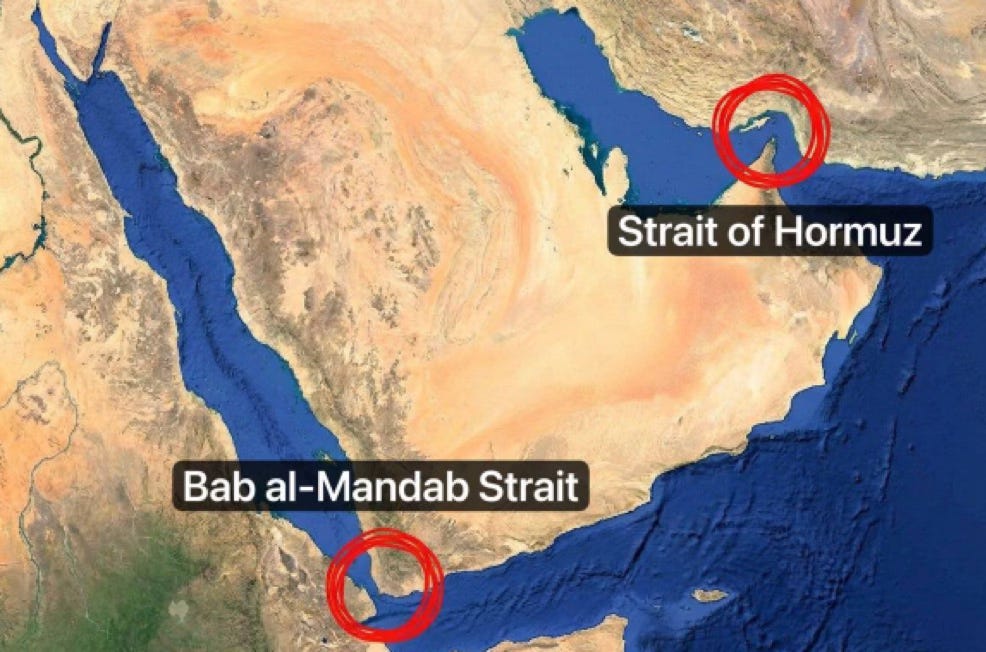 "Some things are apparent. Where government moves in, community retreats, civil society disintegrates and our ability to control our own destiny atrophies. The result is: families under siege; war in the streets; unapologetic expropriation of property; the precipitous decline of the rule of law; the rapid rise of corruption; the loss of civility and the triumph of deceit. The result is a debased, debauched culture which finds moral depravity entertaining and virtue contemptible." -- Justice Janice Rogers Brown "The United States government is the largest criminal enterprise on earth." -rduckwor | |||
|
Member |
I think it’s time for a little “FO” to go with Iran’s “FA”. I admire the patience that President Trump has shown over the last 2 months, but I think if he doesn’t make some sort of impact statement (impact action more accurately) it does start to make our resolve seem questionable. I think it’s time for a little reminder that we’re the ones with the power. Perhaps at the first sign of interference with another strait we hit something other than the strait to show that such behavior will simply not be tolerated. Perhaps it’s time to enforce a complete isolation of Iran, as I do believe that the naval blockade of the strait of Hormuz has been the most effective strategy thus far. “It is not the critic who counts; not the man who points out how the strong man stumbles, or where the doer of deeds could have done them better. The credit belongs to the man who is actually in the arena, whose face is marred by dust and sweat and blood; who strives valiantly; who errs, who comes short again and again, because there is no effort without error and shortcoming; but who does actually strive to do the deeds; who knows great enthusiasms, the great devotions; who spends himself in a worthy cause; who at the best knows in the end the triumph of high achievement, and who at the worst, if he fails, at least fails while daring greatly, so that his place shall never be with those cold and timid souls who neither know victory nor defeat.” | |||
|
Member |
The ports at Chabahar and Bandar Abbas seem like good targets... This space intentionally left blank. | |||
|
Now in Florida |
Victor Davis Hanson is always worth reading. Iranian Endgames? Iran survives by delay, deception, and deterrence games—but the moment may be coming when airpower, not diplomacy, decides how the nuclear standoff ends. By Victor Davis Hanson June 2, 2026 The Trump administration has bent over backward to negotiate an end to Iran’s grand plans to develop nuclear weapons—before the June 2025 bombing, afterward, and again during the follow-up diplomacy of spring 2026. Yet Iran is unlikely ever to abandon its pursuit of the bomb voluntarily. With nuclear weapons, Tehran hopes to become the de facto hegemon of the Middle East. Only then could it effectively coerce or deter both Israel and the wealthy Arab Gulf states. And that is the charitable view, one that excludes the possibility of a messianic Shiite theocracy believing that eliminating the “one-bomb” state of Israel would forever ensure the Shiite minority permanent preeminence in the pantheon of Islamic jihadists. After three months of intermittent war, we are now better acquainted with Iran’s intentions and the realities of the conflict. The Iranian regime has never viewed “negotiations” as a path leading to an ultimate “deal.” At best, the regime’s supposedly “elected” government plays good cop, while the bad cop theocratic henchmen periodically violate whatever understandings have been reached. Accordingly, talks remain perpetually fluid, punctuated by delays, pauses, and renewed demands. The regime’s art of “dealing” is not aimed at resolution but at gaining strategic advantage by postponing any military effort that leads to their demise. The regime’s mere survival is broadcast as victory, whatever the damage to the country. As a result, Iran does not necessarily regard overwhelming military defeat on the battlefield as a strategic loss. The regime believes its own advantage lies in the long term and beyond the battlefield itself. For nearly half a century, this wicked regime has survived through propaganda, bloodcurdling threats, slaughtering civilians at home and abroad, terrorist proxies and clients, and mastery of both global politics and the internal politics of its adversaries, especially in the U.S. and Europe. Its strategy is also to feign detachment from reality and appear capable of doing anything to anyone anywhere at any time. Iran’s leaders are like the crazy assailant on the subway who feels he can do anything he wishes, since most people either fear his antics or don’t wish to stoop to his level to stop him. All threats, ultimatums, and vows are also not credible. They are designed to bluff or mislead opponents into miscalculations. The more left-leaning American presidents, whether Clinton, Obama, or Biden, reached out to dialogue and normalize with Iran, the more the Iranians loathed these presidents for being weak. They view Europe and the U.S. not as nations, but as various successive governments and administrations that, to various degrees, can be manipulated. And they have utter contempt for perceived Western appeasement. Magnanimity they interpret as weakness to be exploited, never as kindness to be reciprocated. This Iran war is unlike our past conflicts in the Middle East. So far, there is no American use of ground troops. The bombing (and thus the war itself) has been historically short, lasting only around 38 days—unlike the two Iraq wars, Afghanistan, Libya, and Serbia. In terms of size, population, resources, wealth, and military strength, Iran has been the most formidable adversary the United States has faced in the Middle East. Yet our losses in this war so far have been historically low, while the damage to the Iranian industrial, nuclear, and military infrastructure has been immense and unprecedented. Unlike past conflicts, where combatants often struggled to distinguish friend from foe in places such as the streets of Fallujah, the villages of Helmand Province, or the rice paddies of South Vietnam, this war has been uniquely suited to overwhelming American airpower. The United States has clearly won the shooting war, though it has yet to secure the peace. One problem is the scarcity of accurate information. We have only rumors and spotty regime-fed reports of what is actually going on inside Iran, given there are neither American ground troops nor embedded Western reporters there. What comes out of Iran is the chronic form of lying associated with “Baghdad Bob” during the Second Gulf War. No one yet knows the full extent of the damage to the regime or the viability of the Iranian resistance. The result is that Iran is likely to be in far worse shape than it lets on. Even so, a militarily weakened Iran seems to hope that escalating tensions in the Strait of Hormuz will raise gas prices, at home and worldwide, and cost Trump the midterms, before American sanctions, blockades, and freezing assets will bankrupt the country. The United States is now weighing two choices. One is to end the war and get some sort of deal, assured that it has already done close to a decade’s worth of damage to Iran, and perhaps more if sanctions persist. The United States would seek to negotiate an exit that lowers oil prices and staves off political catastrophe in the November midterms. America’s anxious Gulf allies might support—or even now insist upon—such a negotiated settlement, assuming that Iran has been sufficiently defanged in the short term, that their vulnerable oil infrastructure remains secure for the time being, that anti-Iran sentiment in the Arab world remains strong, and that the Iranian people will grow increasingly restive if the regime continues to ignore their poverty and instead chooses to rebuild its shattered arsenals and revive its bankrupt Arab terrorist proxies abroad. Yet the long-term limitations of such a limited and transitory victory are twofold. First, Iran’s regime would likely consolidate its hold on power, claiming that its reputation abroad has grown, and that its mere survival should be seen as an incredible victory. Secondly, Iran would likely rebuild and wait to go nuclear until the arrival of a president akin to Obama or Biden, convinced then that there would be no danger of another American intervention and that the new American Left sympathizes with Iran’s anti-Israel agenda and therefore its nuclear aspirations. The regime has good reason, given the current new Socialist-Islamist Democrat Party, that a future Democrat president would revive Obama’s bankrupt visions of empowering a Shia crescent from Tehran to Yemen to “balance” Israel and the Gulf monarchies. An alternative course is a riskier one that could involve greater casualties and Iranian missile and drone strikes against Israel and the Gulf states. It would begin with issuing a final one-week deadline for Iran to concede to U.S. demands to denuclearize, hand over all its enriched uranium, dismantle its remaining missile forces, cease subsidizing Hezbollah, Hamas, and the Houthis, and stop interfering with international traffic through the Strait of Hormuz. Otherwise, for a week or so, the U.S. would strike the remaining regime grandees who believe they are still in charge of the government, along with dual-use bridges, subterranean nuclear depots, power plants, island ports and docks, weapons arsenals and factories, and the remnants of the Iranian mosquito navy. It would then open the Strait of Hormuz, leave a guardian force to keep it navigable, declare victory, go home, and pivot to the economy. The point would be to inflict enough damage on the Iranian theocracy and its appendages to end the current off-and-on war. Either such Iranian concessions or such destruction would humiliate the regime, neuter its military, and halt its nuclear aspirations for decades, leaving it ripe for internal uprising—and reminding the world there is a limit to unpredictable U.S. patience and placidity. LINK | |||
|
| Powered by Social Strata | Page 1 ... 78 79 80 81 |
 | Please Wait. Your request is being processed... |
|
© SIGforum 2026