
Page 1 2
Go | New | Find | Notify | Tools | Reply | |
| Savor the limelight |
Yeah, I’ve read all about them in the last few months. As long as it’s not the rear main seal, I’m going to make the trip with the truck and just check the oil at every stop. I have no clue, which is why I’m asking, but I’m worried that if it is the rear main seal which actually seals a moving part that it could fail completely and leave my truck and boat stranded. | |||
|
| His diet consists of black coffee, and sarcasm.  |
Any significant oil leak, large enough to materially lose oil, would have rustproofed most or all of the underside of the truck. Frankly, for the time and miles, it looks very clean. I agree with the top post on this page, that it might be a valve cover gasket. Because of all the oil flying around under them, they are a common source of leaks on any but a flathead engine. | |||
|
| Technically Adaptive |
As mentioned in the first video posted, it is most likely the upper oil pan gasket inside the bell housing, this video shows excessive crank case pressure. If your crankcase pressure is high, I would not tow with it. | |||
|
| Savor the limelight |
So not the rear main seal. It’s a joy to work on our Florida cars: 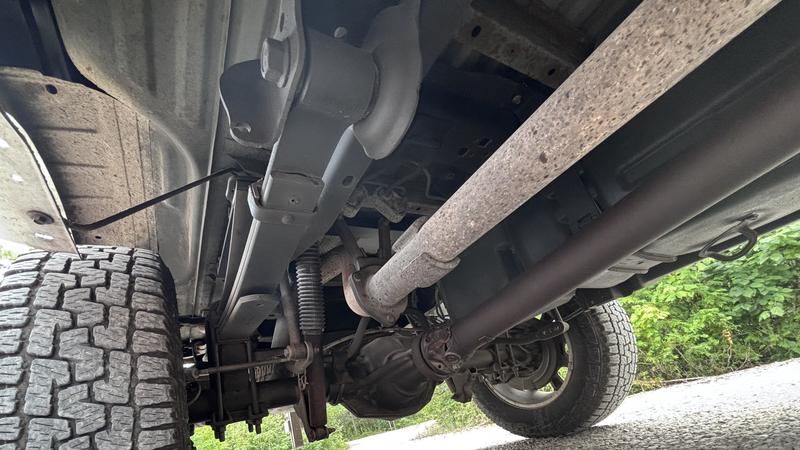 Much better that the ones I worked on in Wisconsin as a young adult. Never had a problem with high crankcase pressure that I know of. The YouTube videos show the oil fill cap popping of from excess pressure. I’ve checked many times and have never had that happen. Before I replace the oil separator yesterday, I stopped the truck at home after picking up the new oil separator, 40 miles round trip, had my son rev up the engine and took the fill cap off. No pop and I could feel any pressure when I covered the fill tube with my hand. | |||
|
| Technically Adaptive |
Be careful with oil leaks on those. If it does a REGEN (exhaust clean out), it will get hot enough to burn things. | |||
|
| Green grass and high tides  |
Personally I'd have it professionally assessed. Not sure that would be a dealership. Being a diesel you could be talking thousands to try to resolve. I hope not.This message has been edited. Last edited by: old rugged cross, "Practice like you want to play in the game" | |||
|
| Buy that Classic SIG in All Stainless, No rail wear will be painless.  |
Buy a case of your favorite brand/viscosity diesel engine oil in Michigan along with a funnel if it's needed for adding oil to the engine. And several rolls of the shop paper towels. Stop every couple hours at the beginning of your trip heading back to Florida. Pull over, go take a piss at the rest area, walk around a bit and let that hot oil drain back into the oil pan. Check the engine oil level, add as needed. Also look under your truck when you first stop, and check that you haven't parked directly over somebody else's fresh oil drippings on the blacktop. Move the rig to dry pavement if needed. By the time you drive 500 or so miles, you'll know what the status of the leakage rate actually is. If it is pissing oil on the ground, just keep the oil level between full and down a quart. If it isn't pissing on the ground, by the time you have stopped and checked twice, you'll know that also. If you can drive it back to Florida, and you can, if you keep it between full and add a quart, the smart move is getting it repaired in Florida where you live (if it is even in need of a repair) If you get a repair in Michigan, and something goes wrong with the repair, how in the hell are you going to get it looked at by the place in Michigan with you and the truck being in Florida? Avoid that scenario at all costs! If it needs repairs, get them done in Florida so you aren't on the road with family, trailer and watercraft. If it uses ten quarts on the way home, who cares. All you will do is prevent rust on the bottom of the truck. Keep the engine oil level on the dipstick between the lines or dots, and drive the truck! 1200 to 1300 miles trip? It used ten quarts? That's 130 miles to a quart of oil. Again, who cares. Get it home under it's own power to the repair shop of your choice, at home, not out on the road. I've seen trucks that leaked a quart in 130 miles. The first place you look for the oil leak is at the bottom of the rear bumper and the tailgate. If it isn't sloppy wet on the rear differential, rear bunper, and tailgate, it's not leaking bad enough not to drive it. NRA Benefactor Life Member NRA Instructor USPSA Chief Range Officer | |||
|
| Technically Adaptive |
^^^^^^^ You do realize that it's leaking oil on the exhaust pipe? if it goes into REGEN, bad things could happen. AI Overview: An oil or fuel-related fire during a DPF regeneration on a 2015 Ford F-250 6.7L Powerstroke is typically caused by extreme exhaust temperatures (exceeding 1,200°F) igniting pooled oil leaks, a severely soot-clogged DPF, or excessive post-injection fuel dilution leaking onto hot exhaust components .Common Causes of Regen FiresCrashed/Clogged DPF Thermal Overload: Forcing a regeneration when a diesel particulate filter is completely blocked can cause runaway thermal events, melting the substrate and igniting trapped soot or nearby lines.Active Oil Leaks: Valve cover gaskets, degraded lower/upper oil pan seals, or CCV system failures can drip engine oil directly onto the hot downpipe or exhaust manifold during the high-heat regen cycle. | |||
|
| Savor the limelight |
650 miles today, only down almost 1/4 of the hash mark, and the boat is still clean. Kept it mostly around 70 and easy on the accelerator. It did a passive regen at some point which is nice since it doesn’t affect my MPG. | |||
|
| Savor the limelight |
Didn’t add any oil, but it was full at the Buc-ees in Kentucky. Must have been parked on an angle or something. Down 1/4 hash mark again at Buc-ees in North Georgia, so oil on the 3/4 of the hash mark. Still have 9 hours and a little over 600 miles to go. | |||
|
Shall Not Be Infringed |
So what's that work out to...1 Qt./~2500 Miles? That's a pretty solid/not insignificant leak you've got there. ____________________________________________________________ If Some is Good, and More is Better.....then Too Much, is Just Enough !! Trump 47....Making America Great Again! "May Almighty God bless the United States of America" - parabellum 7/26/20 Live Free or Die! | |||
|
| Savor the limelight |
1 quart per 4,000 miles and it holds 13 quarts. It's getting fixed when we get home. It leaks worse if you get the turbo going which should help narrow down where the problem is. The engine is mostly buried under the dash, so I can't see anything without a mirror and light. The mirror is at home. | |||
|
| Buy that Classic SIG in All Stainless, No rail wear will be painless. |
So... Inquiring minds want to know. Have you made it home yet without BURSTING INTO FIRE? NRA Benefactor Life Member NRA Instructor USPSA Chief Range Officer | |||
|
| Savor the limelight |
We did. I was a little worried the last 40 miles because I was behind him and there was a weird smell. It wasn’t oil or a regen, but turned out to be an older motorhome that was clearly having engine trouble. I put a half quart in in Valdosta this morning and I’ll check it in the morning. I appreciate the solid advise. Truck runs great, drives great, and tows that boat like it’s not there. My son drove the minivan and jet skis the first day. The next morning, I asked which he wanted to drive and he said minivan, unless I wanted to drive the minivan the 43 miles to Buc-ees to see how it was. We switched and he never offered to switch back. Before he took the minivan to Idaho over the summer, we replaced the shocks, struts, sway bar end links, and CV joints and noticed the bushings in the lower control arms were dry rotted. We didn’t have time before his Idaho trip, so we did it in Michigan last week. Minivan runs and drives great now too. I’ll be driving that to get my daughter’s stuff to NYU at the end of next week. My kids are learning quite a bit working on the vehicles with me. My boys mostly, but my daughter can change the oil or a tire. Speaking of tire changing, I made sure my son had gloves, plug kit, air compressor, sockets, torque wrench, breaker bar, and an impact driver for his Idaho trip. One of his professor’s wife’s Suburban got a flat on Idaho and my son swapped the spare for them. 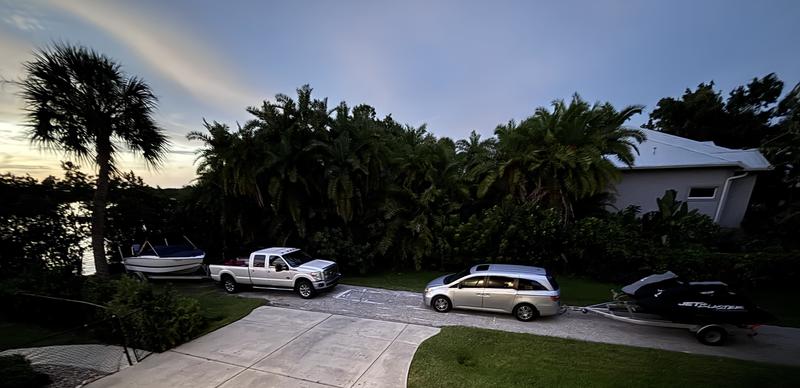 | |||
|
| Buy that Classic SIG in All Stainless, No rail wear will be painless. |
Great, that's the way a road trip is supposed to end. No fuss, no bother other than adding a bit of oil. And NO FIRES! Now, do some research at your leisure after unpacking and putting the boat and watercraft away, and find a shop for getting the oil leak diagnosed and repaired. Dealership or not, do your research. Here in NY, the DMV can be a useful tool for selecting a repair shop, you check for complaints. I don't know if that is possible in FL. Here is how you will want to do it. Get the entire engine, and engine compartment degreased, including underneath the truck. Do not pressure wash a diesel when the motor is hot. I would avoid steam cleaning also. Typically, a small bottle of UV fluorescent dye is added to the engine oil. Then a road test, likely less than 30 miles. Then up on a vehicle hoist, and shine the ultraviolet light around the bottom side looking for the UV dyed oil. You may not see much from above due to how the engine is "shoved" back under the cowl. The leak may not be on the bottom, there are many potential leak site locations above the rear main seal or one of the oil pan gaskets. The UV dye never lies! Since getting out of the business, I haven't stayed current, especially with Ford products. I do vaguely recall a "certain" vintage of Ford trucks, for some of the more meaningful types of engine repairs, removing the entire CAB of the truck was mandatory. Not optional. I don't recall what years were in that CAB removal for major engine service, but me personally, I would be sitting down when they got ready to hand me the estimate for the needed oil leak repairs, just in case your model truck is in that affected "age" bracket where entire CAB removal was the window into some of the major engine repairs. If your truck needs the entire CAB removed for fixing the oil leak, there is no way in hell I would let an independent garage do that repair. Dealership only. Simply put, I believe a Dealership will stand behind that repair MUCH better than an independent shop. Removing the CAB is a very serious major project/repair. Please come back to this thread and let us know how it all played out! NRA Benefactor Life Member NRA Instructor USPSA Chief Range Officer | |||
|
| As Extraordinary as Everyone Else  |
I have a 2016 with the 6.7 and recently replaced the CCV filter with the updated one (from ‘23 on I believe) It is much less restrictive than the original design. So my question is do you have the latest design? Also, are you sure you seated it properly? That bolt in the back is a PITA. In reality if you installed it properly and even if it was with the old design I can’t see it being an issue so fast. ------------------ Eddie Our Founding Fathers were men who understood that the right thing is not necessarily the written thing. -kkina | |||
|
| Savor the limelight |
You aren't kidding about the back bolt. My knuckles are still healing from squeezing my hand in there with the two fuel lines. I got it in with just my finger tips, no thumb. Once I got it as best I could with my finger tips, I used a deep socket, swivel joint, extension and ratchet to snug it. This would have been a good excuse for a cordless ratchet with a long shaft. I went with the part I could get in a timely manner. The original design was from 2011 and had bolts on the top where you could replace a filter without replacing the entire housing. There's been about 4 revisions since. My 2015 didn't have a replaceable filter. I checked the oil this morning and it's over the hash mark. It's parked on a slight hill, nose up. It was nose down when I checked it and added oil in Valdosta yesterday. I'm guessing it leaked between a cup and a pint in 1,600 miles which is a big improvement over what leaked out on the way up. Tomorrow, I'll make an appointment with the same dealership that replaced the frame. At 6,000 miles, a guy in a PT Cruiser ran a stop sign and T-Boned me hard enough to bend the frame right were the engine sub frame bolts to it. The insurance company paid $27,000 to fix it rather than total it. Seriously, they took everything off the old frame and bolted it all on to a new frame. I've got pictures of my cab on a lift, my bed on a rolling cart, my engine and transmission on the ground, and the rolling chassis. That price included renting a 2500 RAM diesel for a month while the work was done. I was a little worried about long term effects, butther don't seem to be any after 10 years and 180,000 more miles. | |||
|
| Powered by Social Strata | Page 1 2 |
 | Please Wait. Your request is being processed... |
|
© SIGforum 2026