
SIGforum.com Main Page The Mason-Howe Rifle Room The value (and joys) of 22 Long Rifle shooting, a general discussion. Now with one drill 26Oct26.
Main Page The Mason-Howe Rifle Room The value (and joys) of 22 Long Rifle shooting, a general discussion. Now with one drill 26Oct26.Go | New | Find | Notify | Tools | Reply | |
| Freethinker |
This discussion was somewhat inspired by the recent thread by member fritz reporting on his new precision 22LR rifle that can be used as a trainer for long range precision shooting with similar centerfire rifles. Not everyone has the “need” for (that N-word) or can afford a rifle like that, but what about the ones most of us can afford? Some thoughts. In short and in general, for the shooter who wants to improve his/her marksmanship and gun-handling skills for any purpose or shooting discipline, rifles that fire the 22 Long Rifle cartridge, and the cartridge itself, offer several advantages towards achieving that goal. Much of what this discusses will already be familiar to experienced shooters, but it may still be worth reconsidering, and who knows—perhaps it will raise issues you haven’t thought about. The first thing most of us will think about is ammunition costs. Top tier rounds of 22 Long Rifle may cost 50¢ (or more!) each: outrageous, right? Compare that with the least expensive 5.56 ammunition I found recently on the SGAmmo site: 45¢ each. So, how can we justify spending 5 cents more a round for lowly 22 Long Rifle than for genuine centerfire ammunition? The answer is what we get out of it. I get far more value from a precision shot at a 1 MOA 50 yard target with a 22LR rifle than hoping the bargain variety 5.56 will hit someplace on the paper (yes, an exaggeration, but …). And needing to pay 50¢+ a shot with 22LR is the exceedingly rare exception. I usually shoot SK Standard Plus ammunition for everything, including with my most precise rifles. The last time I purchased a brick it cost me 23¢ a round, even including shipping and Commirado’s taxes. Plus that’s significantly more expensive than cheaper ammunition that can be had for 10¢ a round and which is perfectly satisfactory for many purposes. Then there’s the pleasure of less noise, recoil, and not having to clean the rifle after every range session. The subject of 22 Long Rifle ammunition is a major topic in itself, but in short there are many different types that should be chosen based on what we’re trying to do with it. What are the improvements in marksmanship and gun-handling we might want to make and how? For precision shooting, there has been an explosion in versions of 22LR rifles that are mimics of their centerfire cousins. My own example is a Tikka T1x Ace Target model. Its chassis is virtually identical to the ones commonly used on rifles for long range precision shooting, including centerfire competitions. I changed the grip to the style I prefer, added forend weights, and its integral Arca-Swiss rail works with a tripod or bipod. Some chassis systems use magazines that are very similar to centerfire mags. Similar chassis are available for other makes of 22LR rifles, including CZ, Bergara, Ruger, and custom builds. Some precision shooters still prefer more traditional stocks, and one of my Ruger 77/22 rifles has a stock like that which means I can use it in a more traditional hunting manner as well. (Its aftermarket Lilja barrel makes it as precise as the Tikka, if not more so, but I prefer the T1x chassis system for most shooting.) Less expensive versions of most rifles come standard with traditional style stocks while being capable of as much accuracy as the chassis versions. My Ruger 77/22 “All Weather” that’s set up for precision shooting would be a little heavy and clunky for use if I were a hunter, and as a more traditional hunting-type model, I also have an original style 77/22. Except for being lighter, it’s a close mimic of the Ruger model 77 in 270 Winchester I purchased in the 1970s and that I used for hunting and metallic silhouette competitions. What about rapid fire? One obvious answer is the multitude of AR-type rifles chambered for 22 Long Rifle available today, but the ancient unaltered 10/22 works well for the purpose for me. What to do with different types? My contention is that regardless of what 22LR rifle one has, it’s possible to use it in a way that provides meaningful skills practice. My stock 10/22 isn’t of much use for benchrest competitions, but it works fine for practice at engaging numerous targets at different distances as quickly as possible. Hitting the heads of five to 10 bowling pins set from 15 to 30+ yards in a timed and recorded drill is great practice for doing something similar at longer distances with an AR or other autoloading CF rifle. I do the bowling pin drill more commonly with the old 77/22: practice not only finding and engaging the target but operating the bolt action as well. In addition to bowling pins there are countless other inexpensive steel and polymer targets suitable for use with 22LR that can be used the same way. Hunting: Engage one target at a time starting with the rifle in a normal carry position, on a timer if possible, but striving for quick target acquisition and accurate engagement. No place to shoot at bowing pins outdoors? Put different sized stickers on a target backer at your indoor range and shoot large to small. That allows practicing follow-up shots as well. For precision rifle practice I use my T1x or 77/22 with Lilja barrel. Shooting in succession at 25 3/4 inch dots located at 50 yards, especially from a less-stable position as from a tripod requires focus on the fundamentals as well as discipline to do well until the end. I have also developed several other types of targets that provide different challenges. I use AI-generated images along with the capabilities of MS Paint to make targets that can be resized in MS Word as desired for different distances. One of my favorite drills is a set of 25 targets that are numbered at random and must be engaged in the proper order. Timing the shots puts a premium on the speed of not only shooting but first finding the proper target in order. “Yeah, yeah; I can’t afford a $1500 rifle, $2K scope, and ammo that costs $10+ a box; now what?” Adjust your drills to make them reasonable to conduct with what you have. Use larger targets (that’s why it’s good if you can make your own), and/or place them closer. Some of the most demanding drills I regularly shoot require more precision than others and therefore I use a more precise rifle, higher magnification scope, and ammunition doesn’t come loose in a 325-round bulk box. But if I didn’t have those things I’d still find ways of getting useful (and satisfying) practice—and I do. When knocking over bowling pins at 25 yards I use my original 77/22 or 10/22 and CCI Standard Velocity or Auto Match ammunition. Practice with the 22 Long Rifle cartridge isn’t the same in all ways as with centerfire cartridges and rifles, but it does hone some of the comparable skills, all at a lower price and often under more convenient situations. Any indoor range will allow the use of that round; a 300 Winchester Magnum? Not so commonly.This message has been edited. Last edited by: sigfreund, “In international politics … you must be either willing to practice appeasement indefinitely, or at some point be ready to fight.” — George Orwell | ||
|
| Freethinker |
The target for the “Hunt and Peck” drill. Begin off the scope; start the timer, if possible for a random delay; when the timer signals find the proper target in numerical order; engage.  The outer circle is 1 inch in diameter, or about 2 minutes of angle at 50 yards. My scoring: Bullet hole touches outer ring 1 point, gray ring 2 points, inner ring 3 points, center dot 4 points. Record the time for each target, then average the total. Add the total score for all 25 targets ÷ average time for all targets = score for the drill. A random number generator. If interested in a Word document form without the numbers entered, let me know. “In international politics … you must be either willing to practice appeasement indefinitely, or at some point be ready to fight.” — George Orwell | |||
|
| His diet consists of black coffee, and sarcasm.  |
Agreed 100% about just plain fun for low cost. My .22s:  Top to bottom: Springfield Armory 2020 Rimfire (Turkish made), walnut-stocked, with a Sightron 3-9x32 rimfire scope; S&W M&P15-22 with a Firefield reflex sight; Ruger MkIV .22/45 Lite. The SA, in my hands, shoots into less than an inch at 50 yards, from a bench with the front rested. It seems to "like" high-velocity 40-grain, little difference between brands. It also has the lightest/crispest trigger of all my firearms. SA rates it at ~3 lbs. Someday I'll get a trigger pull gauge and compare them. Magazines are "cross-compatible" (as SA puts it), i.e., partly interchangeable with those of the 10/22. It doesn't like to be dirty. I found myself getting failures to extract. Paying particular attention to cleaning the chamber puts it back to normal. The M&P has been 100% reliable, the only malfunctions being ammo-related (duds). If not for ignition reliability, 25 rounds quick wouldn't be too shabby for home defense. The sight is a classic case of getting what you pay for. The reticle is not bright enough, washing out in bright sunlight, and the circle/dot (you can choose from others) is actually lopsided, more of an ellipse tilted at 45°. It's not my eyesight, as a Holosun (which cost six times as much) is perfectly round. But for a plinker, it will do, sort of. Some day I'll upgrade the sight and move that one to the pistol. That's if I don't upgrade the rifle altogether. I got to handle a Tippmann a few months ago and the M&P feels like a toy by comparison. Tippmanns are made entirely of metal, the better to simulate the weight of a centerfire AR, and don't cost a great deal more. This is not a high priority, however. | |||
|
| Member |
This topic is worthy of extended discussion. My work schedule is currently quite challenging; I may address issues in sections. Dad introduced me to shooting with BB guns at a young age. I played a fair amount of arcade rifle games, which "shot" light beams. My first firearm was a .22 lever action, which I still have. I got to shoot the .22 on fairly infrequent occasions -- when we were in the forests with nobody around, or at Grampa's ranch. A normal day might be 20-25 rounds of nothing-special Winchester ammo. A rare day would be a full box. I was taught to be stingy with ammo. Don't waste shots. Make every shot purposeful. This laid the mental foundation for precision shooting as an adult. I did not adopt the "spray-and-pray" concept of shooting. A .22lr rifle can easily become a spray-and-pray device. Cue the FRT and bump triggers. Cue the mega magazines. One can dump a boatload of rounds into the dirt for not much money. That's not me. A .22 rifle can be a great technique teaching platform, for both new and experienced shooters. Almost no recoil. Low noise. Nevertheless, good technique is required for consistently accurate shooting. IMO many gun owners will never understand the marksmanship skills that a .22 can help develop. As in controlling breathing. Developing a trigger press that doesn't disturb the sight picture. Learning to support the rifle from the trigger press all the way through the entire recoil cycle, again without disturbing the sight picture. Shooters may never really develop the fundamentals of marksmanship if they... - Continuously participate in spray-and-pray shooting sessions. - Use arms and ammo incapable of reasonable accuracy. - Lack focus in reducing target misses. - Primarily use support equipment that serves as a crutch for learning good technique. i.e. front & rear mechanical rifle supports, uber light triggers. - Don't shoot at targets at various distances. - Only shoot in calm conditions. All the truly talented centerfire rifle shooters I've met shoot a .22lr rifle very well. Many of them started with rimfire or air rifles. Many of them continue practicing with rimfire or air rifles. | |||
|
| If you're gonna be a bear, be a Grizzly!  |
I've been shooting more .22 benchrest stuff lately so my rifle choices show that. I usually shoot a CZ 457 MTR, all factory with a 9 ounce trigger. Shooting with a group of guys that all shoot the same basic rifle will make you a better shooter. My best target so far is a 2375 on a 2500 target, and I may well never get a perfect target on that one. I also have a couple 10/22 target guns that I shoot with the group when we have a 10/22 day. My usual practice day is 2-300 rounds between the MTR and the 10/22's. I see a decline after about 200 rounds, so I shorten up my practice time and concentrate on my technique. Here's to the sunny slopes of long ago. | |||
|
| Freethinker |
Except for professional shooters, most of our shooting is for fun, or at least for satisfaction which is a form of fun. I won’t claim that my source of fun is superior to anyone else’s, but I will encourage anyone who gets satisfaction from their shooting skills to experiment with challenging themselves with meaningful drills. I’m not a hunter, sniper, active law enforcement officer or soldier, or even shooting competitor, so does it really matter how good of a marksman I am? Yes, a lot, actually. Not because I’m going to ever need to stop a mass murderer at a distance of 400 yards or rescue a hostage with an accurate rifle shot, but because of the satisfaction it gives me at a time of life when other sources of satisfaction become fewer. Exercises whose results can be judged in terms of speed and accuracy in comparison with other efforts allow me to objectively determine whether I’m as good as I used to be, and perhaps even better than I once was. My desire to improve also prompts me to continue learning better ways of doing things as well as new challenges, and it’s commonly said that that sort of thing helps us retain our mental and physical abilities. The recent description by fritz of engaging three targets in a set order as quickly as possible led me to try something similar, and I realize now that I need to develop a better way of engaging targets through a larger arc of fire than I’d been accustomed to. And by recording my times and number of misses, I now have a baseline for evaluating future attempts. Try it, and you may like it.  “In international politics … you must be either willing to practice appeasement indefinitely, or at some point be ready to fight.” — George Orwell | |||
|
| Member |
.22lr has poor flight ballistics, which is a combination of low muzzle velocity and bullets with low ballistics coefficients. On the positive side, its poor flight ballistics provides an opportunity to train for longer-distance centerfire shooting -- and at shorter target distances. The following is based on my rifles, at an air density altitude of 7,000 feet. This represents a cool autumn day where I shoot. At lower elevations the bullet drop and drift values will be larger. The .22lr data is for match-grade 40 grain subsonic ammo, optics zeroed at 50 yards. The .308 Win data is for FGMM 175, optics zeroed at 100 yards. I get that a number of rimfire shooters don't have access to ranges longer than 50 yards. And some who have the access may not be interested in reaching out farther. But longer target distances offer challenges and marksmanship growth potential that don't exist at 25 or 50 yards. At 100 yards with .22lr, I experience a bullet drop of 6 MOA and a lateral drift from a 10 mph crosswind of 4.2 MOA. With 308, a 6 MOA drop occurs for targets at 350 yards, and a 4.2 MOA drift occurs at 460 yards. From a standpoint of adjusting elevation for known & kinda-known distances, and of compensating for estimated crosswinds, 100 yards with a .22lr is similar to a .308 in the 400 yard ballpark. For precision rifle training & competition, this is roughly the ground level of where skillsets become necessary. At 150 yards, the .22 drops 14 MOA and drifts 6 MOA. With 308, a 14 MOA drop occurs at 585 yards, and a 6 MOA drift occurs at 625 yards. Which means that 150 yards with a .22 requires similar adjustments to a 308 at around 600 yards. At 200 yards, the .22 drops 26.7 MOA and drifts 7.7 MOA. With 308, these figures translate to drops at 875 yards and drifts at 775 yards. Many folks state that they shoot "in windy conditions", generally meaning that bullet impacts were moving slightly laterally, but they were essentially holding on target. IMO windy conditions mean that POA was off-target, allowing for the wind to push the POI back on-target. A .22lr rifle is exceptionally good at teaching shooters to understand and estimate wind effects. As The Duke said in the movie The Undefeated, "Windage and elevation, Mrs. Langdon. Windage and elevation." | |||
|
Member |
I appreciate the hell out of yalls knowledge and dedication to this type of shooting. I WANT to get better at long distance shooting, but I don’t want to take on the learning curve. I’ll stick to Minute of Beer can, oyster shell, quarter, etc. Yall’s knowledge level is awesome to me. Eight years to retirement! Just waiting! | |||
|
| Freethinker |
That’s fun, too, and although I’m not sure, I believe I may have seen a nefarious oyster shell skulking about recently, and it would have no legitimate business in this neck of the woods.  “In international politics … you must be either willing to practice appeasement indefinitely, or at some point be ready to fight.” — George Orwell | |||
|
| Member |
.22lr ammo is dirty. Almost all rounds are coated with some kind of wax, evidently with beeswax being the most common type. Powders don't seem to burn as cleanly as the better centerfire powders. The primers generally leave a residue that includes uber-small, sharp shards. Wax builds up in the chamber and barrel, holds onto the spent primer & powder residues, making a potential mess. The interesting thing is that most barrels don't shoot at their best when they're really clean. Accuracy is generally best after the bullets have spread their particular load's wax down the bore, which may may require somewhere between 5 and 15 rounds fired. This goes for both clean barrels, and for switching brands or loads within the same brand. For many rimfire guns, there comes a point where the wax/powder/primer residue buildup becomes great enough that accuracy and/or cycling deteriorates. Many barrels can tolerate firing a crap ton of rounds before the barrel fouling seriously degrades accurate. But chambers are a different matter. Tight match chambers are cut with tight tolerances. Too much residue buildup and the round may not extract reliably. Too much residue buildup and the round itself may not fully seat into the chamber, causing the bullet to jump through the throat to the lands -- decreasing accuracy. Semi-auto chambers are cut looser, so the round will cycle more reliably. Eventually this looser cut allows residue buildup, decreasing cycling reliability. Chambers made for generic & cheaper ammo are cut fairly loose, to accommodate so that different ammo shapes. These types of chambers are the least affected by residue buildup, especially with bolt action rifles. As I see it, a relatively clean chamber is more important for accuracy & cycling than a relatively clean barrel. But there are exceptions to the rule. My Kimber sporter bolt action shoots some -- but not all -- match ammo great from the first round after cleaning. I've only shot my new Remy 40X, Bartlein barrel repeater twice. The first session required about 5 rounds to settle down. The second session produced outstanding accuracy with the first 5 rounds, then remained consistent. All my rifles show signs of less reliable cycling at the end of high-volume days. A few years ago I had the pleasure of sitting next to John Paul of JP Rifles at a casual pre-match dinner. Discussions covered multiple topics. I asked for his advice on my fairly new JP .22lr AR15 upper, which by the way is just awesome. Starting with a clean bore & chamber, maybe 60-70 rounds into the day, the rifle began to exhibit intermittent failure to extract spent rounds. This occurred with multiple types of match ammo, but more frequently in cold days than warm ones. John Paul stated this was likely due to wax buildup in the chamber, made worse in colder days. He suggested placing a drop of gun oil on the head of the first round in each magazine, which would cut through and break down the oil buildup. It worked -- the kind of advice you'd expect from such a knowledgeable gun guy. Some shooters don't seem to need to clean their rimfire rifles. They cycle and shoot. Some folks almost seem to wear their lack of cleaning like a badge of honor. Not me -- I clean my rimfire guns. I've seen many dirty rimfire rifles jam and have their accuracy go south in mid-training session or mid-match. One of my favorite lines comes from Jacob Bynum, the owner of Rifles Only, when students discuss equipment issues in training courses. "It worked just fine -- all the way until it failed." | |||
|
| His diet consists of black coffee, and sarcasm. |
My favorite .22 rifle ever was a CZ military trainer, similar to this: 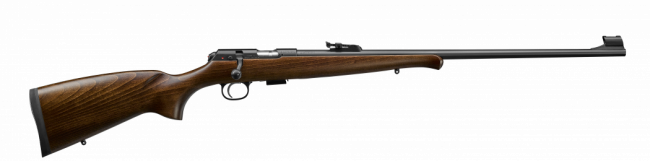 The best non-aperture iron sights ever. The rear, by pulling on a release, slides up and down a ramp graduated for different yardages, and would hit to point of aim at those yardages. (I don't recall the maximum adjustment nor the longest range at which I shot it.) I no longer have it (don't ask), and they are no longer the $239 that I paid for it in 2002, even outpacing the inflation between then and now. | |||
|
| Member |
As usual, Sigfreund and Fritz- A metric ton of wealthy information in your posts. Too much to prune and comment on. Years ago, when my favorite Uncle was paying for all the ammo, I was able to go through some excellent courses when it came to firearms and shooting. A CQB school, first few days on a static range, fixed course of fire for the morning, then after lunch, times got quicker. Day 2 and 3 was much of the same. At some point, the instructors said “load up, the range is yours” to the students. Some were practicing at improving their weak points. Some just blasted away. Full mag dumps, ripping away with an MP-5SD on full auto (if you ever have a chance, I highly recommend it!), blazing away with a custom MEUSOC 1911, or newer M-9’s. Some were a mix of both. Yes, that stuff is FUN!!!! Took a break, and a Gunny Sgt who was an amazing instructor said something to a few of us. “I know the ammo is free, and full auto is fun, but think about this: Never waist a round, learn from it, you’re responsible for all of them.” He also said “I can teach a fuckin epileptic monkey how to shoot, I can’t teach him how to think. I need a higher functioning simian who appreciates opposable digits!” And “Accuracy is the product of uniformity.” Knowledge that stuck with me throughout the years. Especially the “learn from every round” part. Yeah, putting holes in paper, banging steel is fun, and I won’t detract from that. However, putting rounds on top of each other takes knowledge and skill. I’ve shot a lot of different stuff in the past few decades, and there’s guns and rounds I really like. As of the past 3 years or so, I’ve really enjoyed going back to the basics with a trusty .22! I know what I can squeeze out of my Ruger 10/22 and MK-IV. I’m not going to get a sub MOA from my 10/22 takedown at 100 yds, but it will print a reliable group. I know my hold over to hit at 200yds. I know at 25ish yards, I get a predictable group from the pistol, and the (+/- a second or so) time it takes between rounds so I can keep that group. Oh, it can get better… But that takes discipline and the willingness to push yourself. Therein lies the rub. That sweet comfort zone! Hey, who doesn’t like being all warm and fuzzy?!?! Hey, that’s pretty damn good, and I’m happy here. Granted, most people have to pay for their ammo, and it does get expensive. A belt out of an M-60 / M-240 is FUN!!! But it’s also about $100 - $200! But, I someone “learns from every round”, there’s improvement. Improvement in accuracy and speed, efficiency and skill. I asked this question on here years ago- “What’s your range routine?” Grab 2 boxes and be pleased if you’re hitting within the “8 ring”? The “9 ring” the “10 Ring”? Load, chamber, sight, squeeze, lather-rinse-repeat? Or is someone actually asking themselves “why did that round go low and left?” Or do you have the ability to say to yourself “damn! I pushed that round low and left because I cracked my wrist”? Are you changing up the size of the target and distance? Working under time constraints? Quickening the speed until a miss? Your “hunt and peck” drill. (Which I’m using sometimes soon! thank you!) Pushing yourself, even if slightly, out of that “comfort zone”. ______________________________________________________________________ "When its time to shoot, shoot. Dont talk!" “What the government is good at is collecting taxes, taking away your freedoms and killing people. It’s not good at much else.” —Author Tom Clancy | |||
|
| Member |
Otto- A few questions: Do you have a semi-decent .22? What distance can you shoot too? Nothing wrong with “minute of a beercan”, even better “minute of a quarter” Get comfortable at 25 yds with “minute of a quarter”. Then put it out at 35 yds, and try for “minute of a quarter”. Or stay at the 25 and try “minute of a nickel” ______________________________________________________________________ "When its time to shoot, shoot. Dont talk!" “What the government is good at is collecting taxes, taking away your freedoms and killing people. It’s not good at much else.” —Author Tom Clancy | |||
|
| Powered by Social Strata |
 | Please Wait. Your request is being processed... |
|
SIGforum.com Main Page The Mason-Howe Rifle Room The value (and joys) of 22 Long Rifle shooting, a general discussion. Now with one drill 26Oct26.
Main Page The Mason-Howe Rifle Room The value (and joys) of 22 Long Rifle shooting, a general discussion. Now with one drill 26Oct26.© SIGforum 2026