
Go | New | Find | Notify | Tools | Reply | |
| Member |
<IMG class="inline_image" SRC=" [/url] 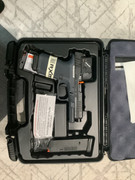 [/IMG] [/IMG]Just received my Ruger RXM with Aimpoint COA optic. I’ve been shooting standard iron sites for over 30 years. When I saw the flash sale for the RXM and Aimpoint at PSA I bought it. I needed another .9mm like I needed a hole in my head. I already have 2 S&W, HK, Sig, Stoeger and Beretta. I had never even held the RXM before. I put 200 rounds through it on Sat. I apologize to myself for my stubbornness on optics. It was a blast. I thoroughly enjoyed the optic. I’m also surprised on how much I liked the Ruger. It felt better than the Stoeger and possibly as smooth as my HK VP9.I still like my hammer fired .9s better but this setup opened my eyes to some more toys to come. It was my first time so I’m not surprised that it was still more comfortable using one eye. Is that normal? | ||
|
Member |
Having used iron sights for most of my shooting, I was the same way. It took time and a lot of conscious effort to get comfortable keeping both eyes open. Something that may help is the concept of not focusing on the dot like you focus on your front sight, when using irons. Instead focus on POI and think of the dot as a layer over top of your aiming point that you are looking through. Dry firing and conscious effort are your friend! It will get easier. Sic Semper Tyrannis If you beat your swords into plowshares, you will become farmers for those who didn't! Political Correctness is fascism pretending to be Manners-George Carlin | |||
|
Fighting the good fight |
No, though some beginners do revert to this, automatically trying to treat it like a magnified rifle scope. Reflex/red dot optics should be used with both eyes open, just like iron sights. The main difference is that with a red dot you're target focused, instead of [front] sight focused like with iron sights. Focus both eyes on the target, keep your head still, present the handgun out into your shooting stance while bringing the optic up into your field of view, and superimpose the dot over the target while continuing to look at the target. This may take quite a bit of practice to allow you to stay target focused and repeatably present your dot into your sight line without having to hunt around for it, especially if your grip/presentation are sloppy. This is the biggest learning curve for many shooters new to dots. One of the reasons that folks typically shoot better with red dots is that red dots force marginal shooters to work on their fundamentals, and are less forgiving for sloppy grip/draw/presentation than iron sights. Luckily, this practice doesn't need to be live fire. You can do it at home for free with dry fire. If you're struggling to present the handgun with the dot in your field of view while staying target focused with both eyes, start out working on the bigger picture while dry firing at home. Turn your dot off, and use the optic window as a "window pane" while drawing and presenting to a target on the wall, focusing on a small target like a light switch or post it note on a wall at room distance. Work on keeping both eyes open and drawing and presenting the gun until you can repeatedly present the optic into your line of sight and "frame" the light switch/post it note in the center of the "window", without moving your head, hands, or gun around. If you have cowitnessed iron sights, you can use these as a crutch at the very beginning while you're working on your optic presentation, but the goal should be to fairly quickly move away from using the irons as an alignment aid and instead remain 100% target-focused. (You should ideally be totally ignoring the iron sights, unless the optic goes down.) Then once you have this "window frame" drill figured out, turn the dot back on, and keep practicing. Because you already worked on your presentation, repeatably framing the target with the optic window, the dot should now be roughly on target when you present it - or at least visible within the optic window, and you can work on tightening up your presentation fundamentals even a bit more to allow you to quickly punch out while staying target-focused and have the dot right where you want it to be. Then go hit the live fire range again. | |||
|
Member |
Having the dot in the window and being target-focused is what I’m working on. It’s getting better but it’s still a thought process and not muscle memory. I gave up on red dots prematurely a couple years ago but honestly didn’t give them the time or training they deserved. I spend 5-10 minutes from time to time just practicing draw, presentation, and sight focus. If nothing else it’s fun and free as Rogue mentioned. Eight years to retirement! Just waiting! | |||
|
| Fighting the good fight |
Yeah, dry-fire training doesn't have to be an all day thing. You can do it in short bursts on your days off, or before you go to bed at night, or whatever. | |||
|
E tan e epi tas |
I grew up shooting both eyes open front sight/target focused with irons. It’s been my default forever. Because of this I never had any issues using pistol dots. Same basic thing I’ve always done with the difference being less emphasis on the “sight/dot” and more emphasis on target focus. I never really understood all the hubbub about transitioning to dots until I realized a couple things. -Lots of folks shoot one eye closed intent on the sights -Lots of folks have poor fundamentals (no disrespect it’s just what I’ve seen) If you’ve always shot both eyes open and have decent fundamentals dots are nothing to adapt to. Take Care, Shoot Safe, Chris | |||
|
| Fighting the good fight |
That's been my experience as well, both as a shooter going over to optics as well as an instructor. If you shoot with both eyes open, can remember to focus on the target instead of the sight, and already have decent fundamentals, transitioning to an optic is not a big deal. But if you struggle with one or all of those, the optic learning curve can be a bit steep, though not insurmountable. You just have to be willing to put in the (mostly dry-fire) work, rather than trying it once or twice and giving up like some folks do. And once you put in the work you'll come out the other side as a better shooter with all your handguns, optics or irons. | |||
|
Sigforum K9 handler |
Matter of fact, I’d be willing to say 10-15 minute sessions frequently are the best. ________________ People hate you. Train like it. | |||
|
| Member |
Lots of awesome advice. The learning curve is always the fun part for me. Getting better at something new is great and probably why I made this decision. I will get it down with time. Thanks for the encouragement. | |||
|
| E tan e epi tas |
lets be honest, its not about new skills or capabilities.... Its about playing with new toys. The child will age but if they are lucky they will never truly grow up. Take Care, Shoot Safe, Chris | |||
|
| Member |
If you have a local instructor that is proficient with red dot pistol training I would suggest booking an hour or two with them. The amount of internet misinformation out there regarding pistol optics is huge. Starting off strong without the bad info influencing you will shorten the learning curve. | |||
|
Member |
Also retraining my draw to a scoop draw with my instructor helped me get the dot on target faster. Punching it out and hunting for iron sights had me chasing the dot. Definitely get a class in with someone that teach or competes in Carry optics. Train how you intend to Fight Remember - Training is not sparring. Sparring is not fighting. Fighting is not combat. | |||
|
| Powered by Social Strata |
 | Please Wait. Your request is being processed... |
|
© SIGforum 2026