
SIGforum.com Main Page The Lounge Social Security Announces 3.6 Percent Cost of Living Boost to Payments in 2027
Main Page The Lounge Social Security Announces 3.6 Percent Cost of Living Boost to Payments in 2027Go | New | Find | Notify | Tools | Reply | |
| Partial dichotomy |
https://www.theepochtimes.com/...FP3biFucxSjIBmNX0%3D Social Security Announces 3.6 Percent Cost of Living Boost to Payments in 2027 That averages out to an extra $75 per month for tens of millions of recipients. Tens of millions of retirees will see their Social Security benefits increase by 3.6 percent under a cost-of-living adjustment (COLA) that goes into effect next year, the Social Security Administration (SSA) announced on Wednesday morning. The new COLA will begin for the nearly 72 million Social Security recipients starting in January 2027, the agency said. The around 7 million people who receive Supplemental Security Income (SSI) will also receive a 3.6 percent increase, and it goes into effect on Dec. 31, 2026. The adjustment translates to $75 extra per month, the SSA said in a news release. “Social Security will implement this cost-of-living adjustment for 76 million Americans, giving them greater financial stability,” SSA Commissioner Frank J. Bisignano said in a statement published on Wednesday. “Under President Donald J. Trump, Social Security is delivering better, faster, higher-quality service for the American people.” The 2027 COLA is the largest annual increase for Social Security and SSI recipients in four years. The adjustment factors in federal inflation metrics recorded by the Department of Labor in July, August, and September. In 2023, a whopping 8.7 percent COLA for Social Security recipients went into effect due to surging inflation amid the COVID-19 pandemic. A year before that, a 5.9 percent COLA was imposed under similar pretexts. Last year, the SSA announced a 2.8 percent COLA that went into effect for payments sent out throughout 2026. Wednesday’s announcement came after the Labor Department announced earlier in the day that the Consumer Price Index (CPI), a closely monitored inflation metric, rose at an annual rate of 3.7 percent in September and was above expectations. The COLA is designed to assist retired people and those with disabilities on fixed incomes to deal with rising prices of food, medicine, services, and other goods. The COLA is specifically based on the Consumer Price Index for Urban Wage Earners and Clerical Workers, or CPI-W, a metric under the broader CPI, reported by the Labor Department every month. In an emailed news release to The Epoch Times on Wednesday in response to the announcement, the chief executive of the American Association of Retired Persons (AARP) said that “there’s a lot on the line financially right now for older Americans: one in five have no retirement savings, and more people feel financially insecure this year than last.” “That makes Social Security’s cost-of-living adjustment critically important. It helps millions of Americans keep up with rising costs for groceries, routine bills, health care, and other everyday expenses,” AARP Chief Executive Officer Myechia Minter-Jordan said in the statement. Most older adults believe the COLA doesn’t adequately keep up with inflation, according to an AARP poll from September included in the news release. That poll found that about three-quarters of those 50 or older disagreed with the idea that a 3.5 percent COLA in 2027 would be enough to keep up with rising prices. Other advocates for older Americans have argued that the COLA should be based on a separate CPI that is used for elderly people. The Senior Citizen League, which releases COLA predictions every month, has often urged lawmakers to base the COLA on the Consumer Price Index for the Elderly (CPI-E) rather than the CPI-W. According to the SSA, people with personal “my Social Security accounts” can evaluate their COLA notice online starting next month, or three weeks earlier than getting a paper notice sent in the mail. SIGforum: For all your needs! Imagine our influence if every gun owner in America was an NRA member! Click the box>>>  | ||
|
| Member |
Nice to hear, I wonder if they fix all problems? | |||
|
Member |
Another bone along with a scrap of meat thrown to us peasants. Keep your money. Lower the cola, lower all taxes permanently and start acting like you're interested in something other than your own bank account. I'm really insulted by these little pittances thrown our way and then the government acts so benevolent and caring. Given the current costs of gas and groceries today $75 a month is hardly an impact. "Fixed fortifications are monuments to mans stupidity" - George S. Patton | |||
|
Member |
Meanwhile, my health insurance goes up 10%.  _________________________________________________________________________ “A man’s treatment of a dog is no indication of the man’s nature, but his treatment of a cat is. It is the crucial test. None but the humane treat a cat well.” -- Mark Twain, 1902 | |||
|
| No More Mr. Nice Guy |
From pre-WWII through to the 1970's, the government successfully reduced the debt/GDP ratio but only because of inflation. When looking at a debt/GDP chart it looks wonderful that they unwound the WWII debt, but that is misleading. Yes, they kept new expenditures in line with tax revenues, and yes that was a good thing. But they didn't actually pay off the debt as we think of it in our personal lives. Looking at absolute dollars, the number of dollars owed stabilized but didn't go down. Then it ramped back up. The lesson imho is that the best we can hope for is Congress reduces the rate of increase in spending. However, any reduction in relative debt, meaning debt/GDP ratio, will be from inflation. Inflation merely transfers the burden from the government to those with savings and investments. I'll take the 3.6% boost in SS. It will help offset the (likely even greater) cost increase in Medicare next year. | |||
|
| Lawyers, Guns and Money  |
Let's look at that chart: 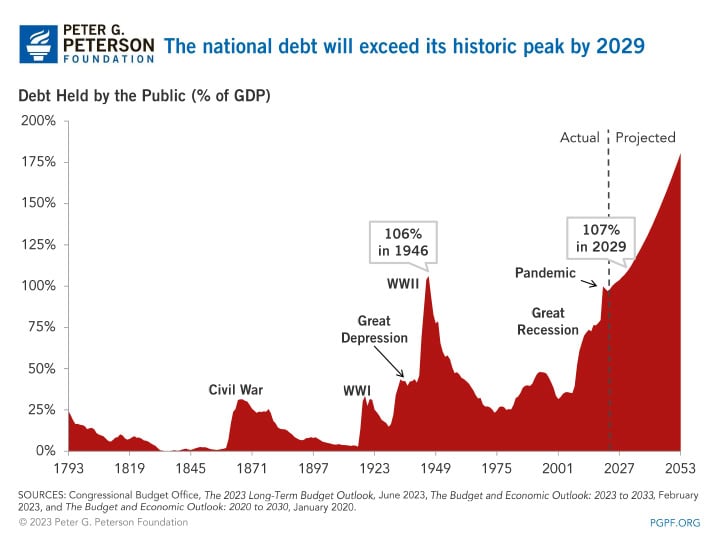 Debt peaked at the end of WWII at around 106% of GDP. The 1950's were not a period of high inflation. The national debt now exceeds its all-time high of 106 percent of gross domestic product (GDP), which occurred in 1946, the year immediately following the end of World War II. Historically, high levels of national debt in relation to GDP resulted from periods of war or economic downturn, such as the Civil War, Great Depression, and World War II, and then receded afterward. In contrast, the federal government’s relationship with debt is now very different. While resources provided to combat the COVID-19 pandemic further accelerated the accumulation of debt, the United States already had an unsustainable fiscal outlook rooted in a fundamental imbalance between spending and revenues. Here, we examine the fundamental difference between the fiscal outlook after World War II and now, and why — despite similar levels of debt — the fiscal outlook now is much worse than it was in 1946. Two major factors explain the difference in the fiscal outlook now: expectations of lower economic growth and the underlying structural imbalance in the federal budget. Historically, labor force growth — along with increasing labor productivity — has been a key component to economic growth as more workers typically means more production, more wages, and more consumption. From 1950 to 1980, the number of civilians age 16 and over increased 72 percent, from 62 million to 107 million. Additionally, labor force participation increased over roughly the same period as more women began working. That growth in the labor force spurred economic growth. Today, labor force growth has slowed considerably. From 2023 and 2053, the labor force is expected to grow by only 10 percent (16 million workers). That slower growth is attributable to the aging of the population, as a greater share of the population will be beyond working age. Over the same period, the number of individuals age 65 and over will increase by 39 percent (24 million individuals). Growth in the labor force will slow at the same time that the number of individuals 65 and over mounts Imbalance between Spending and Revenues Will Continue to Rise Besides economic growth, the debt-to-GDP ratio can be reduced by limiting deficits. The spending that led to the historically high national debt in 1946 was driven by short-term deficit spending tied to the war. After the war, outlays as a share of GDP dropped by about half and remained at an average of 18 percent of GDP from 1950 to 1980. Over those same three decades, annual revenues averaged 17 percent of GDP, leading to an average deficit of only 1.1 percent of GDP. Now, spending and revenues are severely mismatched, and spending is projected to continue to outpace revenues in the absence of intervention from lawmakers. From 2023 to 2053, annual revenues are projected to average 18 percent of GDP, while spending is projected to average 26 percent. That mismatch between revenues and spending will lead to an average deficit of 7.5 percent of GDP. In particular, interest costs will be a key factor that drives up total spending — and therefore deficits and debt. That was not the case in the period following the Second World War, when interest costs remained relatively low. From 1950 to 1980, interest accounted for around 8 percent of revenues. However, as interest rates began to increase towards the end of that period, the share of revenues jumped up to a high of 18 percent. After the financial crisis, the Federal Reserve kept short-term rates low and long-term rates declined; as a result, interest as a share of revenues dropped back to the level seen in the 1950-1980 period. In addition, interest during those two periods averaged around 1.5 percent of GDP or slightly below. In contrast, over the next three decades, rising debt and higher rates means that the federal government will need to devote more resources to paying interest. Measures of net interest costs are projected to be two to three times higher than the period immediately following World War II. For example, CBO projects that, on average, interest payments will account for nearly 25 percent of revenues through 2053. By the end of that period, interest would represent more than a third of revenues; as a percentage of GDP, it will be double the highest ratio to date (3.2 percent in 1991) and continue to grow. https://www.pgpf.org/article/w...-after-world-war-ii/ Covid spending was the big change... We never did completely unwind the HUGE increase in government spending. U.S. Debt to GDP Ratio (1966-2026) U.S. federal debt as a share of GDP was 122.59% in March 2026, up 2.05 points from 120.55% a year earlier. The 2026 average so far is 122.59%, compared with 120.76% for 2025. Over the past 52 weeks the rate ranged from 118.78% (Jun 2025) to 122.59% (Mar 2026). The rate is down 1.44 points over 5 years (from 124.04%) and up 18.60 points over 10 years (from 103.99%). The average since 1966 is 63.67%; the high was 132.82% (May 2020). https://www.macrotrends.net/13...tio-historical-chart There's another chart at the link that shows annual changes, and 2021 really stands out. The point is, I don't think slowing the rate of growth will be enough. We will need actual spending cuts.This message has been edited. Last edited by: chellim1, "Some things are apparent. Where government moves in, community retreats, civil society disintegrates and our ability to control our own destiny atrophies. The result is: families under siege; war in the streets; unapologetic expropriation of property; the precipitous decline of the rule of law; the rapid rise of corruption; the loss of civility and the triumph of deceit. The result is a debased, debauched culture which finds moral depravity entertaining and virtue contemptible." -- Justice Janice Rogers Brown "The United States government is the largest criminal enterprise on earth." -rduckwor | |||
|
| Peace through superior firepower  |
LET'S GO TO THE BIG BOARD!!  | |||
|
| Run Silent Run Deep  |
AND THE SURVEY SAYS?!?! _____________________________ Pledge allegiance or pack your bag! The problem with Socialism is that eventually you run out of other people's money. - Margaret Thatcher Spread my work ethic, not my wealth | |||
|
| No More Mr. Nice Guy |
I agree, but I don't think we can expect any actual cuts. The very best, until the collapse happens, is a reduction in the rate of increase. Even that I think is a lot of wishful thinking that Congress will stop increasing spending. There's no politically acceptable place to reduce spending in any significant way. The hope of growing the economy in real terms so as to reduce the debt/GDP ratio is also wishful thinking these days. This isn't post WWII any more. Growth is really a euphemism for inflation. | |||
|
| Like a party in your pants  |
We all got a first hand preview of what happens when REAL spending cuts are attempted. When Trump appointed Elon Musk and his Big Balls associates to look into Gov. waste the top blew off the capitol building. Way too much money involved for all sides to ever see meaningful change now. | |||
|
| Lawyers, Guns and Money |
Stein’s Law “If something cannot go on forever, it will stop.” Herbert Stein (who served as Chairman of the Council of Economic Advisers under U.S. Presidents Richard Nixon and Gerald Ford) introduced the observation — often paraphrased as "trends that can't continue, won't" — while analyzing unsustainable economic trajectories like rising federal budget deficits and trade imbalances. "Some things are apparent. Where government moves in, community retreats, civil society disintegrates and our ability to control our own destiny atrophies. The result is: families under siege; war in the streets; unapologetic expropriation of property; the precipitous decline of the rule of law; the rapid rise of corruption; the loss of civility and the triumph of deceit. The result is a debased, debauched culture which finds moral depravity entertaining and virtue contemptible." -- Justice Janice Rogers Brown "The United States government is the largest criminal enterprise on earth." -rduckwor | |||
|
| Member |
No joke. My health benefits cost at work went up about 10% and I got a whopping 3% raise. Thanks I think. | |||
|
| Green grass and high tides |
I'll take it. "Practice like you want to play in the game" | |||
|
| Powered by Social Strata |
 | Please Wait. Your request is being processed... |
|
SIGforum.com Main Page The Lounge Social Security Announces 3.6 Percent Cost of Living Boost to Payments in 2027
Main Page The Lounge Social Security Announces 3.6 Percent Cost of Living Boost to Payments in 2027© SIGforum 2026