
Go | New | Find | Notify | Tools | Reply | |
| Edge seeking Sharp blade! |
Was it because early wings were so ineffcient that multiples were needed to get enough lift? So it was a big deal to make a monoplane because it took a while to develop an efficient wing shape that only one would give enough lift? Or were their other reasons monoplanes weren't easy to develop? | ||
|
| Staring back from the abyss  |
I don't know a whole lot about aerodynamics, but my guess would be that the early engines/props weren't powerful enough to generate enough lift from one wing. ________________________________________________________ It is long past time for a Convention of States. The Founding Fathers gave us this tool to fix an out of control government and we need to use it. | |||
|
Void Where Prohibited |
I think also materials and engineering of the time couldn't build a strong enough structure for a single wing to work. "If Gun Control worked, Chicago would look like Mayberry, not Thunderdome" - Cam Edwards | |||
|
Baroque Bloke |
Mostly that. Structural considerations. In the case of crop dusters, a biplane’s shorter wing span was a maneuverability advantage. Serious about crackers. | |||
|
Member |
The first planes were biplanes primarily due to their structural advantages, lift capabilities, and the technological limitations of the early 20th century. Structural Advantages Biplanes feature two wings stacked one above the other (sometimes three), which provides several benefits: -- Increased Lift: The biplane configuration allows for a larger wing area relative to the aircraft's weight, which is crucial for achieving lift with the limited power available from early engines. This design enabled the aircraft to take off and land more easily, especially on the primitive airfields of the time. -- Strength and Stability: The dual-wing structure offers greater structural integrity (exterior supports), allowing for lighter wing designs that could withstand the stresses of flight without excessive weight. Technological Context When the Wright brothers made their first powered flight in 1903, aviation technology was still in its infancy. The engines were weak, and materials were not as advanced as they are today. The biplane design compensated for these limitations by providing: -- Lower Wing Loading: This refers to the ratio of the aircraft's weight to its wing area. A lower wing loading results in better performance at lower speeds, which was essential given the limited power of early engines. -- Agility: Biplanes had shorter wingspans, which contributed to quicker roll rates and better maneuverability, making them suitable for early military applications and aerobatics. Evolution of Aircraft Design While biplanes dominated early aviation, their design began to fall out of favor as technology advanced. By the late 1930s, monoplanes started to replace biplanes due to their superior speed, fuel efficiency, and reduced drag. Improvements in engine power and materials allowed for the development of stronger, more efficient monoplane designs. In summary, the first planes were biplanes because this design maximized lift and stability while compensating for the technological limitations of the time, paving the way for the evolution of modern aircraft. _________________________________________________________________________ “A man’s treatment of a dog is no indication of the man’s nature, but his treatment of a cat is. It is the crucial test. None but the humane treat a cat well.” -- Mark Twain, 1902 | |||
|
Member |
If interested, Greg discusses the trend of early WW1 mono planes to Bi and tri-planes in this video mostly about the Foker DR 1 Tri-plane. https://www.youtube.com/watch?v=zELul8q0HjM No car is as much fun to drive, as any motorcycle is to ride. | |||
|
| His diet consists of black coffee, and sarcasm.  |
Early monoplanes had extensive bracing wires. Cantilever (internally self-supporting) wings had to wait a bit. Bleriot XI, 1909. Monsieur Bleriot flew it across the English Channel. 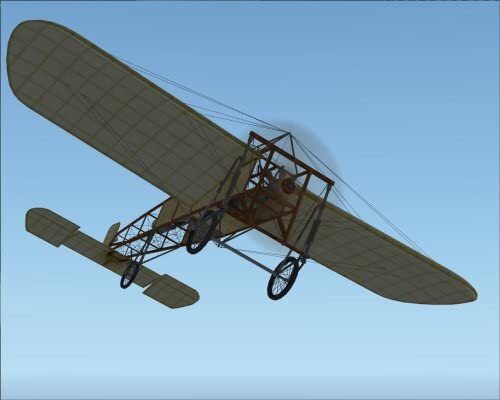 Fokker Eindecker, 1915. Also the first to have the synchronized with the propeller machine gun. The source of the "Fokker Scourge". Allied planes and pilots got the unfortunate nickname "Fokker Fodder". 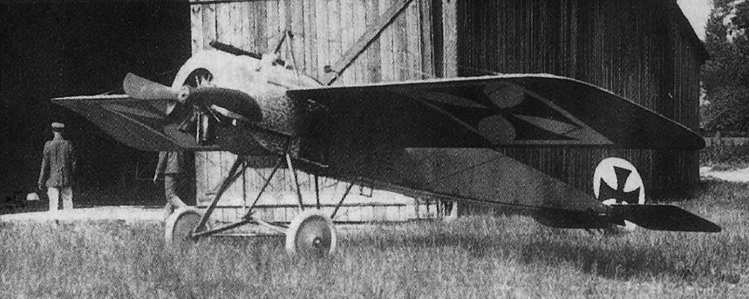 Boeing P-26 "Peashooter", 1932. Became obsolete fast. Tractor monoplane fighters with cantilever wings, enclosed cockpits and retractable landing gear were pretty much standard by 1935. 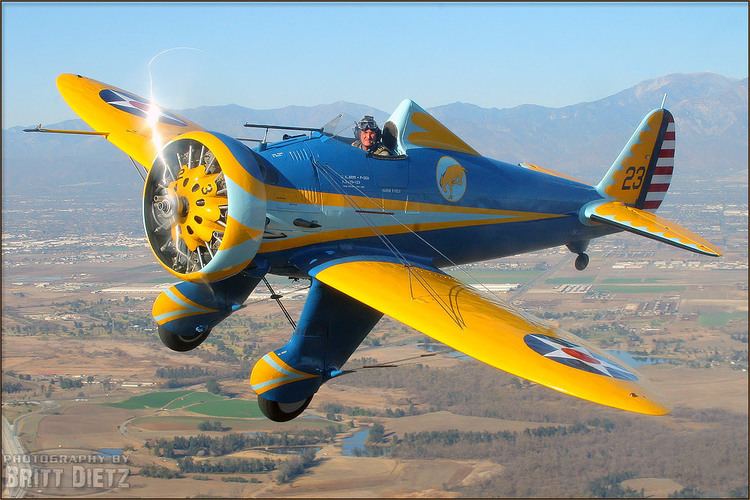 "The Almighty, He put some livin' things on this earth so a man can eat." - Festus Haggen, Gunsmoke | |||
|
| Member |
Also note that these early airplanes all had simple, 2-bladed fixed-pitch propellers. _________________________________________________________________________ “A man’s treatment of a dog is no indication of the man’s nature, but his treatment of a cat is. It is the crucial test. None but the humane treat a cat well.” -- Mark Twain, 1902 | |||
|
אַרְיֵה |
The Model 17 biplane, built by BeechCraft in the 1930s, featured a luxurious five-place cabin and had a cruising speed of just over 200 mph. 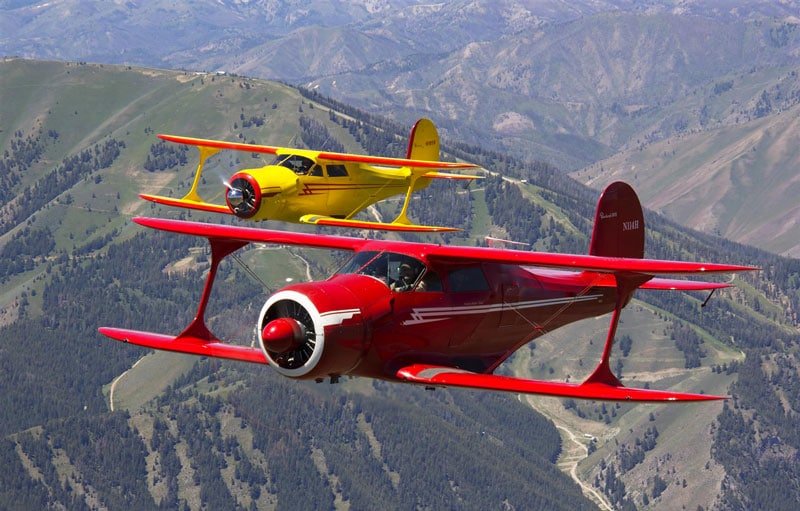 הרחפת שלי מלאה בצלופחים | |||
|
| No More Mr. Nice Guy |
Lift is a factor of the airspeed squared. The early engines were weak, and the aircraft designs were draggy, so they flew slowly. Thus they needed more surface area for the same lift. Related would be that the aircraft materials were heavy, so more lift was needed until lighter designs were developed. Tri-wing aircraft may have suffered lower lift than if one wing had simply been deleted. It seems that many aircraft were designed without mathematical analysis, just guesswork and some random experimentation. Airflow above the wing creates lower pressure while the lower surface has higher pressure. With wings close to each other the high and low pressures interfere in the area between the wings. | |||
|
| Deeds Not Words |
V-Tail, Wow — as a professional Air Defender vice employer or provider, I can only say those are a couple of gorgeous flying machines! Evocative of a the look of a 1930/40s sedan…truly classic and timeless! Thank you for sharing! Godspeed and Good Hunting, Always Navy BMD: When "Aim High" isn't High Enough! | |||
|
| Edge seeking Sharp blade! |
So the short answer is: inefficient airfoils required more area, structural limitations of one wing complicated by available materials, low powered engines required more lift at slower speeds. | |||
|
Age Quod Agis |
The stagger-wing Beech, where the upper wing sits further aft than the lower wing, is one of the most beautiful airplanes ever built, and that is saying something. "I vowed to myself to fight against evil more completely and more wholeheartedly than I ever did before. . . . That’s the only way to pay back part of that vast debt, to live up to and try to fulfill that tremendous obligation." Alfred Hornik, Sunday, December 2, 1945 to his family, on his continuing duty to others for surviving WW II. | |||
|
| אַרְיֵה |
Retractable landing gear was not common on biplanes, especially in the 1930s. 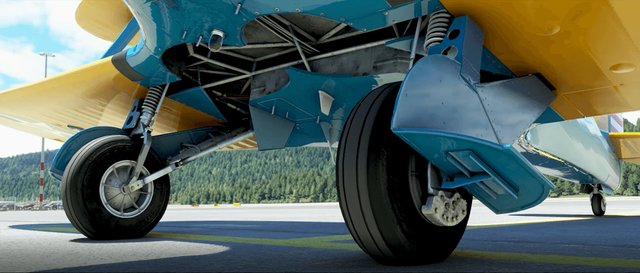 הרחפת שלי מלאה בצלופחים | |||
|
Now and Zen |
It was the Learjet of it’s day. ___________________________________________________________________________ "....imitate the action of the Tiger." | |||
|
| אַרְיֵה |
If you want one, check with Gemco Aviation at the Elser Airport, Youngstown OH. I have not been there for a while, but they did some meticulous restorations. They usually had a couple in progress, and several waiting their turn in the hangar. הרחפת שלי מלאה בצלופחים | |||
|
| come and take it |
I'm an airplane nerd that also thinks the Staggerwing is beautiful. The Griffon Lionheart, kit plane from the 1990s modeled after the Staggerwing. I'm surprised there weren't more kits sold/built. It is beautiful in flight. "The left can't applaud me because their hands are in other people's pockets." - Javier Milei | |||
|
| Age Quod Agis |
There's 6 of them available on the market today, from a restoration project up through $750k. If this gig I'm I've been working on works out, I will have one. "I vowed to myself to fight against evil more completely and more wholeheartedly than I ever did before. . . . That’s the only way to pay back part of that vast debt, to live up to and try to fulfill that tremendous obligation." Alfred Hornik, Sunday, December 2, 1945 to his family, on his continuing duty to others for surviving WW II. | |||
|
| Edge seeking Sharp blade! |
The designer of the Stagger Wing Beech was Ted A Wells. He was a sailboat racing enthusiast and wrote a sailboat racing book. He raced a Snipe class one design boat and my dad did also, and at some point assuredly my dad got beat by Ted. Almost everybody got beat by Ted. Ted raced at the lake I live on in Missouri in our Snipe regatta at least once. Story is that Beech's widow was running the company and thought Ted was too involved in sailboat racing. She sent a plane to a regatta to pick him up. After flying to Wichita, he goes into her office and quits, then flies back to the regatta. | |||
|
Optimistic Cynic |
Back to the original question, I suspect that much of why a double wing design was preferred was because most of the landing strips of that era required slow take off and landing speeds, and were very short to boot. The additional lift provided by the second wing would have been essential in that environment. Not to mention that emergency landings in a convenient farmer's field, e.g. due to engine failure, were much more common in those days. | |||
|
| Powered by Social Strata | Page 1 2 3 |
 | Please Wait. Your request is being processed... |
|
© SIGforum 2026