
Go | New | Find | Notify | Tools | Reply | |
| Member |
| ||
|

Lost |
Looks like the "Defender of the Faith" symbol. Represents the promotion of the Sikh faith as a martial culture. 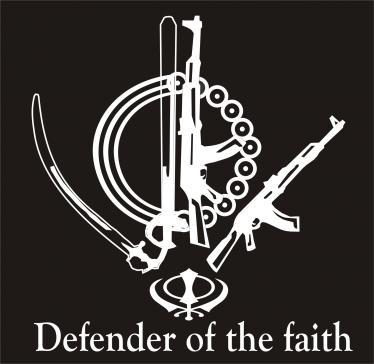 | |||
|
Shaman |
It's Punjabi. I used to consider them the good guys. Now they're protesting the truckers being detained and deported here. Tread carefully Sikh.  He who fights with monsters might take care lest he thereby become a monster. | |||
|
Member |
From a quick search on what do sikhs believe, I found nothing about being militant, bearing military form weapons, etc. The wearing of small ceremonial knives was said to remind the person to try to stop injustice. ------- Trying to simplify my life... | |||
|
| Member |
Quick search Militant Punjabi Sikh groups emerged primarily in the 1980s as part of the Khalistan movement, which sought to create an independent Sikh state in the Punjab region. One of the most prominent figures in this movement was Jarnail Singh Bhindranwale, a radical Sikh leader who gained prominence after the 1978 Sikh–Nirankari clash and became a central figure in the insurgency. He and his armed followers occupied the Golden Temple complex in Amritsar, using it as a base for their campaign for Sikh autonomy. Several militant organizations were formed during this period, including Babbar Khalsa International (BKI) and Dal Khalsa. BKI was founded in 1978 by Sukhdev Singh Babbar following the Sikh–Nirankari conflict and became known for its violent campaign against those it perceived as enemies of Sikhism, particularly members of the Nirankari sect. The group carried out assassinations, bombings, and armed attacks in India and abroad, and is designated as a terrorist organization by India, the United States, Canada, the United Kingdom, and the European Union. It gained international notoriety for the 1985 bombing of Air India Flight 182, which killed 329 people. Dal Khalsa, another militant group formed in 1978 by Gajinder Singh, also aimed to establish Khalistan and was active during the Punjab insurgency. Both groups, along with others like the International Sikh Youth Federation, were linked to Bhindranwale’s ideology and participated in targeted killings and violent confrontations with Indian security forces. The insurgency intensified in the early 1980s and culminated in Operation Blue Star in 1984, when Indian forces stormed the Golden Temple to remove militants, resulting in significant casualties and widespread anger among Sikhs. The violence declined in the 1990s due to government counterinsurgency efforts, but militant activity has seen occasional resurgences, including through new networks radicalized via social media | |||
|
| Lost |
AI Overview: The phrase "Defender of the Faith" in a Sikh context refers to Guru Gobind Singh, the tenth Sikh Guru, renowned for his leadership in transforming Sikhism into a martial force to resist oppression and uphold justice and equality. He established the Khalsa, a community of committed Sikhs, and demonstrated exceptional leadership in battles, establishing the foundation for Sikhs to be a resilient and courageous people. | |||
|
| Powered by Social Strata |
 | Please Wait. Your request is being processed... |
|
© SIGforum 2026