
SIGforum.com Main Page The Mason-Howe Rifle Room Anyone interested in shooting PRS (Precision Rifle Series) matches?
Main Page The Mason-Howe Rifle Room Anyone interested in shooting PRS (Precision Rifle Series) matches?Page 1 2
Go | New | Find | Notify | Tools | Reply | |
| Sigless in Indiana  |
I dove in a few years ago and started shooting in Gas Gun division. I have pulled off a few division (not match) wins. I can do a shallow or deep dive into the gear, technique, ballistics, etc if there is interest. It is a very fun discipline. But it is moderately gear heavy and not a cheap sport to partake in. I want to gauge interest before I spend an hour or two compiling a lengthy post. | ||
|
| Ice age heat wave, cant complain.  |
Absolutely. NRA Life Member Steak: Rare. Coffee: Black. Bourbon: Neat. | |||
|
| Member |
I would read with great interest whatever you post on the topic! | |||
|
| Freethinker |
Me, too. There is no chance I will ever shoot in a sanctioned precision rifle competition, but I am nevertheless interested in the sport. And I have gotten useful information for the type of precision rifle shooting I do from discussions by people who do compete. It may not attract as much attention here as a post about the antics of a celebrity du jour or some politician we love to hate, but I also believe that I won’t be the only one interested. “ One may protest against evil; it can be exposed and, if need be, prevented by use of force. … Against stupidity we are defenseless. … [R]easons fall on deaf ears; facts that contradict one's prejudgment simply need not be believed … and when facts are irrefutable they are just pushed aside ….” — Dietrich Bonhoeffer | |||
|
Frangas non Flectes |
I have a buddy who has been nagging me to go to one since I got my Bergara B14 last year and I haven't because, well... I frankly don't know enough. I'd love to hear what you have to share. Worth to me! ______________________________________________ "If the truth shall kill them, let them die.” "A man who does not read has no appreciable advantage over a man who cannot read." | |||
|
Chilihead and Barbeque Aficionado |
I don’t plan on shooting PRS, but I would be interested in reading about your take on marksmanship with a gas gun. Bolt rifles are easy to shoot tiny groups, but it takes more effort to shoot a gas gun accurately. This is especially true when you’re on the clock. _________________________ 2nd Amendment Defender The Second Amendment is not about hunting or sport shooting. | |||
|
| Sigless in Indiana |
Good to see some interest! I am off to bed right now but I will post some tutorial stuff as well as mistakes I have made along the way. A buddy and I are shooting a match in a little less than 2 weeks so I will cover some of the match prep and the like. Topics will include: Practical ballistics and using a Kestrel with Applied Ballistics software. Positional shooting, utilizing bags, techniques for getting more stable. Technical practical accuracy. AR upper design choices that can affect practical accuracy. Rail deflection. Wind calls and corrections, reading mirage, what to do with the wind call your kestrel is giving you vs. what you see through glass down range. Ammo. Caliber considerations. Component (especially powder) considerations for consistent ammunition. This will probably be the leanest discussion because I don't consider myself to truly be an expert on this stuff, but I can tell you some things to avoid. Rifle setup, what is most important to me in an optic, additional rifle gear like levels, weights, Arca rail attachments, bipod selection, etc. | |||
|
| Freethinker |
On the subject, are you seeing much interest in/use of the Calypso wind meter? I just shoot for fun these days, but even though I didn’t need it, I got one a few weeks ago, and it’s been an eye-opener. I’ve owned Kestrels for years and still have two, including a 5700X, but for wind reading where I am the Calypso is far superior. The winds here are very often highly variable in speed and direction, and the Calypso reads them very fast, even when they’re too light to readily determine direction by feel. The phone app (which is of course required) provides an easy-to-see readout, and one particular advantage is that it provides not only the actual wind speed, but also the effective “crosswind” speed when the unit is pointed at one’s target. I.e., if the actual wind speed is 12 mph, but it’s coming from 1:30 o’clock (45°) so that its ballistic effect is 71% of full value, the primary display will show 8.5 mph as what’s needed for wind correction. The Calypso can be paired to the Applied Ballistics Quantum app so its wind reading will go directly to what the AB says the wind hold for a particular cartridge and target distance should be (the same as what a Kestrel will do with its wind reading). Again, no recommendations, especially as I’m not able to evaluate the Calypso’s value for competition shooting, and of course like the Kestrel they measure the wind only where they’re positioned, but I’m curious whether you’re seeing them in use. Calypso link. “ One may protest against evil; it can be exposed and, if need be, prevented by use of force. … Against stupidity we are defenseless. … [R]easons fall on deaf ears; facts that contradict one's prejudgment simply need not be believed … and when facts are irrefutable they are just pushed aside ….” — Dietrich Bonhoeffer | |||
|
Chasing Bugholes |
I’ve been using the Calypso a while with QuickDOPE and with AB. I like it. I point to the targets for direction instead of aiming north. 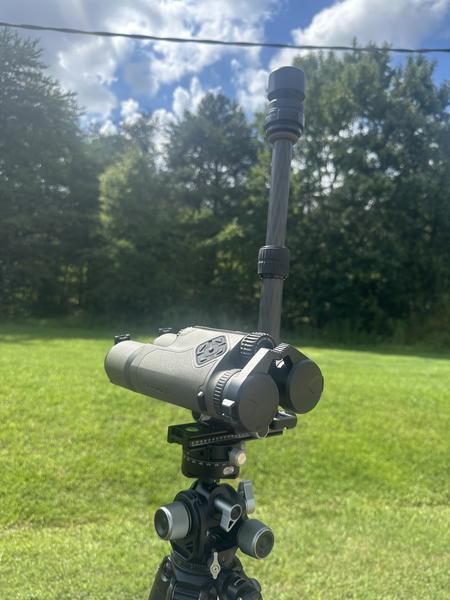 | |||
|
| Freethinker |
My current setup. The mount is a very old quick detach unit I originally used for photography. It’s relatively small and light and allows the Calypso to be attached and removed quickly and easily. I’ve been thinking of getting a riser pole to get the unit up higher, but I don’t know how useful that would be.  “ One may protest against evil; it can be exposed and, if need be, prevented by use of force. … Against stupidity we are defenseless. … [R]easons fall on deaf ears; facts that contradict one's prejudgment simply need not be believed … and when facts are irrefutable they are just pushed aside ….” — Dietrich Bonhoeffer | |||
|
| Sigless in Indiana |
Interesting. I have not seen one of those that I recall at a match yet, but now that I know what to look for, I will keep an eye out. My initial answer is probably not right now because while I do use a kestrel to get a rough baseline, observation of mirage and trace down range usually tells a better tale than the wind at the firing position. It is not uncommon to end up holding the opposite direction of what you would expect based on wind at the firing position, based on contrasting wind as the bullet flies down range. It doesn't happen at every match, but I have seen it often enough to take it into account when I am observing mirage and trace both through my scope while shooting, and while glassing through binos calling hits for other shooters. One of the very best bits of information you can get while glassing for other shooters is seeing their impact on a target. The bullet vaporizes and leaves a cloud of gray dust in the air. What does that cloud do? Does it hang in the air and slowly dissipate, indicating very little wind at the target? Or does it slowly or rapidly dissipate from being driven by wind at the target? Another reason is that I usually build all of the stages into my kestrel the night before a match. This provides a unified and simple resource for quick calculations that don't require a phone or any other pieces of gear that I need to integrate together. Usually what happens is you make sure all your environmentals are correct. (Leaving your kestrel laying on a black notebook will result in a substantially higher reading for ambient temp.) So I unlock the environmentals and swing the kestrel on a lanyard for 20 seconds, then quickly relock environmentals and I am good for half an hour or so. You initial kestrel data for wind will give you Call 1 for steady wind and Call 2 for gusts. I write those down and then observe trace and impact on my first call. If they observed wind call is 60% of Call 1. I try to mentally adjust all my subsequent calls for the rest of the targets to 60% of what I wrote down. The wind often changes or gusts while you are on the clock shooting your stage. Experience allows you to begin feeling that at the shooting position or watching mirage while in the act of shooting the stage, and being able to make intelligent corrections. My first few matches, I was very bad about shooting what I had written down, missing, and continuing to shoot what I had written down on the rest of the targets. That's what my Kestrel was telling me, and I didn't know any better or have the experience to make intelligent decisions after that beep. Getting 4 or 5 matches under your belt, all that mental math starts to become second nature. You recognize when you missed a shot because you were unstable, or when you can reliably blame it on a bad wind call. This is one of the reasons why the vast majority of shooters dial their elevation and hold their wind. If you dial the wrong wind, it is slow and cumbersome to keep dialing it. Because it may change in the 10 seconds that you change positions to move to the next prop and/or the next target. The one exception is moving targets. I try to dial wind to the best of my ability because then the hold on a moving target is the same number of mils, just changing which side you are holding on based on which direction it is moving. Building the stages into the kestrel the night before allows me to point the kestrel at the targets and acquire a compass reading for Direction of Flight(maybe Direction of Fire, it just says DoF in the menu). You can acquire one reading for all the targets, or you can do them individually if necessary. The reading for wind also utilizes the compass so it will apply the wind differentially if necessary, if there is a wide traverse. So I can get my elevation and wind recommendations for 10-12 targets all at once, instead of one target at a time. The apps that function with the Calypso likely also have that functionality. | |||
|
| Chasing Bugholes |
[QUOTE]Originally posted by sigfreund: My current setup. The mount is a very old quick detach unit I originally used for photography. It’s relatively small and light and allows the Calypso to be attached and removed quickly and easily. I’ve been thinking of getting a riser pole to get the unit up higher, but I don’t know how useful that would be.[QUOTE] For me what's useful is being able to glass and range targets with the Calypso pointed toward that target for the correct wind. Being on the same rail as the binos makes that easy. This setup is used by a lot of people currently in rimfire PRS and NRL. This is mine with the Calypso streaming to QuickDope. There are several ways to use it. Either capturing DOF based on one target or North, or just pointing toward a target and noting what you see. I typically point and note the hold on stages with big pans between targets. It's all a big educated guess and that's been easier for me. Typically you would mil size targets and create a wind bracket in mils to determine which targets are outside that bracket. Then put the focus on pointing the Calypso toward them to gather as much information as you can before time to shoot. My binos are VectorX so they have onboard Applied Ballistics and instruments to give a solution while ranging but I don't use that way for the games we play. For something like NRL Hunter that's very useful. I like the stage layout visualization with Quickdope or AB Quantum for this game. 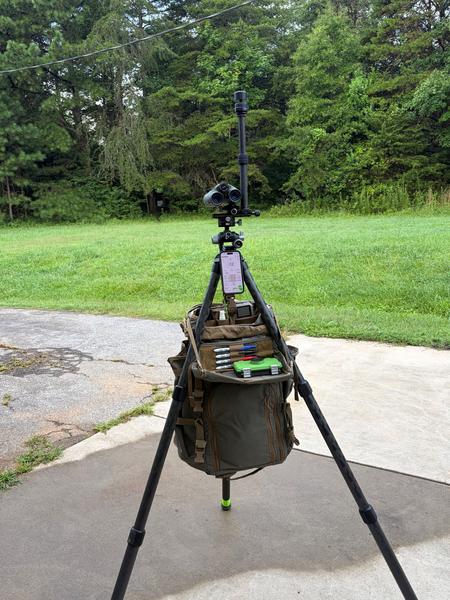 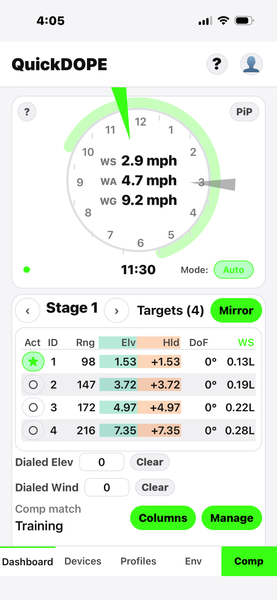 This message has been edited. Last edited by: jelrod1, This message has been edited. Last edited by: jelrod1, | |||
|
Spread the Disease |
I'm definitely interested. I've been really wanting to take a class in this area. Am I correct to assume that lots of this information will be useful for non-AR setups, also? ________________________________________ -- Fear is the mind-killer. Fear is the little-death that brings total obliteration. I will face my fear. I will permit it to pass over me and through me. And when it has gone past me I will turn the inner eye to see its path. Where the fear has gone there will be nothing. Only I will remain. -- | |||
|
| Member |
The Calypso wind meter is totally cool. This is the first time I've heard of it, but for various reasons I have seen very little competition for a couple of years. I've competed in true PRS, kinda-sorta PRS, "field" steel, 2-rifle, rimfire, carbine, and ELR matches. Know & unknown distances. Known & unknown target layouts. Tight times, virtually no time limits, and much in between. I enjoy them all. Field-style steel matches are probably my favorite. Up front, I'm kinda old skool. Not the latest in tech, traditional stocks, MOA reticles without Christmas trees, no Bluetooth. A few very talented local shooters took me under their wings as I began precision steel matches, as I was transitioning from sporting clays competition. Folks had Kestrels, LRFs, Bluetooth, on-location ballistics calculators -- so it wasn't the dark ages. Many of the matches I attended were in East Bumfuck locations, often with limited cell phone connectivity. I remember quite clearly one shooter's advice as we humped gear from one stage to the next..."Hey Starbucks, get your nose out of your Kestrel and look around." Jelrod1 built some of his rifles, Sigfreund has shot with him. This is because our terrain included open flats, canyons, some trees, and lots of lots of lots of wind speed & directional changes. Now if a Calypso's data can be located right next to my scope, that would be frickin' awesome. But in my experience, in Western state locations, the shooter needs to adapt to wind changes shot by shot. Also, I've seen many competitors' scores completely shit the bed, when the Bluetooth capabilities they relied on for dope didn't work. A classic was at the Competition Dynamics matches south of Casper & Douglas, WY. As in 30-90 minutes south of the towns, in the middle of mountains and basins. East Bumfuck for sure. If target distances are known in advance, I generally develop my dope cards the day before. I find it especially helpful to be on the match location the day before the event. I have Kestrel with me, but I generally don't rely on its electronics for other than wind and DA (air density altitude). I develop dope cards on expected DA, but I have notes for corrections in case I'm more than 1,000' off. I generally use Sunrise Tactical's wrist system to hold dope cards. This pic shows a stage from a previous match in the Sunrise -- a field match using my 6.5CM. The new card on the floor is a something I might soon use for my .223 at the family ranch, in a kinda-sorta PRS training stage.  My dope system, lower card: - This is a 4-target stage, with movement between multiple shooting positions. - Stage number is in upper left corner. If targets are all the same shape, I outline the stage number with the shape. In this example, I'm expecting square targets. I've been in many matches where stages were close to each other. Match directors kept shapes consistent within the stage. So in this case, if I saw a round plate, I shouldn't shoot it. - Target distances in yards are on the left, in black, without any coloring or boxes. Target locations are approximated by the position on the card. - Elevation dope is listed in a circle, which I highlight. Could be yellow, orange, pink... My scopes are mainly 1/4 MOA. "7.7" means "7-3/4" MOA. There's no need to write the "5". - Windage for a 10mph crosswind from 3 or 9 o'clock is in red, on the far right. I list exact MOA tenth's for closer targets. When I get to longer targets and ELR stages, I might reduce clutter by rounding to 1/2 MOA or 1/4 MOA, as the windage numbers can get pretty large. A tenth of an MOA wind calculation doesn't mean shit, when your trying to estimate wind for a 1200 yard shot that crosses 2 canyons, a section of trees, a river basin, and a final rise to the target. I will never claim to be a PRS expert. Middle of the pack is about all I can expect. I might make it to the top third on a good field match, if I can keep asshattery to a minimum. Once in a Blue Moon, I rise to the podium. | |||
|
| Chasing Bugholes |
I think the Calypso has more advantage potentially in rimfire than centerfire because the actual distance between you and the targets are closer. Terrain and other things certainly have a big part too but there is just less distance. Doesn't mean it's easier by any means, just look at the drop on my 216 target, but there's less chance of wind in multiple directions. Drops are so much that if you're off a few yards on the distance it's a miss. Smaller venues with less hiking it's easy to tote the gear. A lot of people in rimfire are using it now. You still see some kestrels and I take mine as backup but the feedback from the Calypso is just so much more. I shot a match this past weekend that had an 18" circle at 444. Was dialed 22.3 mils. Fortunately not much wind that morning. I make out a dope card similar to yours fritz, but on the rifle. Some are using those EDope cards and transferring to it from Quickdope but I like the flexibility of writing it out. Or drawing it out to show target position. | |||
|
| Freethinker |
That way of marking target locations and dope information makes total sense rather than just target numbers and dope. “ One may protest against evil; it can be exposed and, if need be, prevented by use of force. … Against stupidity we are defenseless. … [R]easons fall on deaf ears; facts that contradict one's prejudgment simply need not be believed … and when facts are irrefutable they are just pushed aside ….” — Dietrich Bonhoeffer | |||
|
Hop head  |
I have a friend that does several matches a year, one to sponsor folks that need funds to go to VMI he shoots as well as coaches some high school students, and has spent a shitton of money on rifles etc to compete, I jokingly asked him if I could shoot the matches with a 52 winchester and a unertl, he said yes, and encouraged me to sign up, but did say I would lose, or at best, be last, https://chandlersfirearms.com/chesterfield-armament/ | |||
|
| Member |
Absolutely. The more complex the target array, the greater the benefit of mapping target locations. The hardest one I've ever mapped was 15 targets on a stage. A 2-rifle event, carbine & bolt action. 10 carbine targets, scattered left/center/right in 4 different groups. IIRC distances in the 200-500 yard ballpark. Then 5 bolt action targets in the 500-800 yard ballpark. All shot from a ramp built to be like the apex of a roof. I cleaned that stage, which IIRC the match director used for a tie breaker -- hardest stage of the match. Then my asshattery kicked in, and I sucked on a number of the easy stages. If the target array is fairly orderly, something like the on-gun dope card here. 308 practice on my range. Left column is target distances in yards, center column is elevation in MOA, right column is windage in MOA.  | |||
|
| Member |
Now the above picture of my three-oh-hate dope card assumes a person will dial the elevations, or maybe use reticle holds with elevation set at the zero stop. But in some situations there can be an advantage to dialing the elevation of a middle-ish target, then using both hold-overs and hold-overs for the other targets. Most of us screw this up every now and then -- holding the wrong direction. So I learned the mantra "hold under for distances under the zero" -- and "hold over for distances over the zero". But I still screw it up every now and then. Anyway.... the left card is the essentially the same as the one in the previous post. Keep the elevation turret at Zero -- in my case 100 yards. The right card assumes I've dialed 14.5 MOA elevation, and will keep it there for the stage. The middle column are my reticle holds. 6 MOA under for 414 yards, 3 MOA over for 660 yards, and 8 MOA over for 765 yards. This can be extremely fast, as the shooter doesn't pull eyes out of the scope to dial elevation. It just takes a quick view of the dope card, which can be done with the weak-side eye. Notice that the hold elevations have been rounded for even faster visualization in the reticle. Regardless of whether or not the target array is complex, the right card assists the shooter in keeping his eye in the scope. Which reduces the possibility of losing which target is which, or where the targets are. This also assists the shooter in keeping magnification at one level -- i.e. not needing to reduce magnification to find the targets, then dialing back up to shoot them. BTW -- I don't use both types of dope cards at the same time. Chose one or the other. Both are side by side for comparative purposes.  The first time I really implemented this in competition was in a Nebraska match that was part PRS and part field-style. One of the tie breaker stages was 3 targets in a sorta straight row, maybe 400 - 500 - 600 yards. We started with rifle in hand, were required to run forward about 10 yards, drop to prone, then shoot. Close / middle / far, in 3 cycles. 9 potential hits, unlimited rounds, maybe 60 seconds max. I don't recall whether I dialed the close or middle target, but held the differences. The top shooters had clean runs with maybe 25-30 seconds on the clock. I was probably 9 hits with 10 or 11 shots, with 40-45 seconds on the clock. | |||
|
| Sigless in Indiana |
100%. Although some of the stuff will be mostly relevant to gas guns. 90% of it applies to bolt guns as well. | |||
|
| Powered by Social Strata | Page 1 2 |
 | Please Wait. Your request is being processed... |
|
SIGforum.com Main Page The Mason-Howe Rifle Room Anyone interested in shooting PRS (Precision Rifle Series) matches?
Main Page The Mason-Howe Rifle Room Anyone interested in shooting PRS (Precision Rifle Series) matches?© SIGforum 2026