
Go | New | Find | Notify | Tools | Reply | |
| Freethinker |
I have two rifles chambered for 6.5 Creedmoor, a Tikka T3x TAC A1 and Wilson Combat WC-10. I have another 6.5 T3x CTR to be picked up after our wait period. For that reason and just because, along with the fact that it was relatively inexpensive, I purchased a 6.5mm alignment rod* that arrived today. The rod seems to be a quality product and is nicely marked with the caliber size. As close as I can measure it, the diameter of the rod is 0.2555 inch. I of course had to see how the rod worked with the two rifles I already own even though there are no alignment questions to be resolved. The rod fits the bore of the Tikka with very little play, as expected. It must be aligned properly to insert, but it’s just loose enough that I believe it would drop all the way through the bore if not held in position. The WC-10, however, was another matter. It’s more difficult to get it aligned properly to allow it to be inserted into the bore from the muzzle, and then after 2-3 inches or so, it won’t go any farther with light finger pressure. There’s no reason for it to be forced any farther, but now I’m wondering why the difference. The Wilson Combat barrel is obviously tighter than that of the Tikka, and not only is it a little tighter at the muzzle, it evidently gets tight enough to stop the alignment rod just a short distance in. I haven’t fired the WC nearly as much as the Tikka (87 rounds versus 1129), but I wouldn’t think that the greater number, but still small, with the Tikka would have increased bore size—assuming that’s even possible (something I’ve never heard of). FWIW, though, both rifles are capable of consistent sub-MOA groups with Hornady “match” ammunition. So, my question is this: Is the difference between the two barrels just a matter of manufacturing differences? Why would the bore of the WC be tighter a few inches in than at the muzzle? What say the knowledgeable? * https://www.amazon.com/dp/B0H3..._fed_asin_title&th=1 “ One may protest against evil; it can be exposed and, if need be, prevented by use of force. … Against stupidity we are defenseless. … [R]easons fall on deaf ears; facts that contradict one's prejudgment simply need not be believed … and when facts are irrefutable they are just pushed aside ….” — Dietrich Bonhoeffer | ||
|
"Member" |
"Wilson Combat rifle barrels (used on the WC-10 platform) feature button-rifled, match-grade conventional lands and grooves" "Tikka T3x barrels feature cold hammer-forged rifling that often appears shallower or smoother visually than brands like..." Perhaps? (besides the innernets is never worng) | |||
|
| Freethinker |
Perhaps. Something to ponder. Thanks.  “ One may protest against evil; it can be exposed and, if need be, prevented by use of force. … Against stupidity we are defenseless. … [R]easons fall on deaf ears; facts that contradict one's prejudgment simply need not be believed … and when facts are irrefutable they are just pushed aside ….” — Dietrich Bonhoeffer | |||
|
| Saluki |
Is there any possible way the barrel is bent? It wouldn’t take much runout to eat up the tolerances. It sounds ridiculous but it’s the only thing I can think of. ----------The weather is here I wish you were beautiful---------- | |||
|
| Freethinker |
That seems unlikely. The gun was purchased new, seen very little use and nothing abusive, and delivers excellent precision. If the barrel were actually bent even a little I’d expect it to show up in some way. But I can’t be certain with the means I have to examine the possibility. I will be checking the new Tikka, and I may contact Wilson Combat for their opinion. Thanks for the ideas, though. Added: I’m beginning to wonder about the mentioned difference between the WC button-rifled barrel the hammer-forged Tikka barrel, especially if there is some indication that the lands of the Tikka are not as high as the WC’s. According to the ’net, the land (“bore”) diameter of the 6.5mm barrel is 0.256" which is very close to the diameter of the alignment rod. If the WC lands are just a little taller than spec, that would explain why the rod I have can’t be inserted farther into the barrel. I’ve also long thought that shallower barrel lands might improve precision, which might be true of the Tikka barrel. Anyway, a puzzle to consider further. “ One may protest against evil; it can be exposed and, if need be, prevented by use of force. … Against stupidity we are defenseless. … [R]easons fall on deaf ears; facts that contradict one's prejudgment simply need not be believed … and when facts are irrefutable they are just pushed aside ….” — Dietrich Bonhoeffer | |||
|
Hop head  |
Button means pulling a button thru the blank, lubed etc, and that button cuts the grooves, so it may be a tad bit tighter than a hammer forged where the barrel is beat into shape (as in hammered to fit) over a mandrel wear on the button or mandrel may come into play as well, maybe? https://chandlersfirearms.com/chesterfield-armament/ | |||
|
| Freethinker |
Yes, more possibilities. “ One may protest against evil; it can be exposed and, if need be, prevented by use of force. … Against stupidity we are defenseless. … [R]easons fall on deaf ears; facts that contradict one's prejudgment simply need not be believed … and when facts are irrefutable they are just pushed aside ….” — Dietrich Bonhoeffer | |||
|
Yeah, that M14 video guy... |
Both are high stress processes and no cutting is involved. A button rifled barrel swages the rifling with a carbide button that is pushed or pulled through the bore. A hammer forged barrel uses high pressure forging from all sides to form the barrel around a mandrel with rifling grooves. Then the mandrel is removed to reveal the rifling. Bore sizes vary from manufacturer to manufacturer. Some are tighter than others. That's why I have reamers and alignment rods that have changeable pilots. Typical pilot sets for 6.5 barrels come in sizes from 0.2545" to 2570", usually in 0.0002" increments. Both processes induce high internal stresses that must be removed through post-rifling heat treatment. Most stresses can be removed, but some stresses remain. When a blank is machined after button rifling or forging, and after heat treating (if it's heat treated), the bore can/will open up. Think of it this way; when a barrel is rifled using high pressure, either from inside (button) or outside (forged), and you remove some of the outer layers of steel during barrel contouring, the stress pushes outward toward the surface that was removed. Most barrels are thicker at the chamber, thinner at the muzzle. The thinner the profile, the more it opens up. For button rifles, it's typically at the muzzle. That's why I never recommend cutting a factory button rifled barrel to a shorter length. There is a good chance that the bore will open up an inch or two (or more) from the muzzle. Fluting a poorly heat treated button rifled barrel will open up the bore in the middle. It's even worse for hammer forged barrels, Once the blanks are machined, like for a mass produced hunting rifle, the whole bore opens up. Cut rifled barrels are stress relieved before rifling, but since the rifling is being single-point cut, no stress is induced and there will be no bore distortion. Tony. Owner, TonyBen, LLC, Type-07 FFL www.tonybenm14.com (Site under construction). e-mail: tonyben@tonybenm14.com | |||
|
| Member |
I'm not the knowledgable, just interested, but I'm confused. this is an alignment rod for a suppressor? Per the SAMMI spec document for 6.5cm the nominal bore diameter is .256. As near as I can see SAMMI doesn't spec an allowable range but maybe Benny6 can comment on that. But I'm sure the mfg has some tolerance. But IMO your rod is ridiculously close to the nominal bore diamater. I'm suprised if it would fit in many barrels. “So in war, the way is to avoid what is strong, and strike at what is weak.” | |||
|
| Yeah, that M14 video guy... |
SAAMI does specify an allowable range on every print, but it's not obvious. It's under the footnote labelled CHAMBER:Unless otherwise noted, all diameter +0.002" . So that means the allowable bore size is 0.2560" to 0.2580". I just broke out my personal set of pilots and they (ten of them) range from 0.2555" to 0.2574". Tony. Owner, TonyBen, LLC, Type-07 FFL www.tonybenm14.com (Site under construction). e-mail: tonyben@tonybenm14.com | |||
|
| Freethinker |
Thanks, benny6, for all that. You are exactly the sort of authority I was hoping would comment. Now I need to examine things further. The alignment rod diameter measurement I came up with was based on calipers that read (round) only to 0.0005 inch, so it may be somewhat larger than 0.2555. I found a video about reading the vernier scale on a Mitutoyo micrometer that I need to review because it’s been years since I used it and I’ve forgotten how it’s done. Nevertheless, it still seems odd that the rod won’t go into the Wilson Combat barrel more than a couple of inches, and for its purpose of checking suppressor alignment it could have been slightly smaller in diameter. Larger and therefore tighter is obviously better for precision, but only if it’s not too large. I also measured the rod diameter at only one point, so it’s possible that it’s larger at another point and that’s what’s limiting how far it can be inserted, and perhaps was even intentional—? Thanks again to everyone who posted. Always learning something new. “ One may protest against evil; it can be exposed and, if need be, prevented by use of force. … Against stupidity we are defenseless. … [R]easons fall on deaf ears; facts that contradict one's prejudgment simply need not be believed … and when facts are irrefutable they are just pushed aside ….” — Dietrich Bonhoeffer | |||
|
| Yeah, that M14 video guy... |
Does it by any chance stop around the location of the gas port? Sometimes the gas port can have a burr where it was drilled that normally comes out with cleaning or shooting. Owner, TonyBen, LLC, Type-07 FFL www.tonybenm14.com (Site under construction). e-mail: tonyben@tonybenm14.com | |||
|
| Freethinker |
No, good question, but the gas port is about 8 inches from the muzzle, and the rod stops about 2 inches from the muzzle. “ One may protest against evil; it can be exposed and, if need be, prevented by use of force. … Against stupidity we are defenseless. … [R]easons fall on deaf ears; facts that contradict one's prejudgment simply need not be believed … and when facts are irrefutable they are just pushed aside ….” — Dietrich Bonhoeffer | |||
|
| Yeah, that M14 video guy... |
I referenced alignment rods in a previous post. The rod I use is different from the rod you use. Mine is for aligning a barrel in a lathe to cut chambers and thread barrels. My rods use interchangeable pilots for a precise fit. Not too loose and not tight either. I measure runout at the end of the barrel and adjust, then I advance the rod 2" into the barrel and align the bore at that spot. I adjust until I have no runout. Here's a video about the rod I'm using... There is no such thing as a perfectly straight bore. There's no way to drill that far in wituout the cutter drifting off a bit. When precision builders cut chambers and thread barrels, they align to the first two to three inches of the bore (at whichever end we're working on). So when I align a barrel to cut muzzle threads for suppressors, I align the first two inches of the muzzle. At the other end of the lathe headstock, I can have as much as 0.040" or 0.050" of runout. Observe... It doesn't mean the barrel isn't aligned, it just means aligning to the curvature or deviation of the bore will result in runout on the opposite end of the barrel. I say that to say: don't overthink it. If you can insert your rod two inches and it aligns with your suppressor, you're most likely good. There's no telling how much deviation there is inside that bore, but if following the trajectory of the last two inches of the barrel, it should be good. As for the WC barrel, there's probably some very minor deviation in the bore, but it may be 0.0001" to 0.0002". And for the alignment gauge you have, it needs to be measured with an outside micrometer that goes down to 0.0001" graduations. I use a Brown and Sharpe micrometer to verify pilot sizes. 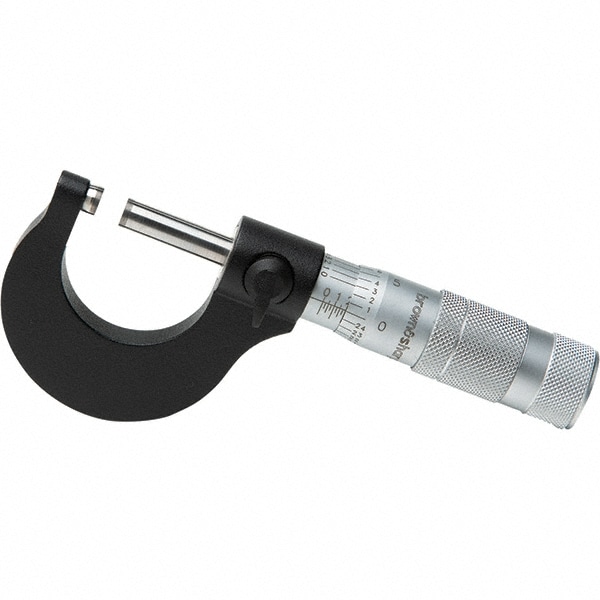 https://www.mscdirect.com/product/details/99870271 Tony. Owner, TonyBen, LLC, Type-07 FFL www.tonybenm14.com (Site under construction). e-mail: tonyben@tonybenm14.com | |||
|
| Freethinker |
Again, I really appreciate all the education about things I knew nothing about. I have a Mitutoyo micrometer with 0.0001 graduations, just haven't used it in a long time. I don't have or use a suppressor on the WC-10, just a flash hider, but decided to check it with the rod because it was the right caliber. | |||
|
| Freethinker |
After a refresher on the vernier scale, I took several measurements of the alignment rod, and they varied from 0.2552 to 0.2556. I suspect that the small variation was due to my measurement techniques as much as anything. Those dimensions would make the rod a very close fit with a minimum bore diameter of 0.256, and any bore deviation (as I believe I understood the explanation by benny6) would prevent it from going farther than what I’m able to insert it. As a comparison with the 6.5mm alignment rod from Amazon whose diameter may be only 0.0004" less than the smallest 6.5 bore, I have a Geissele rod to use with my 308 Winchester rifles, and its diameter is about 0.2973", or 0.0027" smaller than 0.3000" which is the smallest SAAMI-acceptable bore diameter for the cartridge. That allows a lot more tolerance for the rod to fit different bores. To keep saying it, thanks again for the explanations that helped me understand something that was a complete mystery to me before. | |||
|
| Yeah, that M14 video guy... |
You're very welcome! Tony. Owner, TonyBen, LLC, Type-07 FFL www.tonybenm14.com (Site under construction). e-mail: tonyben@tonybenm14.com | |||
|
| Powered by Social Strata |
 | Please Wait. Your request is being processed... |
|
© SIGforum 2026