
Go | New | Find | Notify | Tools | Reply | |
| Happiness is Vectored Thrust  |
While I love Sigs and other modern pistols and revolvers, I have a fondness and appreciation for the historical firearms that came before. I enjoy posting about them on occasion here in hopes that the information presented might educate and/or inspire others on these historic arms. Today's installment is the Merwin, Hulbert & Company Frontier Army revolver. The story of Merwin & Hulbert & Company is a somewhat confusing one. The firm is probably the most famous and successful “gun making company” that never actually manufactured a single gun! The firm had its genesis in 1859, when Joseph Merwin and his partner Edward Bray started a firearms and sporting goods store in New York City. By 1866 Edward Bray had left the company and Charles Simkins became a partner, leading the company to change its name to Merwin & Simkins, and later that year to Merwin, Taylor & Simkins, when Charles Taylor also joined the venture. By 1869 the short-lived partnership was dissolved, and a new partner, William Hulbert, joined Merwin, forming Merwin & Hulbert. The first products offered by Merwin, Hulbert & Company were a series of large frame revolvers, initially in single action, and eventually in double action as well. These guns were introduced in 1876 and were produced well into the 1880s, in a variety of frame and action configurations, but always in a .44 caliber format. The calibers offered included the .44 Merwin & Hulbert, .44 Russian and .44-40. The revolvers that Merwin brought to market were probably the most technologically advanced and possibly the best-built revolvers of their time, but amazingly, Merwin, Hulbert & Company did not actually manufacture them! Rather the Hopkins & Allen Company manufactured them all under Merwin’s watchful eye. Had the source of production remained a secret, the Merwin, Hulbert & Company “Frontier Army” revolvers may well have eclipsed the Colt Single Action Army as the most successful civilian handgun in the west. However, Hopkins & Allen had made a name for themselves in the manufacture of inexpensive, low to mid quality arms, and even though the Merwin, Hulbert & Co. arms were anything but low to mid quality, the association with Hopkins & Allen severely hampered sales. Examples of the Merwin, Hulbert & Company Army revolvers were even tested by the US Ordnance Bureau and found to be superior on number of points to the Colt M-1873 Single Action Army then in service, but no contracts were ever forthcoming. The Merwin, Hulbert & Company revolvers utilized a revolutionary system for loading and unloading. After placing the revolver on half cock, the action was opened by depressing a spring loaded catch on the lower left side of the forward portion of the frame, and pulling a similar catch under the frame to the rear. This unlocked the action of the revolver. This allowed the user to rotate the cylinder, the forward portion of the frame, and the entire barrel to the right, and push it forward. This caused any spent cases to be ejected, leaving the unfired ones in the cylinder chambers. Fresh cartridges could then be inserted in the empty chambers through a sliding loading gate in the right side of the frame. It is not clear exactly how many of the First Model Frontier Army revolvers were produced, due to an erratic serial numbering system and an 1891 fire that destroyed all of Merwin, Hulbert & Company records. It is believed that at most only a few thousand of all of the large frame revolvers were produced, and significantly fewer were of the early open top pattern. History always leaves us with the question - what, when and where did you play your role? I think with the case of early Merwin Army revolvers the Western Frontier was their role. Perhaps even more specific, the really harsh Frontier of the Southwest. Merwins’ were quite popular, and many of them found homes along the Texas Border. The carved Mexican Snake & Eagle ivory grips were very popular throughout the West, but more on the Southwest Frontier. This example is a 1877 First Model Merwin, Hulbert & Company Frontier Army revolver chambered in .44 Merwin Hulbert. It is all matching, with all original parts. There is about 30-35% original nickel finish present, mostly on the frame, trigger guard, cylinder flutes and some on barrel. The balance is a soft gray patina with some darker gray but untouched and natural. The Ivory grips are original to the Merwin, have obtained that pleasing mustard patina, with an extremely artistic rendering of the Snake & eagle perched on a Prickly Pear Cactus. I hope you found the information about these high quality and relatively unknown guns interesting. I'm very proud to add this unique and unusual genuine "Old West" revolver to my western firearms collection. 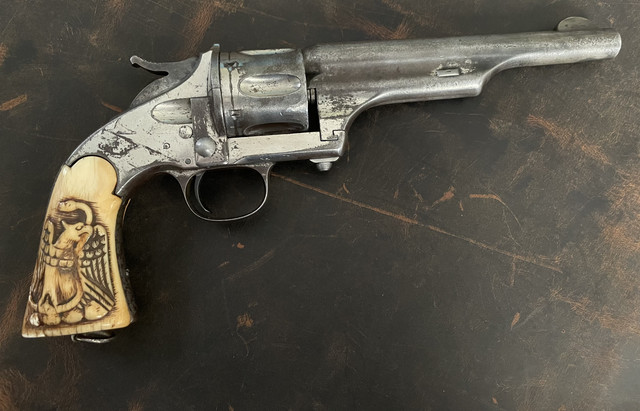 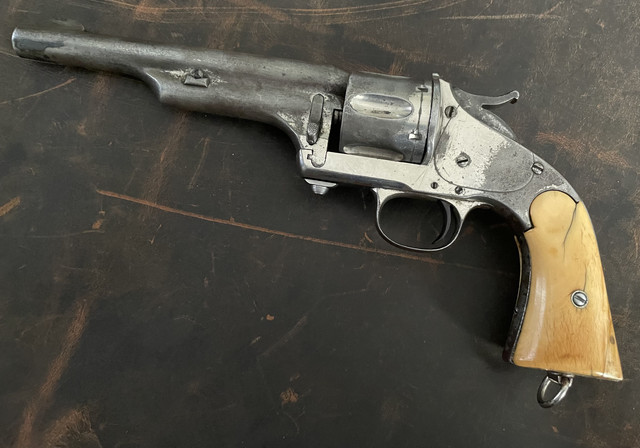 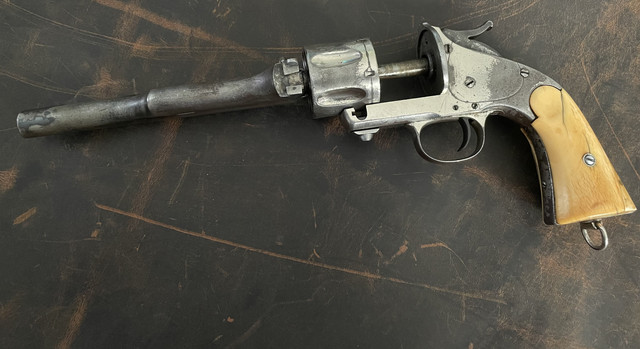  This message has been edited. Last edited by: mojojojo, This message has been edited. Last edited by: mojojojo, Icarus flew too close to the sun, but at least he flew. | ||
|
| Gracie Allen is my personal savior! |
You'll run across the occassional mention of them in historical accounts, and the comments generally seemed positive. I always wondered why we've all heard about the Colt and Smith & Wesson these days but there are relatively few modern-day mentions of the Merwin & Hubert. Weren't M&H pretty well known for their double action revolvers when they came out? | |||
|
Member |
I seem to recall mention of M&H revolvers being quite pricey, relative to competitors. Seemed to me they were sort of "Cadillacs" of the pistol world in their day. ------------------------------ The pool's in, but the patio ain't dry. | |||
|
| Happiness is Vectored Thrust |
They were actually less expensive than the major manufacturer like Colt and Smith & Wesson. They were certainly very well made, both for the 19th Century and even the 20th. Icarus flew too close to the sun, but at least he flew. | |||
|
| Member |
I recall having the opportunity to play with one at a local shop, unfortunately priced out of my range at the time. The bit that sticks is the precision of the manufacture. Pulling the opened forward section forward you could feel absolutely zero play in the mechanism. Everything felt like it was made to the closest tolerances possible. Cool gun. Number 1387 out of 10,789,382 I just didn’t have the budget for at the time. (Numbers exaggerated for comedic effect, and have no legal standing whatsoever) I really like the smaller DA/SA ones I have seen with the folding hammer. I think they ended up being made by Hopkins and Allen at some point, not sure when… Bill R | |||
|
Member |
The whole time _______________________________ Do the interns get Glocks? | |||
|
| Member |
I've always been fascinated by M & H's. I've been a tool maker for 47 years and the machining that makes this gun possible, at this time period, is mind boggling. So, so freaking cool! This was all machined on flat belt equipment, run by, most likely a central steam engine. It hadn't even been 100 years since the lathe was invented in France to turn rollers to press their silk the way they wanted it. From that time on, they had to invent measuring tools (micrometers) in both Metric and Inches, figure out how to mass produce those measuring tools, and then standardize them, and apply their accuracy to mass production. The M & H certainly shows a lot more machining than just lathe work, it shows mill work and very little if any lathe work. Mill work is a whole different animal and another leap forward in the industrial revolution progress. They even had to design milling cutters to make the cuts, to allow the frame and barrel cuts to interface. A new process to mass machining, it had to be a head scratcher... So....If you figure that this gun was machined in 1877, The process of vertical milling was, most likely, in it's infancy. But M & H pulled this off... Geezus what a piece! My highest respect to M & H for doing what they did when they did it! | |||
|
| Member |
I know of one M&H that made it to Hollywood. In one of the Gunsmoke TV movies, a rider is approaching a house. He stops, draws his M&H and breaks it open to check, revealing that it is really not loaded, no cartridges pulled back by the trick extraction system! I read of a M&H being shot, the trick controlled extraction did not work as well as claimed. There was a project to manufacture reproduction M&Hs that went on for some time. Eventually the organizers gave up and refunded the deposits they had collected. All I ever saw was drawings, no sign they ever made even a prototype. | |||
|
Prepared for the Worst, Providing the Best |
That's pretty cool! How did the extraction/ejection system differentiate between fired and unfired cartridges? Was it just that the projectile stuck out far enough into the chamber to keep the loaded rounds from falling out while letting the empty cases drop free? ----------------------------------------------------------- Any comments made by this poster are my own and do not reflect the views or opinions of my employer. | |||
|
| Member |
That is the way it is supposed to operate. They made a lot of smaller calibers, the .32 MH is similar to .32 H&R and .32 S&W Long with a lot of bullet nose showing for the selective extraction. | |||
|
Member |
Extremely cool. --------------------------- My hovercraft is full of eels. | |||
|
| Happiness is Vectored Thrust |
Yes, when you rotate the barrel and pull the cylinder forward, it only comes far enough forward to have the empty casings drop out. On the rounds that have not been fired the bullet is still mostly in the cylinder chamber and thus held on either end in place. Slide the cylinder back and rotate the barrel into the locking position and then load the empty chambers with fresh rounds through the sliding loading gate on the right side. Some of the Merwin & Hulbert guns came with two barrels, a longer one and a short one. With the rotating barrel design you can change the barrel in less time than it takes to talk about doing it. Icarus flew too close to the sun, but at least he flew. | |||
|
| Member |
I had a smaller DA one at one point. The tolerances were incredible! I remember after cleaning it and putting some lubricant on the cylinder pin, I could pull the barrel and cylinder forward as if to remove spent cases, then let go of the barrel/cylinder and it would start to slide back into place by itself; amazing suction! | |||
|
| Happiness is Vectored Thrust |
Speaking of smaller versions (pocket models), I ran across this one when not looking for another gun, but at the asking price I couldn't not buy it! For those who are interested, "Merwin, Herbert & Company manufactured their line of pocket revolvers in an amazing array of models...all were made only in nickel finish. The first pocket models were solid frame, single action revolvers similar in appearance to the small frame Smith & Wessons and others of the era, having spur triggers and a cylinder pin exposed at the front. They were .38 centerfire caliber, had scoop flute, five shot cylinders and regular hammers, and came in 3 1/2 inch and 5 1/2 inch barrel lengths. Grips were saw-handle and birds-head styles. Standard material for grips was black hard rubber with a setter-type dog cast in relief within the circular panel at the top, which was later changed to the circle with plain center or with a raised pattern of dots." (from The Story of Merwin, Hulbert & Co. Firearms by Art Phelps) This is a very early example of their pocket revolvers. It has a 3 1/2 inch barrel and early saw handle "setter dog" grips. Per Art Phelps, "On First Model, spur trigger pockets the loading aperture was unusual for revolvers of the era, consisting simply of a hole in the right cylinder shield. These were made in very limited quantity and are quite rare today." I'm very pleased to have stumbled across this rare Merwin & Hulbert pocket model and to add it to my "Old West" firearms. *a note to anyone interested in collecting or even buying old guns (or anything else); get the books first and read/research. It may seem backwards to do so, but that knowledge will allow you to see things others miss and acquire some very nice items at a lower price. This revolver is but one example of that process paying off for me. 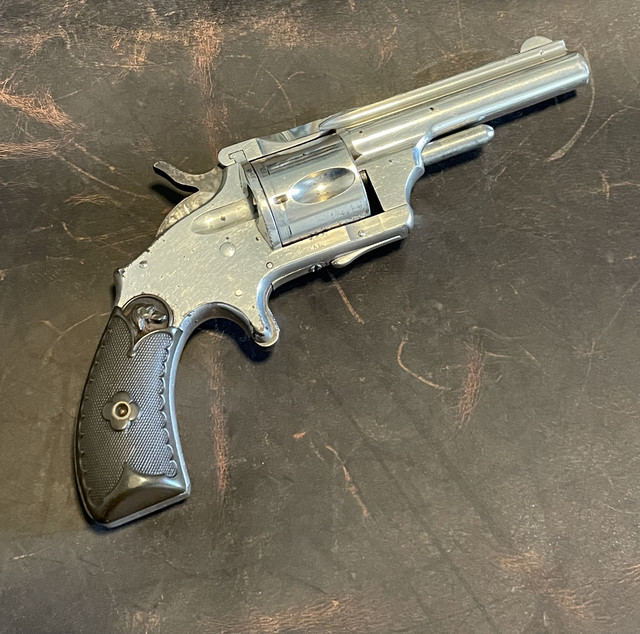 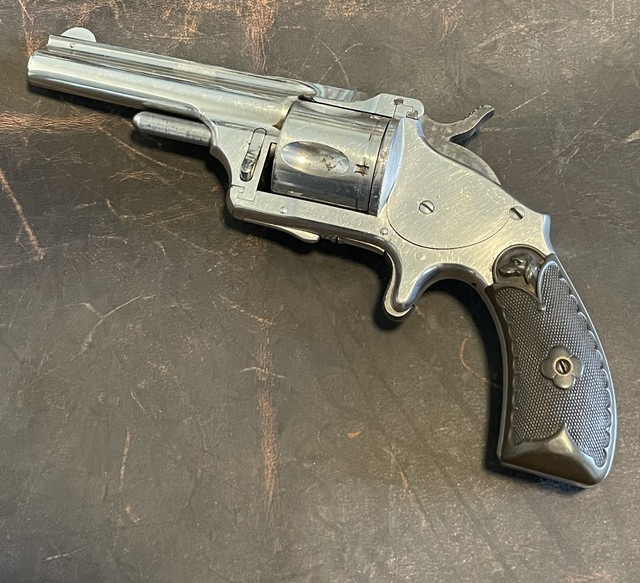 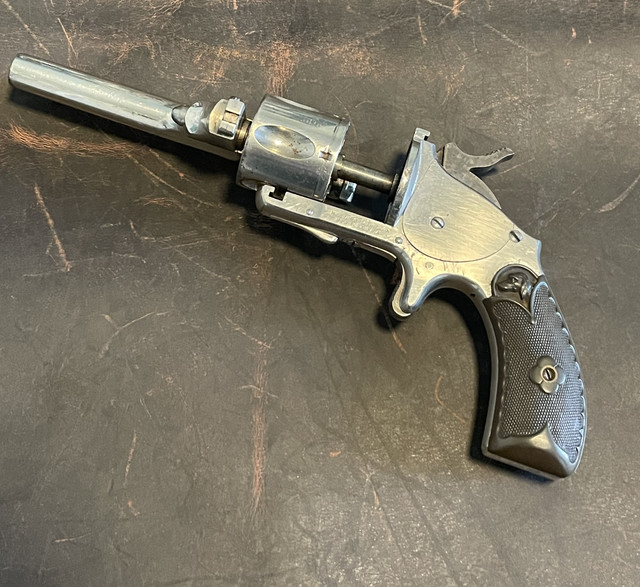  Icarus flew too close to the sun, but at least he flew. | |||
|
| Powered by Social Strata |
 | Please Wait. Your request is being processed... |
|
© SIGforum 2026