
Go | New | Find | Notify | Tools | Reply | |
| Member |
I cleaned up this old slide and posted some pics at another site. A member there pointed out to me something unusual. This is a jh stamped slide, but isn’t marked with a serial number, and there’s no indication someone deleted it. How could this be? 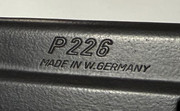 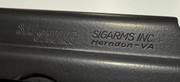 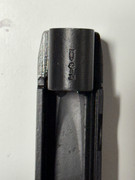 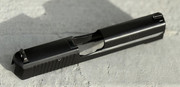 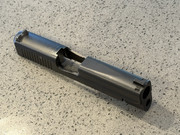 | ||
|
Seeker of Clarity |
Can't say I see any indications it was deleted, but that doesn't look like original finish to my eyes, so I guess it's not out of the question that it was, or that it's a replacement slide. The frame would be the registered part, right? | |||
|
| Member |
I should have provided more detail. When I bought this slide it was sand blasted. Definitely no missing serial on it. I then cleaned it up and cerakoted it. Someone from a different forum mentioned, it maybe from a police armory, but that doesn’t explain the lack of serial number. Would sig Germany have sold a bunch of replacement slides to a US police department? | |||
|
Oriental Redneck |
The old German SIGs have triple serial numbers as their standard, but contrary to popular belief, serial number on slide or barrel is not a legal requirement. Only the proofing and marks are. Serial number on the frame is, of course, a requirement. So, it’s not inconceivable that they did forget to rollmark the SN on your slide, and, even if they found out, they probably said something like “Eh, the frame has the SN, so we’re legally ok”. Q | |||
|
| Member |
Good info. Thanks | |||
|
| Member |
I have seen these a couple of times before. We know for a fact that non-serialized slides were sent to the US later on because there were US-assembled folded-slide SIGs that only had the serial number on the frame (which is the only one legally required in the US). So my thinking for these early (W. German) slides without numbers was always that they were just sent to the US as spare parts (at some point). It's also curious because it begs the question of how SIG DE used to mark their parts. It's pretty clear that not all markings were always applied at the same time. It's also possible that the order in which the markings were applied (and how many were applied simultaneously) changed over time. Also (totally off-topic), I wonder if the finish is original. It looks kind of like a K-Kote. | |||
|
| Oriental Redneck |
That doesn’t explain the proof marks. Proofing is required on a completely assembled firearm to be sold. Spare parts themselves sitting around do not require proofing. Naked folded slides w/o serial number and proof marks were sold plenty on fleabay years ago. Those were no doubt spare parts. Highly doubt OP’s slide was just a spare.
He said he Cerakoted it. Yes, it does look like K-kote. Q | |||
|
| Member |
^^^Oops. I missed his second post about the Cerakote. You’re right that spare parts don’t require proof marks. I was watching a YouTube video though (a tour of the Walther factory in Germany), and the guide explained that the proof marks have to be applied before being sent to the proof house, otherwise the proof house won’t accept them. In those days, US-assembled SIGs didn’t exist, so it would make sense for SIG DE to have marked all of them anyway. | |||
|
| Oriental Redneck |
Sorry but not buying whatever that “guide” is saying. He essentially said, “We’re giving you the passing mark before the testing even begins”. What? That makes zero sense. Maybe that’s how Walther DE does things, but it’s not the proper way. The gun has to pass the proofing process first then is given the proof mark.
Q | |||
|
| Member |
Sorry, but my first thought was "Well yeah, an 87 foot slide certainly is an abnormality." Sorry man.  Rednecks- Keeping the woods critter-free since March 2, 1836. | |||
|
| Member |
Insanely accurate though! | |||
|
| Member |
This is where I originally watched the video. It appears the YouTube user deleted his account and the video along with it. It's been a couple of months since I watched it (maybe someone who has the video will re-post eventually). I did find another tour of the factory from another YouTube channel called "Hunter Zagreb". It's the same guide in both videos, who I just realized is actually Bernhard Knöbel (the current CEO of Carl Walther GmbH). | |||
|
| Oriental Redneck |
^^^^ The video by Hunter Zagregb of the Walther factory tour with their CEO explaining things I have seen. It’s 16 minutes long with the girl reporting. If that’s the one you’re referring to, I couldn’t find anywhere where the CEO saying the guns receive the proof marks prior to sending them to the proof house for testing. Anyway, it doesn’t matter. If the other video you saw is true, as I said above, maybe that’s how Walther does things, but it’s not CIP legal. I asked CIP, the regulatory body that makes the rules for firearm and ammunition testing for its member states, directly, if there are any exceptions to their proofing regulation, i.e., the gun has to pass the testing before receiving the proof mark. This is their answer, verbatim: ”The firearm receives the proof mark only after the proof testing process and IF THE TEST IS OK.” Q | |||
|
| Member |
^^^Unfortunately, the video I am referring to is the broken one in the guns.com link. Anyway, I wouldn’t be surprised if SIG did it that way too at one point. The early W. German guns all had missing finish on the proof mark. This would indicate that the proof mark was applied after proofing (the frame was already anodized), or otherwise, in the correct CIP order. Later guns (that were still old enough to be roll-marked instead of laser-etched) did not have missing finish on the proof mark, indicating that it was applied before the frame was anodized (i.e. proofing happened after the proof mark was applied). It is of course a possibility that SIG just found a way to apply the mark without disturbing the anodizing. Still, how would we explain this P229, with mismatched CIP/N and Eagle/N proofs?  | |||
|
| Oriental Redneck |
^^^^ My friend, I’ve been meaning to get back to this thread to say that you nailed it. Regarding both SIG Sauer DE and Walther DE. My consultation with a former product manager at SIG DE confirmed what you wrote. In the old days, SIG did it in the order it was spelled out by CIP: test, then mark, if passed. In newer times, they had an agreement with the proof house (Kiel), which is actually in SIG headquarters btw, to laser etch the proof marks while also doing the serial numbers before sending the guns next door for proof testing. Any guns not passing the testing were to be repaired or got tossed. With the high volume of guns to be tested, this way SIG helped relieve some of the workload for the proof house. He also mentioned that it appears Walther also had a similar agreement with the proof house they use (Ulm). These big gun companies are given a little leeway in bending CIP rule of testing and marking. But the result is the same, only guns that passed testing get to be sold on the market. So, I’ll take those two servings of crow, now. With apologies to the CEO of Walther. Q | |||
|
| Powered by Social Strata |
 | Please Wait. Your request is being processed... |
|
© SIGforum 2026