CBO data show that government transfers now account for a historically large share of income among low-income households. Does today’s welfare system encourage mobility or entrench dependency?
Tyler Turman
President John F. Kennedy once said, “We must find ways of returning far more of our dependent people to independence.” President Lyndon B. Johnson sought to meet that challenge by launching the War on Poverty in 1964, insisting that its purpose was not to make people “dependent on the generosity of others,” nor merely to “relieve the symptom of poverty,” but to “cure it and, above all, to prevent it.”
Sixty years and some $20 trillion in welfare spending later, that message appears to have gotten lost. Rather than helping the poor climb out of poverty toward self-reliance, government handouts have instead pulled the ladder away by supplanting work as their primary source of income.
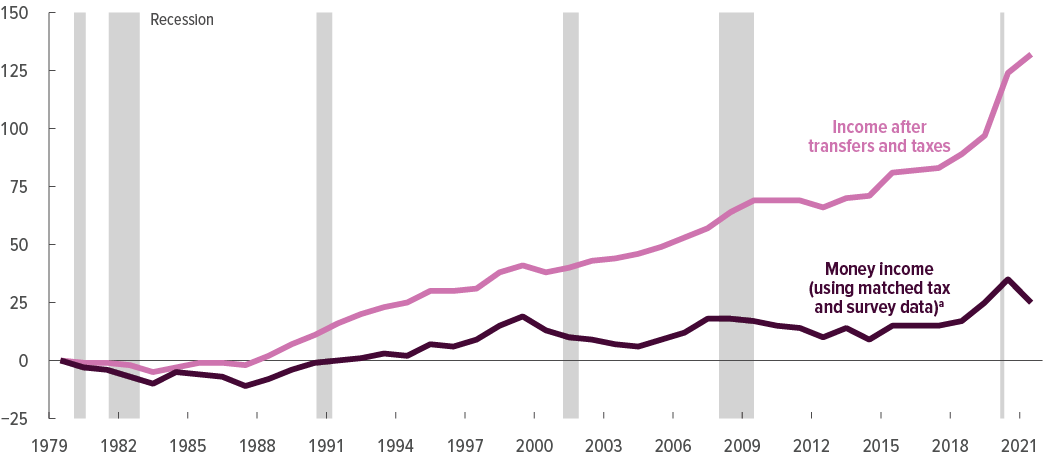
According to January’s Congressional Budget Office (CBO) report, average total income for the poorest households nearly doubled from 1979 to 2022. But most of that increase was fueled by government wealth transfers.
Cumulative Growth of Income Among Households in the Lowest Quintile of the Income Distribution, by Type of Income
Congressional Budget Office, using data from the Census Bureau. In 2021 dollars. Shaded areas show recessions. (This is a prior release to the CBO report cited by the author, and includes many temporary COVID-era benefits not reflected in the most recent report.)
If the success of America’s social safety net is measured by how much cash the government can dole out, then it’s a testament to the scale and generosity of the welfare state. But that was never the yardstick the architects of the welfare state themselves used when selling their War on Poverty to the public. Welfare was intended to be a means toward self-sufficiency and independence through work.
Viewed through that lens, the CBO report paints a far more troubling picture: Low-income Americans are receiving an ever-growing share of their financial resources from government transfers instead of work.
In 1979, households in the lowest income quintile earned, on average, about 53 percent of their total income from money income — wages, salaries, business income, and other earnings from private-sector work. Means-tested transfers — government cash and in-kind benefits targeted to low-income households — made up just 26 percent.
Since then, the numbers have gone in completely opposite directions. During the pandemic, income from work plummeted to an all-time low of just 33 percent, while means-tested transfers skyrocketed to 57 percent.
Even after temporary COVID-era benefits expired, about 42 percent of the income of America’s poorest households comes from their own earnings. Government transfers also sit at 42 percent, matching earnings from work dollar-for-dollar.
The means-tested transfer rate — that is, the value of welfare benefits relative to income before government assistance and taxes — tells the same story. In 1979, it stood at 32 percent. By 2022, this figure had more than doubled to 72 percent. In other words, for every dollar a low-income household earned (after counting social insurance like Social Security and Medicare), 72 cents were in welfare benefits. During the pandemic, this reached a staggering 93 percent.
The report’s findings are indicative of a trend that is all too common in America’s “social safety net.” Rather than enabling the poor to rely on their own earnings, welfare traps people in government dependency.
The federal government now spends over $1 trillion each year on welfare programs, and, despite historically unprecedented economic gains for low-income Americans, more of them are dependent on government assistance than at any point in the country’s history. That’s hardly an outcome taxpayers should be proud of in a country that styles itself as the land of opportunity. Indeed, if welfare’s purpose is to provide transitional support, then persistently high caseloads should signal that government assistance has become a destination, not a bridge.
If the federal government is going to be in the business of wealth redistribution at all, taxpayers are entitled to demand that it cultivate a culture of work, as then-senator Joe Biden said before the 1996 welfare reforms. But if taxpayers have been pouring trillions of dollars into a money pit that has failed to achieve its own stated goals for over 60 years, it’s time for a serious reckoning.
It is neither efficient nor compassionate for the government to create a perpetual underclass of citizens trapped in a cycle of dependency at the taxpayers’ expense. No amount of political or moral grandstanding can ever justify this state of affairs.
As Congress floats the idea of a second reconciliation bill going into 2026 amid the One Big Beautiful Bill Act (OBBBA)’s welfare reforms, it would do well to remember that a paying job will always be the best anti-poverty program.
The CBO’s report should be a warning. If the goal is independence, welfare policy must be judged by whether it increases work and reduces reliance on government aid. But if the welfare state has become the narcotic President Franklin ‘New Deal’ Roosevelt himself warned against, then Congress should follow his prescription: “The federal government must and shall quit this business of relief.”
"Some things are apparent. Where government moves in, community retreats, civil society disintegrates and our ability to control our own destiny atrophies. The result is: families under siege; war in the streets; unapologetic expropriation of property; the precipitous decline of the rule of law; the rapid rise of corruption; the loss of civility and the triumph of deceit. The result is a debased, debauched culture which finds moral depravity entertaining and virtue contemptible." -- Justice Janice Rogers Brown
"The United States government is the largest criminal enterprise on earth." -rduckwor
February 25, 2026, 07:55 AM
Leemur
There’s no shame anymore in being able bodied and being on welfare. The majority have been conditioned to believe that being poor is someone else’s fault and you deserve ever increasing amounts of handouts. It’s called vote buying and it’s infuriating.This message has been edited. Last edited by: Leemur,
February 25, 2026, 07:59 AM
chellim1
quote:
It’s called got buying and it’s infuriating.
I've never heard the phrase "got buying".
"Some things are apparent. Where government moves in, community retreats, civil society disintegrates and our ability to control our own destiny atrophies. The result is: families under siege; war in the streets; unapologetic expropriation of property; the precipitous decline of the rule of law; the rapid rise of corruption; the loss of civility and the triumph of deceit. The result is a debased, debauched culture which finds moral depravity entertaining and virtue contemptible." -- Justice Janice Rogers Brown
"The United States government is the largest criminal enterprise on earth." -rduckwor
February 25, 2026, 08:07 AM
rizzle
quote: The report’s findings are indicative of a trend that is all too common in America’s “social safety net.” Rather than enabling the poor to rely on their own earnings, welfare traps people in government dependency. End quote
Their own earnings are not enough to deal with the cost increases from health insurance, automotive costs, food, rent, everything... Too much is taken out of a $25. an hour pay check to have anything left.
Really can't blame the "poor" for this mess.
February 25, 2026, 09:18 AM
darthfuster
Transfers created dependency. Dependency created resentment. Resentment demands justice. Transfers are justice.
You’re a lying dog-faced pony soldier
February 25, 2026, 09:32 AM
chellim1
^^^^ darthfuster: That's a good way to put it!
"Some things are apparent. Where government moves in, community retreats, civil society disintegrates and our ability to control our own destiny atrophies. The result is: families under siege; war in the streets; unapologetic expropriation of property; the precipitous decline of the rule of law; the rapid rise of corruption; the loss of civility and the triumph of deceit. The result is a debased, debauched culture which finds moral depravity entertaining and virtue contemptible." -- Justice Janice Rogers Brown
"The United States government is the largest criminal enterprise on earth." -rduckwor
February 25, 2026, 10:16 AM
RogueJSK
quote:
Originally posted by chellim1:
quote:
It’s called got buying and it’s infuriating.
I've never heard the phrase "got buying".
I suspect that's a typo. Even Urban Dictionary has never heard of "got buying" as slang.
If I had to guess, he means "vote buying", but typed either "gote buying" or "vot buying" and it was autocorrected to "got buying".
February 25, 2026, 10:44 AM
KMitch200
When politicians rob Peter to pay Paul, they can always count on support from Paul.
Nobody wants to put Santa Claus out of office - except Peter.
-------- After the game, the King and the pawn go into the same box.
February 25, 2026, 10:53 AM
LS1 GTO
quote:
Originally posted by Leemur: There’s no shame anymore in being able bodied and being on welfare. The majority have been conditioned to believe that being poor is someone else’s fault and you deserve ever increasing amounts of handouts. It’s called got buying and it’s infuriating.
My grandmother told me a story about an event when she was a teenager(?) during the depression.
She said a hobo came to the house looking for any kind of work so he could buy something to eat. Great-Grandma Cox tried to give him a sandwich but the hobo refused the "free" food and insisted he be allowed to work for for it.
Much has changed in 90 years.
Life moves pretty fast. If you don't stop and look around once in a while, you could miss it.
"If dogs don't go to Heaven, I want to go where they go" Will Rogers
The definition of the words we used, carry a meaning of their own...
February 25, 2026, 11:18 AM
architect
Like we needed a "report" to know the truth of the "welfare system." Much like Johnson's polices made low-income fathers abandoning their families economically advantageous leading to Govt.-facilitated persistence of slums, ghettos, and dysfunctional families. The same thing is happening on an even more extreme scale in those leftist States' homeless populations. If you make the basics of life too easy to obtain, there is a significant portion of the populace who will be content with what htye get for "free," and not proud enough to care to advance their positions in society.
Whether this is more due to intrinsic human nature, or political maneuverings is uncertain, but it certainly is tragic.
The main issue for me is "how do we extricate ourselves (the working, tax-paying contingent) from this situation?" Cutting off welfare and other social programs, and thereby forcing many millions of people into desperate circumstances, obviously will not work.
Charity degrades the recipient of it, and by association, the giver of it as well.
February 25, 2026, 11:24 AM
bryan11
We read in the 1990s about single moms on welfare that felt trapped. If they got a job that paid less than $60,000, they would end up with lower income overall. It didn't make sense for them to get a job as it would only cut their overall income.
Health insurance has amplified this. Take someone on disability and Obamacare. If they start working, they lose their disability and their insurance becomes more expensive. Unless they get a job that's both very secure long term and has a great salary, it doesn't make sense to work.
Maybe migrants are in a similar situation. The system of transfers strongly encourages people to stay on it.
February 25, 2026, 12:46 PM
Georgeair
quote:
average total income for the poorest households nearly doubled from 1979 to 2022. But most of that increase was fueled by government wealth transfers.
From a math standpoint, inflation during that time is 4x, so unless this is in inflation-adjusted dollars it's not terribly surprising.
I'm not defending the programs, just pointing out the math is fuzzy at best, and might not be as dramatic as the presenter is trying to make it in that particular passage.
You only have integrity once. - imprezaguy02
February 25, 2026, 01:03 PM
chellim1
quote:
unless this is in inflation-adjusted dollars it's not terribly surprising.
I agree... the math is fuzzy... but if you look at the graph, the work income is largely flat and transfers keep increasing.
Cumulative Growth of Income Among Households in the Lowest Quintile of the Income Distribution, by Type of Income
While we keep hearing that wages for the bottom half of the income spectrum keep falling... maybe part of that is that many don't feel like they need to work?
"Some things are apparent. Where government moves in, community retreats, civil society disintegrates and our ability to control our own destiny atrophies. The result is: families under siege; war in the streets; unapologetic expropriation of property; the precipitous decline of the rule of law; the rapid rise of corruption; the loss of civility and the triumph of deceit. The result is a debased, debauched culture which finds moral depravity entertaining and virtue contemptible." -- Justice Janice Rogers Brown
"The United States government is the largest criminal enterprise on earth." -rduckwor
February 25, 2026, 01:23 PM
bryan11
quote:
Originally posted by chellim1: While we keep hearing that wages for the bottom half of the income spectrum keep falling... maybe part of that is that many don't feel like they need to work?
Some don't feel the need to work and for some transfers make it illogical to work. For IT jobs and more, offshoring has increased unemployment and lowered wages for US jobs.
February 25, 2026, 01:30 PM
slosig
“Root hog or die” has never been more obviously right.
I may be a reactionary, but it seems like getting the government out of the business of babysitting and forcing people to either make it on their own, depend on local charity, or leave the chat would be a huge improvement.
Ronald Reagan wasn’t perfect, but he was absolutely correct that the government is the problem much more often than it is the solution. A return to a *severely limited* government would be a boon to this country.
February 25, 2026, 01:35 PM
HRK
Electronic payment systems have helped eliminate the peer pressure on some of the welfare programs.
People on food stamp programs now just swipes a digital government debit card, looks just like someone who works for a living and pays their own way to the observer.
In some ways that's good because there are people who truly need help, and it likely helps with the financial costs of managing the program.
Credit card processors love it as it creates transaction revenue however that doesn't go back to cover the costs of the program, just transfers it from government labor to digital expenses and transfers taxpayer money to processing companies.