
Go | New | Find | Notify | Tools | Reply | |
Charmingly unsophisticated |
I was under the impression that the bayonet was not a widely issued item for the colonists, particularly for militia, during the early stages of the war. _______________________________ The artist formerly known as AllenInWV | ||
|
| Sigs are my Panacea...  |
I am not an expert by any means, but have always understood that at that time, it was more of a defensive weapon than offensive. Also, I am sure that they did not see the use of them as 'gentlemanly'. * --- Sig 365, 365XL, 245, P6 * | |||
|
| Charmingly unsophisticated |
I thought I read something about it being part of the reason British troops were feared...if they got close enough, they were well-drilled in its use and no one who wasn't similarly equipped/trained really didn't want to get shishkabobbed. _______________________________ The artist formerly known as AllenInWV | |||
|
| Sigs are my Panacea... |
I am always shocked at the brutality and animosity that the Redcoats often had for British subjects... The colonists were not some distant group of agitators, they were much closer to being cousins. * --- Sig 365, 365XL, 245, P6 * | |||
|
| Sigs are my Panacea... |
A little research goes a long way! " The British army was renowned for their disciplined use of fixed bayonets . An advancing line of charging redcoats often caused raw, inexperienced colonial soldiers to panic and flee. " From American Battlefield Trust * --- Sig 365, 365XL, 245, P6 * | |||
|
| Freethinker |
One of our true experts will no doubt chime in, but one of the issues with bayonets in the War for Independence was that they could not be fitted on the civilian type muskets and rifles that were more common on the American side at the beginning. Bayonets were considered essential for military muskets by that time in history because of their obvious slow reloading speed. Based on all I’ve read, a common tactic was that when forces got close enough to each other, there would be a final volley of fire (if possible) followed by a bayonet charge. As I recall, the British were firm fans of the bayonet, but when available and appropriate, the Americans used them as well. No one was concerned about “gentlemanliness.” Bayonets on rifles served an important defensive purpose when units would form “squares” to repel cavalry attacks because supposedly horses would not charge into them (being smarter than their riders, evidently). Those sorts of actions were less common during the revolution than in wars in Europe, I believe. But I also recall reading that during our Civil War, bayonet wounds were relatively rare. The rifled muskets by then made gunfire far more effective (maybe) than during the revolution, but it was generally thought that one side or the other often broke and ran before it came time for the other to use their spears. “ One may protest against evil; it can be exposed and, if need be, prevented by use of force. … Against stupidity we are defenseless. … [R]easons fall on deaf ears; facts that contradict one's prejudgment simply need not be believed … and when facts are irrefutable they are just pushed aside ….” — Dietrich Bonhoeffer | |||
|
| Sigs are my Panacea... |
Revolutionary war bayonets had a triangular cross section that made the wounds they caused much more difficult to treat. Plus, most were about 17" long!! * --- Sig 365, 365XL, 245, P6 * | |||
|
Member |
My personal opinion was prior to effective breechloaders, long arms were basically Pikes which went bang. Massed fire was required to achieve effective fire on the opponent and they would then finish with the bayonet. 40 to 50 yards away banging away shoulder to shoulder until one side or the other would break. The Brit’s drilled 3 rounds a minute until they could do it blind folded. Most bayonet wounds were inflicted after the opposing line would break and run. | |||
|
| Freethinker |
That is generally considered to be a myth. Although more than one reason for the shape is cited, the shape gives more rigidity than something flat like a knife blade while reducing weight and material used as compared with something like a pointed rod of the same diameter. “Bayonet-knife” was/is(?) a term used by the US military because as knives they are much more useful as a general tool than the old type bayonet. Although probably intended to be mildly fun-poking, there is a Bill Mauldin cartoon from WWII showing two cooks in a mess tent:  Just from a physical design standpoint, later bayonets with wide knife-type blades would be more likely to cause a fatal injury due to tissue destruction (i.e., cutting arteries and veins) than the more narrow cross section of the triangular bayonets. Keep in mind that during the era of the War for Independence and continuing for decades thereafter, there was no good effective treatment for deep puncture wounds that penetrated the body. A surgeon wasn’t going to open up the body to repair internal organs, clean out materials such as intestinal contents that could cause infection, or administer antibiotics. The best that could be done would be to try to allow the body to heal itself if nothing too important was damaged by the wound. I have read in more than one source that the superficial entrance wound of a puncture would be left open to permit drainage of pus, etc., rather than keeping it inside. One YouTube discussion of triangular bayonets: https://www.youtube.com/watch?v=jszNi57T-Fg “ One may protest against evil; it can be exposed and, if need be, prevented by use of force. … Against stupidity we are defenseless. … [R]easons fall on deaf ears; facts that contradict one's prejudgment simply need not be believed … and when facts are irrefutable they are just pushed aside ….” — Dietrich Bonhoeffer | |||
|
Member |
Whether he really said this is open for questioning.  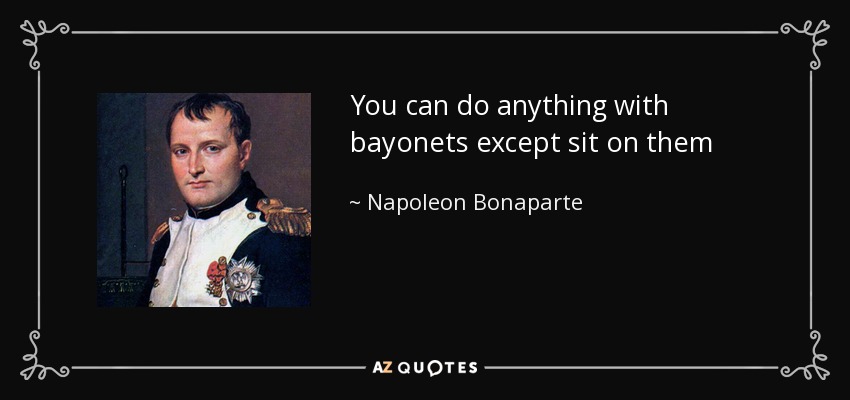 --------------------- DJT-45/47 MAGA !!!!! “Quidquid latine dictum sit, altum videtur.” "Sometimes I wonder whether the world is being run by smart people who are putting us on, or by imbeciles who really mean it." — Mark Twain “Democracy is the theory that the common people know what they want, and deserve to get it good and hard.” — H. L. Mencken | |||
|
| Member |
RegRding wounds in the pre antibiotic era especially the civil war, infections were so common that if a wound was not draining pus ( it was called laudable pus at the time) reoperation was performed to find out why the wound wasn’t healing “ normally” ! It is my understanding while early on colonists were using a lot of long arms that were not designed for bayonet firing, as time went on the extensive use of the charlleville pattern french musket( supplemented by small stores of pre revolution brown besses plus captures brown besses ) with associated bayonets became standard. As the continental army became more disciplined and trained they used bayonets just as much as the British.opposing armies charged each other generally until one side broke and surrendered territory usually without a lot of bayonets connecting with flesh, though it certainly did happen | |||
|
Member |
With the way warfare has changed I doubt there will be little use for the bayonet but that doesn't mean training should stop. The last bayonet charge. Korean War Bayonet charge Let all Men know thee, but no man know thee thoroughly: Men freely ford that see the shallows. Benjamin Franklin | |||
|
Member |
I understand that early militia troops occasionally used 'plug' bayonets in their muskets. Later on, when more modern weapons (for the time) were acquired, socket bayonets were used. "Cedat Fortuna Peritis" | |||
|
| Freethinker |
My thoughts about training to use spears and clubs in modern combat. There were times in US military history when makework had to be found for the troops because they didn’t have anything useful to do, and filling “idle hands” was a concern. In my earliest days in the Army, painting rocks was still not unknown. I also remember hearing about “Coalbin Willie” at one post. In the 1950s and early 1960s coal-fired heating was still used in some places. That meant there were coalbins where the coal was stored outside for use as required. One of Colonel(?) Willie’s tasks for his people on Saturday mornings was to remove all the coal from the bins, refresh the whitewash inside the bins, and stack the coal back neatly until the next weekend. Other than keeping the post looking spiffy, it helped ensure that the troops didn’t get themselves in trouble—at least on Saturday mornings. By the time I retired, the requirements for other training that had little to do with war-fighting had increased to the point that soldiers had less free time that needed to be filled by such tasks. Based on what little I know of military life today, that trend of other training such as how to be nice to your trans squad leader seems to have continued. So, what does all that to do with finding time for bayonet training and the value of such training? In basic training in the mid-1960s we had bayonet training with our M14 rifles. It was actually more fun than much of what we did, and it did help develop the upper body strength to handle and shoot our weapons as they were supposed to be used. Personally, though, I kept thinking of my father’s opinion about the pointy pieces of metal that affected the rifles’ accuracy if left on when firing: “The only time a bayonet would be of any use on a rifle is if you’re out of ammo and the other guy is out of ammo,”—in his opinion that was not too likely in modern warfare. He, BTW, was a combat engineer in the ETO in WWII who came back with four Purple Heart medals, and knew something about combat. He was also a competitive shooter who knew something about rifles. I’m not sure why by the time when I enlisted during the Vietnam war that bayonet training was required when they were trying to get us through basic training as quickly as possible. There was some mention of the “spirit of the bayonet” being “Kill, Drill Sergeant,” and perhaps it was just tradition, but a day of running through a course stabbing dummies didn’t really prepare us for suddenly being transported back in time to Seminary Ridge or Isandlwana. I will say, though, that I decided if I ever needed to use our heavy wood and metal spears in combat, a vertical buttstroke would have been my method of choice.* (Google AI says that the buttstroke would be useful if the enemy was “too close to shoot.” I am trying to imagine how close that would be and why he hadn’t shot me already.) During my training I did wonder if I could impress any of the cadre by breaking the stock of my rifle. It never happened, but even 60+ years later, I suspect I could mess up the receiver extension of an AR pretty good by using the technique on an appropriate target. I do have a bayonet that will fit on an AR or two, though, and it makes for a cool picture.  * If an aggressor can take multiple handgun shots without being put down, as we know can happen, a stab wound isn’t going to be guaranteed to be any more effective. Driving his lower jaw up into his brain, though? Prolly better. “ One may protest against evil; it can be exposed and, if need be, prevented by use of force. … Against stupidity we are defenseless. … [R]easons fall on deaf ears; facts that contradict one's prejudgment simply need not be believed … and when facts are irrefutable they are just pushed aside ….” — Dietrich Bonhoeffer | |||
|
| Member |
Bayonet training is an on off thing. In the 60’s & 70’s was standard in basic ( Army) When I went through in 1984 was during one of the times it wasn’t done, then a year or two later was back. There was an incident in Iraq of a British unit successfully performing a bayonet charge. When I was in Iraq we were issued bayonets, but after my first couple missions stopped carrying it. With all the other gear we carried another 1&1/2 pounds and the snagging getting in and out of vehicles and tight spaces, more trouble that it was worth. | |||
|
| Freethinker |
Interesting to know what has transpired with bayonet training since my day. One last war story about bayonets: After our agent in charge got concerned about our being in a somewhat isolated position in RVN, he arranged for us to move onto a large compound. Although we were supposed to be noncombatants (sort of), we did have rifles thanks to the efforts of our admin clerk*, and we were assigned to a bunker along with the EOD people who were right next to us. One night when the compound was attacked the alert was sounded and we all headed to the bunker. The captain OIC of the EOD detachment who was relatively new there showed up with a bayonet fixed to his M16. The NCOIC said, “Captain, take that damn thing off your rifle before you stab someone.” He sheepishly complied. Other than in my own training, that was the only time I ever saw a bayonet on a rifle except for ceremonial purposes. *As counterintelligence agents our issued weapons were 38 Special Colt Detective Special revolvers along with 12 rounds of FMJ ammunition, but our guy got a bunch of beat-up M16s from the local Special Forces unit. No bayonets, though. Alas.  Oh, yeah, one more comment by my father about bayonets. During his pre-WWII training, they were told that if the bayonet got stuck in the victim after stabbing him, the recoil of firing a shot would dislodge and free the bayonet. His response was, “If you still had ammunition to fire a shot, why the … would you stab someone with a bayonet‽” “ One may protest against evil; it can be exposed and, if need be, prevented by use of force. … Against stupidity we are defenseless. … [R]easons fall on deaf ears; facts that contradict one's prejudgment simply need not be believed … and when facts are irrefutable they are just pushed aside ….” — Dietrich Bonhoeffer | |||
|
| Charmingly unsophisticated |
I got to Germany just in time to be issued the M9 bayonet. Almost immediately gaps began appearing in the motor pool fence as we began trying out the wire-cutting scabbard. My original question had to do with a Facebook post by a guy here in Arkansas who does reenacting. He was donning colonial militia gear and included a bayonet. Someone posted "But the bayonet!! -some boomer somewhere". I'm Gen X but I was about to question that.  I did ask, and his (the reenactor) response was that British troops marching to Lexington & Concord were going to seize militia stores, which included rifles, powder and bayonets. He did concede that bayonets were probably rare among militia, but not unheard of. _______________________________ The artist formerly known as AllenInWV | |||
|
| Member |
I watched this video today about how it was in the Continental Army. At about the 3:00 minute mark the narrator tells of John Stark's efforts to arm and train troops with the bayonet. The Hessians at Trenton were surprised with how well it was wielded. (link provided, but not embedded) https://www.youtube.com/watch?v=VdGUlS0ZI78 | |||
|
| Powered by Social Strata |
 | Please Wait. Your request is being processed... |
|
© SIGforum 2026