
Page 1 2
Go | New | Find | Notify | Tools | Reply | |
| Member |
Army approves M111, first new lethal hand grenade since 1968 03.10.2026 Picatinny Arsenal By Michael Chambers PICATINNY ARSENAL, NJ – The U.S. Army has cleared the M111 Offensive Hand Grenade (OHG) for Full Material Release (FMR). Developed by the Capabilities Program Executive Ammunition and Energetics (CPE A&E), in conjunction with the U.S. Army Combat Capabilities Development Command (DEVCOM) Armaments Center at Picatinny Arsenal, the M111 OHG will replace the obsolete body and fuze of the Mk3A2 hand grenade series, marking the first new lethal hand grenade to achieve FMR since 1968 when the Mk3A2 entered service. The Mk3A2 is restricted for use due to its asbestos body unlike the M111 which utilizes a plastic body that is fully consumed during detonation... Complete article with photos: https://www.dvidshub.net/news/...d-grenade-since-1968 Filler is Comp A-3: https://www.global-ordnance.co...plosive-Comp-A-3.pdf | ||
|
| Member |
Will training have to be adjusted so “frag out” no longer gets yelled when throwing one of these? | |||
|
| Ammoholic |
It is the Mk3A2 which the new Mk111 is replacing that has asbestos, not the Mk111. The asbestos lobby might bitch though, surely someone’s ox is being gored. | |||
|
| No, not like Bill Clinton  |
So what the heck did I train with? It wasn't the MK3A2. M67?  | |||
|
| Get my pies outta the oven!  |
So this is only for use in enclosed areas like urban combat and does not replace the M67 fragmentation grenade is what I'm reading? | |||
|
| Member |
Correct. "In open terrain, the Soldier will employ the M67 to maximize lethal fragment effects, whereas in enclosed and restricted terrain, Soldiers will employ the M111 to maximize BOP effects on the enemy." | |||
|
Fighting the good fight |
This is replacing the MK3, and both the MK3 and M111 are concussion grenades. Intended to be used on the offensive when assaulting enclosed areas like trenches, buildings, and bunkers, with little fragmentation to help minimize friendly injuries. It relies on overpressure rather than large amounts of fragmentation in order to disable enemies in enclosed areas. Whereas the M67 is a fragmentation grenade, intended to be used in more open areas, or especially defensively when you and your buddies are likely to be behind cover. It relies on shrapnel to inflict casualties. Since the early to mid 20th century, militaries have commonly classified their grenades as "offensive" (concussion) versus "defensive" (fragmentation). | |||
|
Optimistic Cynic |
M67 -> M111. Does this mean there were 44 failed prototypes? I kind of envy the guys who got to test them. | |||
|
| Ammoholic |
From the article in the OP, you likely trained with the M69 which is the training version of the M67. | |||
|
Charmingly unsophisticated |
As a product of the "when in doubt, frag it" era, I have questions. Why is BOP preferred in enclosed spaces to fragmentation? Does BOP reach behind obstacles (furniture, etc) better than shrapnel? _______________________________ The artist formerly known as AllenInWV | |||
|
Spread the Disease |
Depends on the situation, but it can. Blast waves wrap around corners/obstacles, even if fragments cannot penetrate them. There are limits, dead zones, and other complexities, but it is possible. Blast pressure drops of very quickly with distance, especially with smaller blasts, so the target would have to be very close. ________________________________________ -- Fear is the mind-killer. Fear is the little-death that brings total obliteration. I will face my fear. I will permit it to pass over me and through me. And when it has gone past me I will turn the inner eye to see its path. Where the fear has gone there will be nothing. Only I will remain. -- | |||
|
Member |
First shalt thou take out the Holy Pin, then shalt thou count to three, no more, no less. Three shall be the number thou shalt count, and the number of the counting shall be three. Four shalt thou not count, neither count thou two, excepting that thou then proceed to three. Five is right out. Once the number three, being the third number, be reached, then lobbest thou thy Holy Hand Grenade of Antioch towards thy foe, who being naughty in My sight, shall snuff it. | |||
|
| Smarter than the average bear |
I have no experience and know little about grenades. Have we not been using "pineapple" looking grenades? Is it just the new ones that are smooth cylinders? Is that something you'd want to have to throw in the rain? Seems slipery to me. | |||
|
| Charmingly unsophisticated |
The old 'pineapple' style (no clue what the nomenclature is) probably went out of style after Korea. M67 looks sorta like a slightly deflated racquetball with the fuse assembly sticking out the top. _______________________________ The artist formerly known as AllenInWV | |||
|
| Savor the limelight |
Are they ambidextrous? | |||
|
| Freethinker |
The iconic “pineapple” grenades’ fragments were provided by the external segmented casing. It was often reported that the fragmentation was inconsistent; it didn’t always break up into each of the segments of the case. I recall reading that sometimes the entire bottom portion would break away as a single piece. Erratic fragmentation could reduce the casualty-causing effectiveness of the device. Without bothering to confirm with an Internet search, I recall that modern fragmenting grenades use a notched sort-of heavy wire spiraled inside the case that fragments more reliably and into many more pieces. “If the man doesn’t believe as we do, we say he is a crank and that settles it. I mean it does nowadays, because now we can’t burn him.” — Mark Twain | |||
|
| Member |
Info on the M67: https://en.wikipedia.org/wiki/M67_grenade I won’t dig up links or references, but from past lectures and training the pineapple style grenades fell out of fashion due to inconsistent fuses, inconsistent fragmentation spreads, and complaints of violating some BS Geneva Convention statute of being ‘too effective’. The M67 had a more predictable 3-5 second fuse (depending on fuse manufacturer), could be thrown more accurately with its baseball-style shape, and had a more consistent fragmentation kill/blast radius. It will be interesting to see how effective this new milk-container concussion grenade is. If Rangers choose M67’s over this, similar to how they abandoned the 25mm XM25 launched-grenade platform, that will be a real world testiment to its usefulness. | |||
|
King Nothing |
Ballistic High-Speed recently released a super slo-mo video of the M67 and Mark 2 “Pineapple” grenade. The grenades start closer to the 26 minute mark, but interesting video altogether. You can literally watch how the grenades come apart. https://m.youtube.com/watch?v=oBNLgvr8wVo ...Then it comes to be that the soothing light at the end of your tunnel, was just a freight train coming your way... | |||
|
| Get my pies outta the oven! |
Those pineapple type grenades haven't been used for a very long time, this has been the one in use pretty much since Vietnam. I even think they purposefully chose this shape as it's a familiar shape for Americans to hold and throw (baseball) 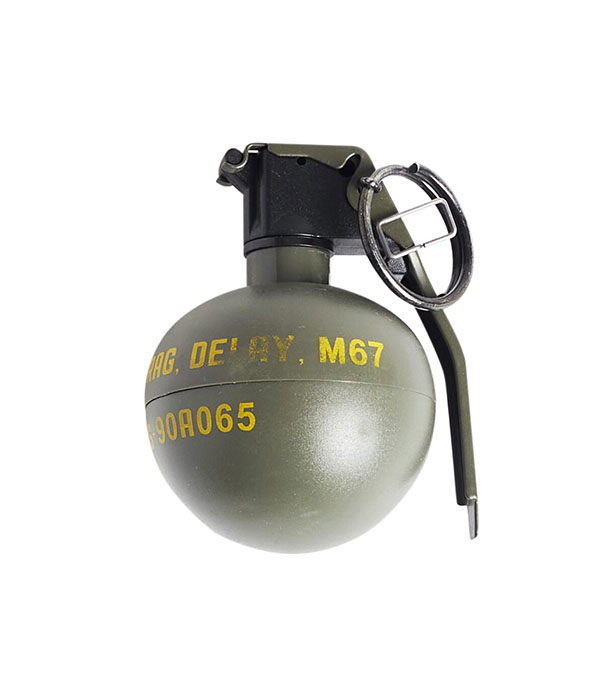 Got to throw two live ones in Army Basic training, that was fun! | |||
|
| Fighting the good fight |
Yep. The original "pineapple" MK1 frag grenade was introduced in 1917 and used during WW1, but wasn't very reliable. The upgraded pineapple MK2 came out right at the end of WW1 and was used through WW2 and into Korea. In the early 1950s towards the end of the Korean War they went to the lemon-shaped M26. This was eventually replaced by the spherical M33 in the mid-1960s, which was used through Vietnam to today after becoming the modern M67 when they added a safety clip and some more modern materials and manufacturing methods. So the iconic "pineapple grenades" haven't been in primary use since the early 1950s, though old stock continued in limited use through Vietnam. MK2 -> M26 -> M33 | |||
|
| Powered by Social Strata | Page 1 2 |
 | Please Wait. Your request is being processed... |
|
© SIGforum 2026