SIGforum
Question about rifle ballistics
January 26, 2026, 09:41 AM
OttoSigQuestion about rifle ballistics
Questions for yall that are smarter than me cause I know mane 1% about ballistics.
My FFL told me he was shooting coyotes from his back porch at about 200 yards and was dead on.
He said he moved upstairs to his heated bathroom and shooting out the window he missed the next six shots.
Ignoring the possible fact that he could have had an unlucky streak. How does shooting from elevation affect impact? Does it at that elevation?
Target area is completely flat and he was using a 6mm ARC rifle.
I’ll google this too but I was hoping someone could explain it to me like I’m five.
Eight years to retirement! Just waiting! January 26, 2026, 09:45 AM
smlsigI’ll defer to those smarter than me but in just thinking about it a 10 foot rise over a distance of 200 yards doesn’t seem to much of an angle difference when you’re trying to hit a yote size critter…
------------------
Eddie
Our Founding Fathers were men who understood that the right thing is not necessarily the written thing. -kkina
January 26, 2026, 09:47 AM
OttoSigOkay, should have googled first.
You impact high when shooting from elevation because drop on works for the straight distance, not the c2 distance.
I think I got my middle school equations still memorized.
Yall correct me if I’m wrong.
Still doesn’t seem like moving upstairs would make that much change. He must have just missed.
Eight years to retirement! Just waiting! January 26, 2026, 10:01 AM
egregoreBesides the elevation difference that requires a lower aiming point, there are other variables including, but not limited to, whether the target is moving.
"The Almighty, He put some livin' things on this earth so a man can eat." - Festus Haggen, Gunsmoke January 26, 2026, 10:15 AM
220-9erMaybe he was braced on a railing on the back deck and holding it in his hands at the bathroom window.
___________________________
Avoid buying ChiCom/CCP products whenever possible.
January 26, 2026, 10:21 AM
newtoSig765Range perception changes with elevation as well. A target viewed from above looks farther away than from level, and a target viewed from below looks closer. Your friend may have misjudged the distance, even at just 200 yards (approx) and over-compensated.
A WWII Luftwaffe tailgunner taught me this, and considering the source, it's one of those incidents I'll never forget!

--------------------------
Every normal man must be tempted, at times, to spit on his hands, hoist the black flag, and begin slitting throats.
-- H L Mencken
I always prefer reality when I can figure out what it is.
-- JALLEN 10/18/18
January 26, 2026, 10:25 AM
sigfreundI will reply at more length after I get my Internet service back, but I once calculated the effect of shooting at a target 100 yards above horizontal and distance of 400 yards. The point of impact difference between shooting at the upward angle and shooting horizontally was an inch or so.
“ One may protest against evil; it can be exposed and, if need be, prevented by use of force. … Against stupidity we are defenseless. … [R]easons fall on deaf ears; facts that contradict one's prejudgment simply need not be believed … and when facts are irrefutable they are just pushed aside ….”
— Dietrich Bonhoeffer January 26, 2026, 11:03 AM
gpbst3quote:
Originally posted by sigfreund:
I will reply at more length after I get my Internet service back, but I once calculated the effect of shooting at a target 100 yards above horizontal and distance of 400 yards. The point of impact difference between shooting at the upward angle and shooting horizontally was an inch or so.
Well this is clearly the exact opposite of the OPs question so I don't think you have an credibility here

So basically is negligible.
January 26, 2026, 11:15 AM
1860ARMYMuch depends on the bullet, the loading, the zero'd distance and the platform. For Yotes I'd be using a 55-60gr bullet going fast, if zero'd at 100 going to 200 might drop a couple inches-depending on above, BC, Density altitude, etc., going 10 feet up would have a negligible influence on the POA or drop.
60
January 26, 2026, 11:46 AM
LS1 GTOJust my opinion…
All things being equal at time of trigger pull (except for elevation difference), the miss(es) are on the shooter for a 200 yd shot. (Although i am basing this off of .270, 30.06, and .44mag rifle shots all hand loaded with scopes sighted in for 150 yds).
My analysis is not theoretical or mathematical but, real world.
Hunting rifles noted above are sighted in at a range with level horizontal targets and from a bench. Field shots are from raised stands approximately 12-18 feet off the deck with shots being from 100-250 yds and targets being deer - big and small. Deer shots are also from a rest on the stands.
I also shoot from a couple flat elevation stands.
Same results on all shots, dead deer though granted, deer are bigger than yotes so maybe that is the main factor?
Life moves pretty fast. If you don't stop and look around once in a while, you could miss it.
"If dogs don't go to Heaven, I want to go where they go" Will Rogers
The definition of the words we used, carry a meaning of their own...
January 26, 2026, 11:48 AM
BillyBonesNYConcur, shooting from distance of 10’ up isnt going to make much of a difference.
Maybe his range estimation isn’t accurate.
I’d like to know the caliber as well.
Temperature difference would also be a factor, I’ve seen some weird stuff with smokeless powder in really cold climes.
I’ve shot dear out of the upstairs bathroom window with a Ruger no 1, .270 at approx 150 yds, no discernible difference. That was many years ago.
January 26, 2026, 11:56 AM
kkinaI forget the technical explanation (at one time I could explain it), but yes, when shooting from an elevated position you have to aim low. The funny thing is that I believe you also must offset low when shooting at an elevated target (maybe someone can confirm).
ETA: Almighty AI says:
quote:
When shooting from an elevated position (downhill) or to an elevated position (uphill), you must aim low because gravity acts only on the horizontal distance, not the longer diagonal line-of-sight distance. The reduced horizontal distance means the bullet has less time to drop, resulting in a higher-than-expected impact.
The effect begins to have significance at around 200 yards.
January 26, 2026, 11:58 AM
fritzLet's start with the assumptions of the distance from the porch to the target is exactly 200 yards and the shooting position from the porch is exactly 200 yards. This is probably unlikely:
- The shooting position from the porch probably wasn't lazed. And you stated "about 200 yards".
- The shooting position from the 2nd floor window probably wasn't lazed.
- If the porch position was somewhere on the porch, the 2nd floor window position was behind (i.e. longer than) the porch position.
If the porch position was lazed at exactly 200 yards, assuming the higher shooting position was EXACTLY above the porch position, the bullet travel distance from the porch position would be 600.08 feet. But due to the way elevated position ballistics work, the bullet covers only 600.00 feet along the ground -- therefore no difference in vertical impact ballistics for either shooting position.
Now let's assume that the 2nd floor window position was more likely 5-10 yards rearward from the porch position. The minimal angle of the shot has insignificant effect on this scenario's flight ballistics. But the additional distance to target might result in lowering the impact by 1/4 to 1/2 inch -- the shooter would need to consult his dope table for specifics. A 6ARC bullet flies pretty flat at 200 yards.
If there was a noticeable crosswind at the time of the shot, the elevated position would almost certainly fly in faster moving air. That might increase the lateral bullet drift by an inch (maybe a little more of less) -- over the drift one would see from a shot from the porch.
My guess -- Shots from the porch were likely from a stable position, such as bench or prone. Shots from the window were likely from a barrier-type position, with only one portion of the stock supported by a solid object. To be blunt, most people really suck shooting from barrier-type positions. Missing a coyote-sized object at 200 yards from a barrier-type position is quite common. Most people just haven't developed the fundamentals to shoot a rifle from anything other than a benchrest, with uber solid front and rear supports.
By the way, there is a rifle-related section of SF for rifle-related questions.
January 26, 2026, 12:28 PM
sigfreundStill no Internet, but checking the figures for my example, the difference between shooting horizontally and at the 14 degree angle of the description is about 1.6 inch.
That was using the usual ballistics data for the 308 Winchester 168 grain Gold Medal Match load. For a flatter trajectory the difference would be less.
For common hunting distances and shooting angles concerns about up/down engagements are vastly overblown.
“ One may protest against evil; it can be exposed and, if need be, prevented by use of force. … Against stupidity we are defenseless. … [R]easons fall on deaf ears; facts that contradict one's prejudgment simply need not be believed … and when facts are irrefutable they are just pushed aside ….”
— Dietrich Bonhoeffer January 26, 2026, 12:50 PM
fritzquote:
Originally posted by sigfreund:
Still no Internet, but checking the figures for my example, the difference between shooting horizontally and at the 14 degree angle of the description is about 1.6 inch.
That sounds reasonable.
I plugged the OP's example into a web triangle calculation site.
- 10 feet vertical leg of the triangle
- 600 feet horizontal leg of the triangle
- 90 degree angle between vertical & horizontal legs
---- downward angle of .955 degrees from the elevated shooting position
January 26, 2026, 12:57 PM
egregore
January 26, 2026, 01:07 PM
KMitch200quote:
Originally posted by BillyBonesNY:
Concur, shooting from distance of 10’ up isnt going to make much of a difference.
Maybe his range estimation isn’t accurate.
I’d like to know the caliber as well.
OP stated that “about 200yds” so it’s a guess.
The caliber is 6mm ARC.
Using 4DOF with my gas gun velocity:
At 200 yds 6mm ARC has only 1.45 moa drop if sighted in 100.
A full value wind at 10mph is 0.79 moa
He just missed. (probably due to shooting from a barricade rest that fritz noted)
Any elevation change wasn’t the reason.
--------
After the game, the King and the pawn go into the same box.
January 26, 2026, 06:37 PM
sigfreundSome more explanation.
There are a couple/three factors involved in the question of whether shooting at an up or down angle requires us to aim at a different point than if shooting at a target on our same level.
The basic reason is that there are two (relevant) forces that affect the trajectory of a bullet. One is gravity, and the other is atmospheric drag. Gravity pulls the bullet down from its initial line of travel, and air drag slows the flight of the bullet so that it takes longer to travel any X distance during its flight. Modern ballistic solvers or even practical zeroing at different distances account for both factors.
The complication when a bullet is fired at an up or down angle from the horizontal is that although gravity acts on the bullet for the horizontal distance, air drag acts on the bullet for the distance it travels through the air. And if it’s traveling at an angle, that distance will be longer than the horizontal distance; it’s the hypotenuse of the right triangle pictured below.
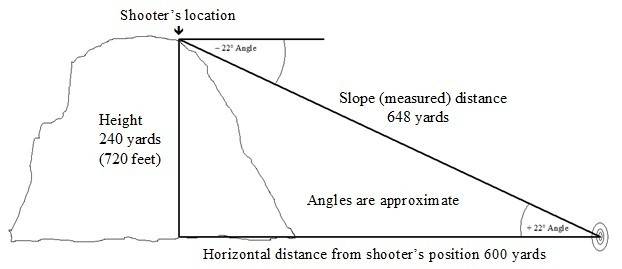
In the example the horizontal distance to the target from the shooter’s location is 600 yards, but the actual distance through the air is 648 yards. So, what happens if the shooter determines the range to the target as 648 yards by using a rangefinder or Mark 1 calibrated eyeball, and decides that’s the distance he should set his riflescope’s elevation for? Because the horizontal distance that gravity pulls on the bullet is only 600 yards, though, the 648 yard setting will be too high.
Well then, why not set the elevation for 600 yards? Ah, ha: Because the air drags the bullet for 648 yards, and if we set it for 600 yards, the bullet will hit low. What to do? The answer is that modern ballistic solvers, or perhaps our own extensive shooting experience in such situations will tell us the intermediate setting between 600 and 648 yards to use.
In traditional practice a hunter was more likely to know the actual angle distance to a target than the horizontal distance because he estimates the distance by eye or even with some sort of range indicator. If he uses that distance to estimate his aiming holdoff, that resulted in a bullet impact that was too high: Hence, the “Aim low” guidance. It’s also sometimes said that if we’re estimating a distance by eye, looking up or down at an angle makes us tend to overestimate the distance; that doesn’t make much sense to me, but perhaps it’s true.
But to return to the original question, a 200 yard horizontal distance and an elevation of a few feet on a porch would make virtually no measurable difference whether the horizontal or angle distance were used for aiming purposes. For all of what I discussed above to matter, the distances have to be significantly longer and the angle much greater.
If it’s a really high porch, for example, 21 feet (7 yards) above ground and the horizontal distance was 200 yards, the angle distance would be about 200.1 yards, or virtually the same as the horizontal distance. That tiny difference would have no meaningful effect on the point of aim. Using my 308 Win. GMM example above under “standard” atmospheric conditions, the difference in drop between 200 and 201 yards (not 200.1) is only 0.06 inch.
“ One may protest against evil; it can be exposed and, if need be, prevented by use of force. … Against stupidity we are defenseless. … [R]easons fall on deaf ears; facts that contradict one's prejudgment simply need not be believed … and when facts are irrefutable they are just pushed aside ….”
— Dietrich Bonhoeffer January 27, 2026, 07:13 AM
sourdough44All I know is as a hunter, the elevation thing is not a big deal for the most part. Yes, I type from the flatter Midwest.
To me, 15 feet higher on a 200 yard shot is less than a nothing burger.