
Go | New | Find | Notify | Tools | Reply | |
Age Quod Agis |
AOPA Article Textron halts Bonanza, Baron lines Factory support to continue November 21, 2025 By Jim Moore Eight decades after the Beechcraft Bonanza made its first flight, Textron Aviation confirmed production will soon end on the venerable six-seat single—along with the Bonanza's twin-engine piston sibling, the Baron. The Beechcraft Bonanza's historic production run will end when the final orders are filled, Textron Aviation confirmed via email November 20. The Beechcraft Bonanza's historic production run will end when the final orders are filled, Textron Aviation confirmed via email November 20. Photo by Chris Rose. A Textron Aviation spokesperson emailed a statement on the decision November 20, after pages for both piston models were removed from the company website: "As part of Textron Aviation's product investment plan, the company will end production of the Beechcraft Baron G58 and Beechcraft Bonanza G36 models once all current orders are fulfilled," the company said. "Known for their power and craftsmanship, the Baron and Bonanza aircraft have been cornerstones of the company’s leadership in the piston market for nearly eight decades. More than 6,000 Baron and 18,000 Bonanza aircraft have been delivered worldwide." General Aviation Manufacturers Association annual shipment reports show sales of both models slowed to a trickle in recent years—13 Bonanzas and 23 Barons were delivered in 2017 before deliveries of both models stopped cold during the COVID-19 pandemic: zero for 2021, the same year that Textron Aviation announced a seventy-fifth anniversary special edition Bonanza was available for delivery in 2022, with modern avionics and a retro color scheme. Just three Bonanzas (no Barons) were reported sold in 2022, followed by five of each model in 2023, followed by five Bonanzas and two Barons in 2024. Cirrus Aircraft, meanwhile, sold four-seat piston singles and seven-seat jets by the dozens, or even hundreds, year after year. American Bonanza Society Air Safety Foundation Executive Director Tom Turner wrote that Textron Aviation has assured his organization that Textron will continue to provide parts and engineering support for both models. "With continued parts support from Textron Aviation, the large aftermarket that has grown around the product line over the decades, the passion of Beech owners, and the support of the American Bonanza Society and the ABS Air Safety Foundation, Bonanzas, Debonairs, Barons and Travel Airs still have a long and bright future," Turner wrote. The original Model 35 Bonanza first flew on December 22, 1945, the manifestation of Walter Beech's desire to apply the military aeronautical advances achieved during World War II to a civilian model that had six seats, boasted superior speed, and "cut a swath through general aviation like a timeshare salesman through a clutch of snowbirds," according to AOPA's aircraft guide. Derivatives included the Model 33 Debonair introduced in 1960, and a military version adapted for surveillance missions during the Vietnam War, the QU–22B Pave Eagle, which married a Bonanza fuselage to the wings and landing gear of a Baron. Earthrounder Adrian Eichhorn circumnavigated east-west in 2016, and flew over the north pole in 2021 in his P35 Bonanza. He also mentored fellow earthrounder Shinji Maeda, who flew a nearly identical Bonanza around the world east-west that same year. The Baron marked 50 years in production in 2010 (four years before Beechcraft was acquired by Textron) with an anniversary edition of the G58 that featured Garmin avionics and optional weather radar, since the nose was not occupied by an engine or propeller. Aviation writer Pete Bedell credited the Baron's impressive longevity to a design that "simply works." "If you need to move four people and their gear 600 nm in three hours, there are several airplanes to meet the mission," Bedell wrote. "But do they have twin-engine redundancy and its resulting reassurance, known-ice capability, weather radar, the ability to get in and out of short/unimproved airstrips, or a service network that consists of, say, basically any mechanic in the country? For these reasons, there has been a Baron in the lineup at Beechcraft for five decades." AOPA more recently used another Baron to demonstrate unleaded fuel alongside traditional avgas. The company statement described the discontinuation of the last two Beechcraft piston models as a "strategic shift" that "will enable Textron Aviation to focus on welcoming the [single-engine turbine] Beechcraft Denali to its product portfolio while thoughtfully assessing future investments within this segment." "I vowed to myself to fight against evil more completely and more wholeheartedly than I ever did before. . . . That’s the only way to pay back part of that vast debt, to live up to and try to fulfill that tremendous obligation." Alfred Hornik, Sunday, December 2, 1945 to his family, on his continuing duty to others for surviving WW II. | ||
|
Political Cynic |
Sad news but inevitable. In my former life as an A&P and avionics guy I worked on a lot of Beechcraft. | |||
|
Member |
Oof, closing down two long enduring workhorses to focus production on a multi-million dollar turbine. I don't know what the order list for the Bonanza and Baron looks like these days, but I guess we'll see how that works out. "The people hate the lizards and the lizards rule the people." "Odd," said Arthur, "I thought you said it was a democracy." "I did," said Ford, "it is." "So," said Arthur, hoping he wasn't sounding ridiculously obtuse, "why don't the people get rid of the lizards?" "It honestly doesn't occur to them. They've all got the vote, so they all pretty much assume that the government they've voted in more or less approximates the government they want." "You mean they actually vote for the lizards." "Oh yes," said Ford with a shrug, "of course." "But," said Arthur, going for the big one again, "why?" "Because if they didn't vote for a lizard, then the wrong lizard might get in." | |||
|
| Thank you Very little  |
The end of the Doctor Killer... | |||
|
| Savor the limelight |
From the article in the first post  : :“Just three Bonanzas (no Barons) were reported sold in 2022, followed by five of each model in 2023, followed by five Bonanzas and two Barons in 2024.” | |||
|
| No More Mr. Nice Guy |
That was the V-Tail, aka the "Forked Tail Doctor Killer". | |||
|
אַרְיֵה |
My 3,000+ logged hours in the series includes more than 1,200 hours as instructor. Two of the safest pilots, and one of the scariest (so both ends of the distribution curve) pilots I instructed, were doctors. Mine, for more than thirty years: 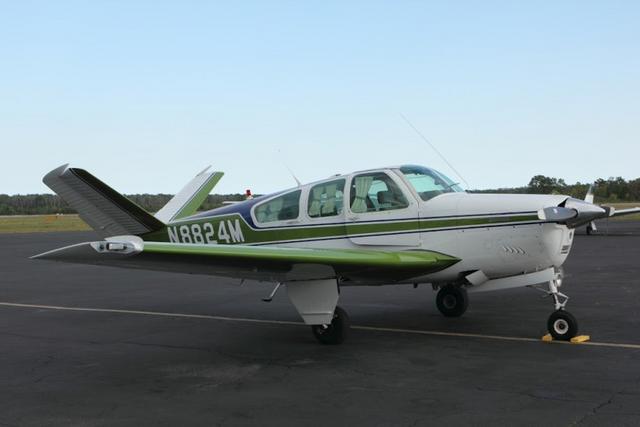 הרחפת שלי מלאה בצלופחים | |||
|
Member |
^^^^
I love the color, V-Tail. Very good looking aircraft. | |||
|
| Ice age heat wave, cant complain.  |
LR, this doesn't mean you can change your handle. NRA Life Member Steak: Rare. Coffee: Black. Bourbon: Neat. | |||
|
| Thank you Very little |
Early Bonanzas had the V-Tail, and being more expensive the buyers were affluent and typically Doctors. It killed quite a few, not because it was a bad design but because it wasn't that forgiving of not being safe, plane was considered a hot rod of the air... We had a Piper Seneca III for a while, similar, a bit faster on paper, hired a pilot who knew how to fly,  | |||
|
| אַרְיֵה |
The Bonanza is very clean, aerodynamically -- low drag, so just a wee bit of nose down and it really accelerates. Airspeed can build very quickly to red line (never exceed). High airspeed -- higher than the airplane was designed to fly at -- can lead to control surface flutter, much like "death wobble" on a motorcycle. Recovery from high airspeed, while not difficult, is counter-intuitive, and must be taught. Part of the training curriculum for pilots transitioning into the Bonanza family, as well as recurring proficiency training, is recovering from high airspeed. Not hard to do, but should be practiced with an experienced instructor until the correct sequence becomes an automatic response. הרחפת שלי מלאה בצלופחים | |||
|
| Knows too little about too much  |
Sad. A Baron saved my life in 1980. RMD TL Davis: “The Second Amendment is special, not because it protects guns, but because its violation signals a government with the intention to oppress its people…” Remember: After the first one, the rest are free. | |||
|
Member |
I've owned this IO-550 powered 1970 V-tail for 4 years, and is my last airplane. 40 years ago I had a 56TC Baron that ate me out of house and home, but the V-tail is perfect for this old man - 75 years young tomorrow. 180 KTAS cruise @13.5 gph, 120 gallons on board with the tip tanks.   | |||
|
Member |
Lovely paint scheme, aileron The Enemy's gate is down. | |||
|
| Ammoholic |
I think you mean the end of the Forked Tailed Doctor Killer. Beech hasn’t been building V-Tails for a while now though. | |||
|
| Member |
The last V-tail was a 1984 model built in 1983 | |||
|
| Member |
What does the V tail vice traditional form mean in terms of flying qualities? Does the v tail require more vigilance? V Tail mentioned the counter intuitiveness of recovering from an overspeed. I have no idea what that means. I’ve instructed at a bunch of levels and what I consider intuitive is to reduce power and raise the nose while not over stressing the aircraft. That also means rolling wings level so you don’t do a rolling pullout and rip a wing off. | |||
|
| אַרְיֵה |
Not really. Bonanzas were manufactured in three series: 33, 35, and 36. 35 is the v tail, 33 is basically same airplane with conventional tail, and 36 is essentially a stretched 33. Differences in flight characteristics between the three types are minor. The typical situation is a descending spiral with increasing bank angle and airspeed. Step 1 is, as you said, reduce power and roll wings to level. Next, is the counter-intuitive part. The airspeed is too high, and when the wings are rolled level, the airplane wants to return to previous trimmed airspeed. This means that the trim system will raise the nose. If the pilot does the intuitive thing and applies back pressure, the combination of pitch trim and pilot input can easily be result in an excessive G load and cause parts of the airplane to depart; not A Good Thing! The American Bonanza Society's BPPP (Bonanza Pilot Proficiency Program) teaches that after reducing power and rolling wings level, enough forward pressure (there's the counter-intuitive part) should be applied to the yoke, to control the rate at which the pitch trim will raise the nose while returning to the previously trimmed airspeed. This, of course, reduces the G stress on the airframe. הרחפת שלי מלאה בצלופחים | |||
|
| Rumors of my death are greatly exaggerated  |
Sad to see them go. Such a nice solid bird. "Someday I hope to be half the man my bird-dog thinks I am." looking forward to 4 years of TRUMP! | |||
|
| Powered by Social Strata |
 | Please Wait. Your request is being processed... |
|
© SIGforum 2026