
Go | New | Find | Notify | Tools | Reply | |
| Member |
OK, weird question. I have a 1959 Impala that I started to restore back in high school. In 1987 or so, we used what I remember to be O Henry's roofing tar to seal up the bottom when we had the body off the frame. Don't laugh. We didn't have a budget or experience for that matter. Fast forward to today. I'm having real reproduction floor pans welded in where our old metal/fiberglass patches were installed in the few rusted out spots. Once the welder is done, I think I'm going to remove all the old tar off, clean the surface and then apply a GM red oxide or modern undercoating. When this roofing tar has come in contact with gasoline, it breaks down and smears. My guess the gas is sufficiently strong to "melt" or smear the tar. If I want to remove the tar (think 6' x 10' area), what's the best way? 1) Spray bottle with gasoline, spray and let is soak and soften, scrap away? 2) Blow torch/controllable flame thrower to soften or loosen tar, scrap away? 3) What level of mask do I need so I don't get lung cancer in six weeks? Yes, the gas tank has been removed, the fuel lines blown out, and the fuel pump at the engine block has been capped off. Thoughts? P229 | ||
|
Void Where Prohibited |
I've had good results removing tar with acetone. You need to wear gloves and have adequate ventilation. "If Gun Control worked, Chicago would look like Mayberry, not Thunderdome" - Cam Edwards | |||
|
fugitive from reality |
Whichever choice you make be it gasoline or acetone the cartridge filter you need is the P100 particulate filter with OV (organic vapor) capability. Edited because my spelling sucks.This message has been edited. Last edited by: SgtGold, _____________________________ 'I'm pretty fly for a white guy'. | |||
|
| Member |
Ok. Thanks. I’ve got the car in a single car garage, good ventilation and a box fan. The car is on a lift too, so that helps. I pretty sure acetone is stable and safe in an heavy duty spray bottle. I see some good 3M P100 filters. Thanks P229 | |||
|
Don't Panic |
I don't know why, but I did Google "is tar flammable" when I read idea 2. | |||
|
| Member |
Methyl ethyl ketone MEK and a good putty knife The above precautions of gloves, ventilation, and a respirator would apply with it too | |||
|
| Member |
Always used mineral spirits to clean up after a roofing patch job. | |||
|
Fighting the good fight |
Same, though that is new tar, not 40 year old tar. I'd start with basic mineral spirits or acetone and a putty knife, and up it to MEK if that's not cutting it. | |||
|
| Member |
As an overnight thought, would a sand blaster work? Some people use them in the repair process for rusted floor panels before welding new ones in place. Might be faster for a large area. Would cut risk of fire. | |||
|
| Member |
Sig Op, the car is on the road after our amateur restoration from 1986 to 2000. My recent efforts to replace the floor pans was the only rust issue with the car. At this point, sand blasting doesn't seem like a good idea. The roofing tar is entirely adequate for my fair weather use. With the new floor pans, I have to cover them with something. Should I just spray those areas with something more modern? Or do I strip all of the old tar then paint the entire bottom of the car with GM red oxide? I did a quick test patch this morning. Acetone doesn't do much damage Gas does a better job. Both however do not cause bubbling like painter stripper on paint. With the acetone and gas, I had to rub and scrub, slowly peeling small layers of tar before I got to bare metal. Doable but not ideal. I may use the wire wheel, which is what I use in prepping for the new floor pans. To be continued. I may grab some MEK. P229 | |||
|
| Thank you Very little  |
Think I'd take a scraper to the bottom, see what comes off, then as others said any petroleum based product should help soften it up. I'd get some plastic painters sheets from Home Depot or Lowes, cover the floor with them and just scrape it off and let it fall, then clean up will be as simple as rolling up that painters plastic sheets. | |||
|
| Eating elephants one bite at a time  |
Possibly captain obvious here, but sparks and flammable materials such as the vapors you might get opt to work with could go WHOOSH! Please be careful. | |||
|
| Member |
I would use a heat gun and a scraper to remove as much as possible Then you can experiment with your solvents. | |||
|
| Member |
I like this idea! P229 | |||
|
| Member |
Dry ice? No experience with Tar, dry ice could be less messy and yet equally oxygen depriving! ___________ ___________ ___________ | |||
|
| Thank you Very little |
Videos on this seem to make the process a very promising alternative to scraping and brushing since it's not damaging to the metal and removes all the rust, dirt and other things stuck to the bottom of an older car. Might see if there is a service in the area and will it remove the tar. | |||
|
| Shit don't mean shit |
My go-to for removing stuff from my old cars (I have several) is my Makita 4.5" angle grinder and a wire wheel. Not a sissy wire wheel either, one of these.... 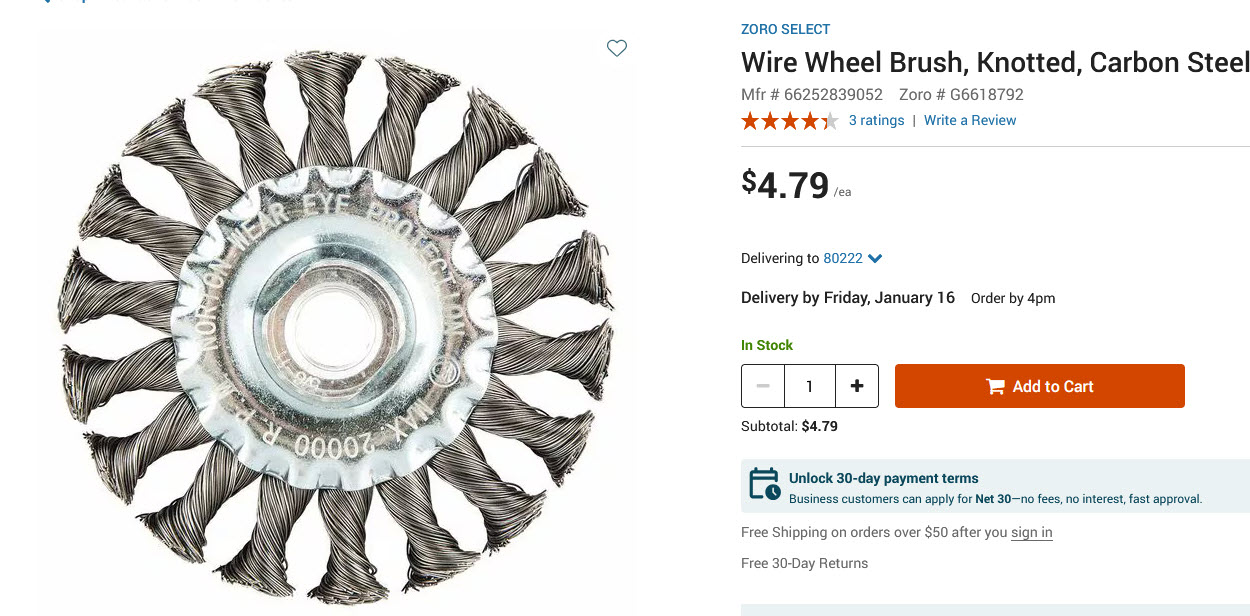 | |||
|
| Member |
Goat, I used the wire wheel brush to remove the tar around my patchwork so that the original, healthy metal would be exposed for the welder. It worked great but flung millions of tar boogers everywhere (ask my wife about our light colored sofa I sat on after I showered). It would be idea, but may not reach everywhere. I tried the heat gun. Effective but really slow. It was only 1200W. I think at this point, I'm resigned to just let it be. It's held up nicely for 37 years and shows no sign of peeling off, hiding rust or other negative side effects. So, I'm gonna leave it along. On the new bare metal from the new pans, I'm gonna use a nice rubberized coating from an aerosol can. On the topside, I'll use POR-15 on the lone surviving driver side front pan that is rusty but solid. Then I'll spay the interior floor with rattle can GM red oxide. If this was a show car, I'd be concerned. But since I'll never sell, this will be just fine. P229 | |||
|
| Saluki |
I’m joining the “no good reason to strip it all off” clan. Unless this is going to be a concours restoration project you are just borrowing problems. Just shoot the new metal with your favorite preservative paint, then try to match the majority with color, he’ll see if the GM stuff can be tinted close enough. I recently bought a classic, in looking at many candidates, most were undercoated with what could pass for “tar”. It covered many flaws I'm sure, but looked nice enough at the same time. ----------The weather is here I wish you were beautiful---------- | |||
|
| Powered by Social Strata |
 | Please Wait. Your request is being processed... |
|
© SIGforum 2026