Water in outboard oil - 04/06/2025 Final Update bottom p3
quote:
Originally posted by trapper189:... ...
"My milkshake brings all the mechanics to the yard..."
"the meaning of life, is to give life meaning" ✡ Ani Yehudi אני יהודי Le'olam lo shuv לעולם לא עוד
December 27, 2025, 09:22 PM
egregore
After the engine is run, check the oil not only as soon or as feasible afterwards, but after it has sat for at least a few hours.
"The Almighty, He put some livin' things on this earth so a man can eat." - Festus Haggen, Gunsmoke
December 29, 2025, 08:36 AM
trapper189
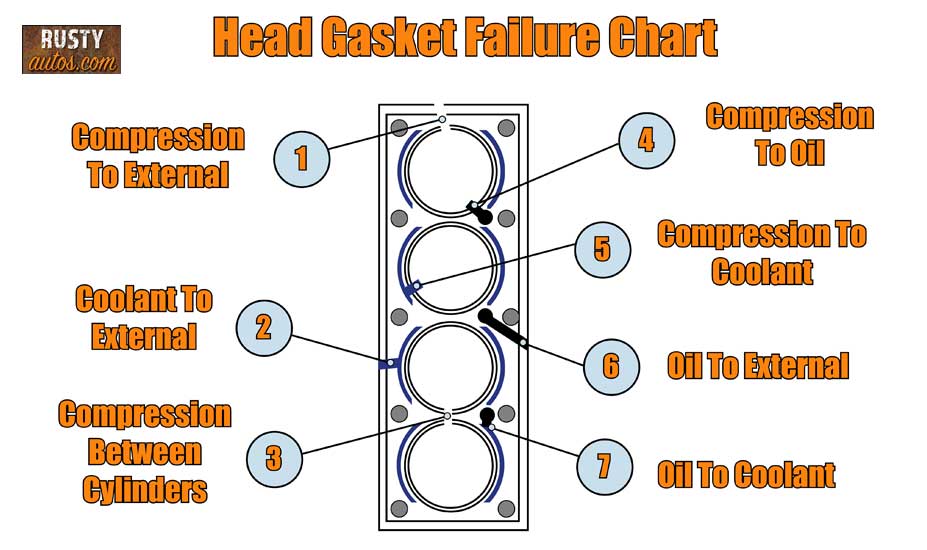
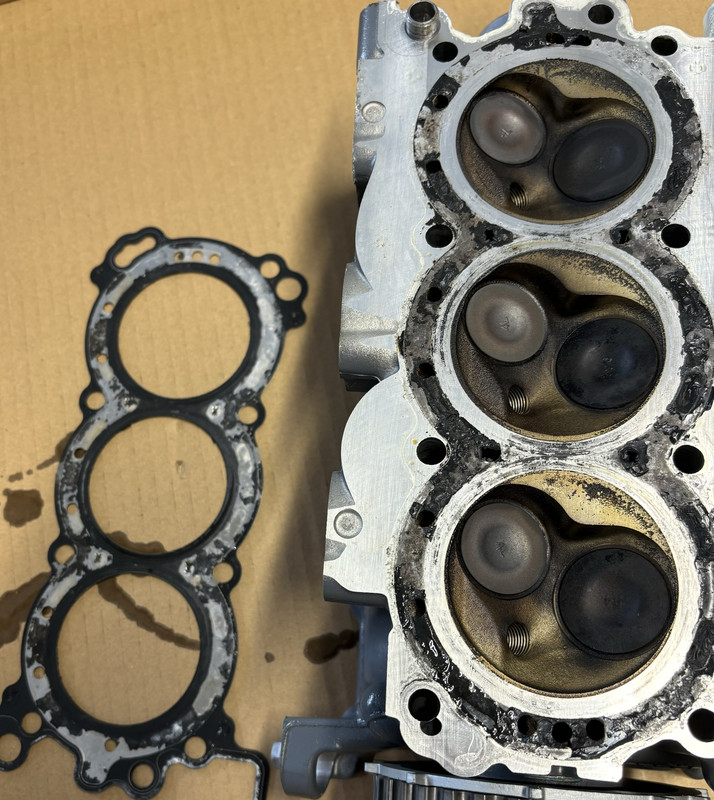
^^^That graphic is great! I really thought it was going to be useful once I pulled the head. Here’s what my gasket looks like:
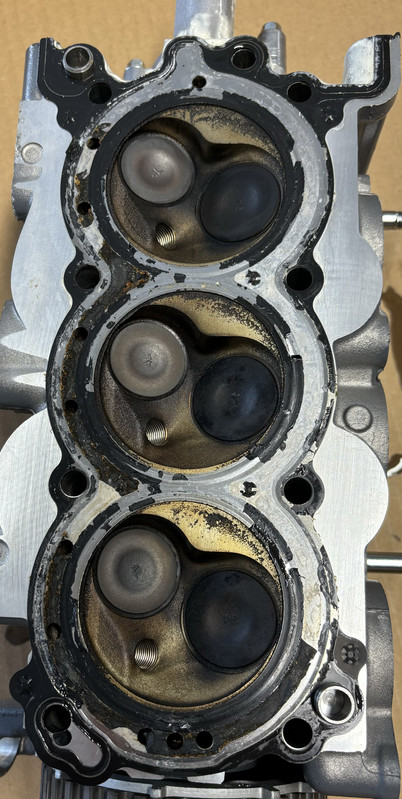
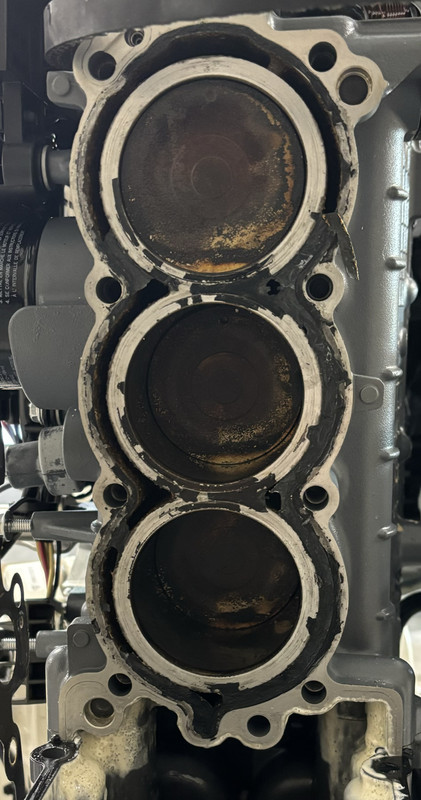
The only thing I can tell for sure by looking at my head gasket is that I shouldn’t reuse it. I’m in new territory here, so I have no clue what I’m looking at. The cylinder walls look good though; beautiful cross hatch pattern and no scoring.
We’re going to clean up the mating surfaces later today. Probably going to order a machinist’s straight edge to see if the head is warped. Seems like a substantial casting compared to a two stroke head.
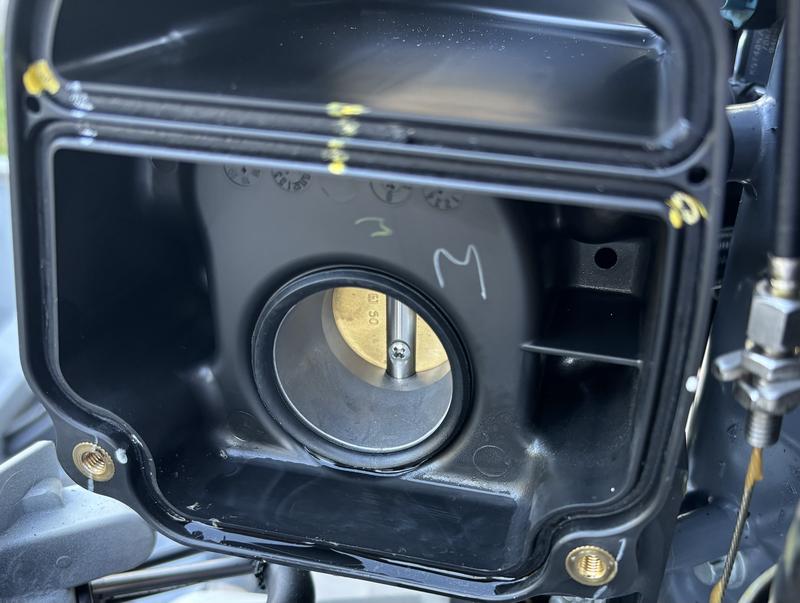
My son said smoke, probably steam, was coming from the back of the engine cover where air gets sucked into the intake. There was a pool of water when I separated the air filter housing from the throttle body. There was nothing unusual around the exterior perimeter where the head mates with the block.
We would have had it off last night, but the tools I bought my son didn’t have an 8mm 12 point socket for the cylinder head bolts. We read the service manual, then skipped half the steps. The service manual said remove the flywheel, stator, camshaft, and the entire powerhead, before separating the head from the block. I couldn’t see any obvious reason to do all that other. Hopefully it doesn’t bite us in the ass.
quote:
Originally posted by sigmonkey: "My milkshake brings all the mechanics to the yard..."
Never heard that song until now.
December 29, 2025, 09:36 AM
4MUL8R
I'm thinking you are both wise and brave to attack this. If you can take that head to a trusted engine machine shop, I wonder if they would do a very very small skim across the head? As long as they properly referenced the flat surfaces as 90 degrees apart, I bet they could make it look like new.
Do you have the torque specs? Do you have the bolt torque order? Do you have the very nice digital torque wrench? Are the bolts "torque to yield" and one use only? Sometimes they are, sometimes they are old-fashioned.
You all may need to carefully brace the motor to withstand this high torque, if you haven't already removed it from the transom.
At Mercury Marine engine plant, they put all the bolts in at once! Crazy assembly tooling machinery.
------- Trying to simplify my life...
December 29, 2025, 09:43 AM
smlsig
quote:
Originally posted by 4MUL8R: I'm thinking you are both wise and brave to attack this. If you can take that head to a trusted engine machine shop, I wonder if they would do a very very small skim across the head? As long as they properly referenced the flat surfaces as 90 degrees apart, I bet they could make it look like new.
Do you have the torque specs? Do you have the bolt torque order? Do you have the very nice digital torque wrench? Are the bolts "torque to yield" and one use only? Sometimes they are, sometimes they are old-fashioned.
You all may need to carefully brace the motor to withstand this high torque, if you haven't already removed it from the transom.
At Mercury Marine engine plant, they put all the bolts in at once! Crazy assembly tooling machinery.
I agree. Cleaning the heads and verifying they are dead flat are critical in addition to what 4mul8r says.
------------------ Eddie
Our Founding Fathers were men who understood that the right thing is not necessarily the written thing. -kkina
December 29, 2025, 09:50 AM
trapper189
I wounldn’t say brave. I figure I have an engine that’s not useable and would be cost prohibitive to have someone else fix. The worst I can do is waste some time and a couple hundred bucks taking a crack at it.
I do have the torque specs and patterns for everything I done so far. I have a good ($150) torque wrench in the correct range, not digital, but the bolts are not torque to yield. It didn’t take much to loosen them and looking at the service manual the final torque is 22lb-ft.
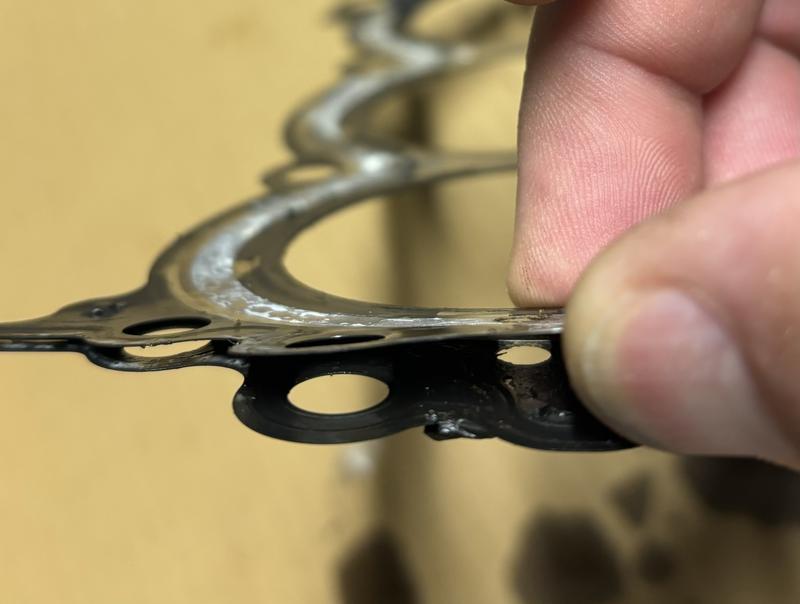
New question: how many layers is a head gasket supposed to have?:This message has been edited. Last edited by: trapper189,
December 29, 2025, 10:13 AM
nhracecraft
^^ It depends. Multi-layer gaskets do exist and designs vary by application and/or manufacturer. They can (and often do!) separate when removing the head. You 'may' find the the point of failure somewhere in there though.
When reassembling the motor, cleanliness of the block and cylinder head mating surfaces is paramount, as are properly torquing the head bolts in the proper sequence! This will be a good learning experience for your son. Service manuals are a great resource (especially for torque specs and torque sequences!), however they generally only provide info on what to do (usually in what order), but NOT how to do it. I always tell people, the most important skill of a good mechanic is paying enough attention when you took it apart so you can remember how to put back together properly, hopefully with NO spare parts! That and cleanliness, cleanliness, cleanliness!
Good luck identifying/resolving your issue. More importantly, have fun doing it with your son!
If Some is Good, and More is Better.....then Too Much, is Just Enough !! Trump 47....Making America Great Again! "May Almighty God bless the United States of America" - parabellum 7/26/20 Live Free or Die!
December 29, 2025, 11:43 AM
sigmonkey
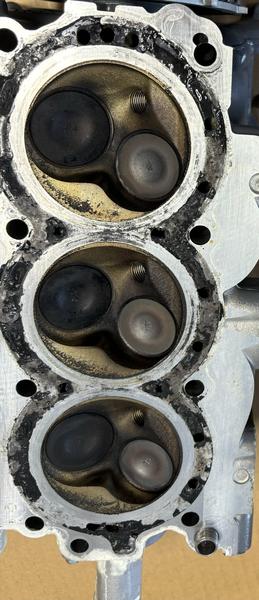
Typically, if there is water entering the combustion chamber, it will have a "cleaning effect" in that/those cylinders. (water, methanol/water, and/or petroleum distillates is a main method of cleaning without disassembly.
The affected holes will have clean combustion chamber/valve faces, piston dome.
Leaking from coolant/water jacket into oil passages/sump will create the milkshake, and may not have entered any cylinder(s), and can be from cracked head, block, head gasket, intake gasket, or even induction (swamping in a boat or vehicle through water, high speed, off roading)
Looking at the head, I would rule out anything entering the cylinders, but gaskets or crack in block would be the focus.
Almost certain if there was a lot of water in the air induction area, that it may have swamped that are.
Is there any venting/crankcase breather other than the induction where steam from the crankcase from moisture would be in the area of that engine cover?
If not, that leads to asking if they think it may have had a "big drink" while they were out boating. (part of boating is learning what not to do when boating)
I'd clean, inspect what I could, put it together and take it out, stay near the marina and put it through the test.
"the meaning of life, is to give life meaning" ✡ Ani Yehudi אני יהודי Le'olam lo shuv לעולם לא עוד
December 29, 2025, 01:59 PM
trapper189
quote:
Is there any venting/crankcase breather other than the induction where steam from the crankcase from moisture would be in the area of that engine cover?
There is. I don’t have a good picture of it, but there’s a large, 5/16 maybe 3/8 ID, hose going from the top of the cylinder head cover (valve cover in non-marine terms) to the back of the air cleaner housing. Also, the runner that goes from the hole in the back of the engine cowling to the air cleaner housing that feeds fresh air. This is the water: Nothing after the throttle body was wet though; each intake runner is at least 10” long. I taste tested it and it wasn’t saltwater.
I have a theory that works with the steam cleaning and the point where the head gasket is separated:
In the picture, the head’s entire mating surface is evenly coated with black residue from the head gasket which matches up with the water jacket around the cylinders themselves in the block except for the two points at the bottom by the two bottom cylinder head bolt holes. The third hole in the middle is an oil passage between the head and block. The part of the head gasket where the two layers of steel separated was between those two head bolt holes.
I’m thinking once they put the flush port plug back in and restarted the motor, then as the block started to fill with water, some of the water turned to steam and the pressure shoved the water at the bottom through the head gasket at that point right into the oil sump. Condensed steam would also explain the puddle of freshwater in front of the throttle body.
On another note, the local Suzuki marine dealer had the head gasket in stock. They had to retrieve it from a bin stored in the attic, but they had one. It is two layers of steel.
Part of me wants to slap the whole thing back together. The other part of me says order the machinist’s straight edge, wait until it get’s delivered, and then make sure the head isn’t warped.
December 29, 2025, 02:07 PM
pbslinger
3M roloc pads are good for cleaning without damaging the surfaces. Instead of buying a machinist straight edge, consider gluing a sheet of fine wet or dry on a piece of glass and making a few swipes to indicate flat.
December 29, 2025, 02:09 PM
HRK
Got a nice glass table in the house?
Set the head, once cleaned, on that table, see if it wobbles or doesn't go flat on the glass, at least as a check before you slap it together.
December 29, 2025, 02:53 PM
trapper189
The best I can do is a piece of the quartz kitchen counter.
The service manual says no more than .002” both ways diagonally or on each of the four sides. It also says use 400 grit wet on surface plate to bring it to spec.
December 29, 2025, 03:33 PM
powermad
quote:
Originally posted by pbslinger: 3M roloc pads are good for cleaning without damaging the surfaces. Instead of buying a machinist straight edge, consider gluing a sheet of fine wet or dry on a piece of glass and making a few swipes to indicate flat.
At my shop, Iron block and heads are first scraped with a carbide scraper followed by stones, I have various sizes. Cat, Volvo, Cummins and PACCAR will reject warranty claims if they have been hit with a 3m disk.
About 30 years ago I ran a disk over a Honda block. Fired it up and shot coolant to the ceiling. Wound up buying that one a new block and ton of extra work.
3m rol-loc disks will also remove the surface finish. Those machining marks are not just tooling marks but a specified surface finish for a gasket seal.
December 29, 2025, 03:59 PM
pbslinger
quote:
Originally posted by powermad:
quote:
Originally posted by pbslinger: 3M roloc pads are good for cleaning without damaging the surfaces. Instead of buying a machinist straight edge, consider gluing a sheet of fine wet or dry on a piece of glass and making a few swipes to indicate flat.
At my shop, Iron block and heads are first scraped with a carbide scraper followed by stones, I have various sizes. Cat, Volvo, Cummins and PACCAR will reject warranty claims if they have been hit with a 3m disk.
About 30 years ago I ran a disk over a Honda block. Fired it up and shot coolant to the ceiling. Wound up buying that one a new block and ton of extra work.
3m rol-loc disks will also remove the surface finish. Those machining marks are not just tooling marks but a specified surface finish for a gasket seal.
Disregard my bad advice. Thanks.
December 29, 2025, 04:49 PM
powermad
I do keep ones that have been used up and they are more a buffer wheel for light stuff at slow speed.
I have a 2" cup brush that I use with the speed turned down for most general cleaning, depending on what it is.
December 29, 2025, 05:16 PM
trapper189
This is aluminum on whopping 30 cubic inch, 3 cylinder, 30hp, 4-stroke, gas motor. It’s not a particularly high performance engine.
On another note, I don’t think my son’s mistake caused the problem, but rather exacerbated an already existing one. I didn’t mention it because I didn’t think it was related, but it’s been losing a bit of oil the last five time we used it before the flush plug incident. With no signs of external leaks, I figured it was burning the oil. Given the split part of the head gasket and clean spots on the cylinder head being adjacent to the pressurized oil passage between the block and head, I’m thinking the oil was being flushed out with the raw water cooling.
December 29, 2025, 06:04 PM
HRK
quote:
Originally posted by trapper189: This is aluminum on whopping 30 cubic inch, 3 cylinder, 30hp, 4-stroke, gas motor. It’s not a particularly high performance engine.
If it sits level on the spare piece of quartz then I'd scrape it with a plastic scraper, wipe both surfaces clean and pop it back together with the head gasket you bought.
Worse case is it's not the issue, and you either have to get a new engine or have it rebuilt.
Which is where you are now....
December 29, 2025, 06:36 PM
c1steve
Definitely do use a rotary tool for cleaning. Do it by hand, often with an abrasive cloth or paper wrapped around a very flat surface. I start if with razor blades, then go to Scotch Bright pad from 3M.
-c1steve
December 29, 2025, 06:37 PM
6guns
^^^ I agree with HRK.
If I read correctly before, the max out of flatness is .002", which I wonder if you'd be able to detect with naked eye. Regardless, I'd put it back together making sure all the surfaces are completely clean.
This may sound weird, but when I've done precision assembly in the past, I found my bare CLEAN finger the best way to clear any minute particles from surfaces...remembering to wipe often with a lint free clean rag. I'm specifically thinking about assembly of high pressure fuel injection pumps on a Sulzer slow speed diesel engine. There was no room for error.
SIGforum: For all your needs! Imagine our influence if every gun owner in America was an NRA member! Click the box>>>
December 30, 2025, 01:23 PM
trapper189
I don’t think I can see .002” anymore if I ever could. I ordered a straight edge yesterday and it should be here today. I’ve done clutch covers on motorcycles, but those aren’t that critical. I might have a 25 year old tube of Yamabond in a drawer somewhere.
Update: Got home and the machinist’s straight edge and feeler gauges were on the porch.
...

 This message has been edited. Last edited by: trapper189,