July 31, 2026, 08:56 AM
chellim1quote:Originally posted by sourdough44:
I’m still waiting for the Government grocery store. I want to buy eggs for 50 cents a dozen.
About that grocery store...
A Wolf In New York City Mayor's Clothing
Submitted by QTR's Fringe Finance
Zohran Mamdani may be the most effective and dangerous wolf in sheep's clothing American politics has produced in years.
Beneath the polished charm and social-media-friendly persona is a grotesque combination of noxious policy ideas, delivered with snake like charm and layered with what feels like an outright hatred for success, individual liberty, free enterprise, private property, and many of the principles that helped make this country prosperous in the first place.
Mayor BigBrain™ was in the news twice this week. First, he came under fire after “effectively doxxing thousands of wealthy New Yorkers”, according to the New York Post when the city published a database identifying hundreds of thousands of property owners who could potentially be subject to his proposed pied-à-terre tax.
But perhaps taking a cue from the Soviet Union’s infamous “kulak” lists, where relatively prosperous peasants were identified, labeled as class enemies, and ultimately targeted for confiscation, deportation, or worse, the database reportedly included many people who may never owe the tax at all, including primary residents and tax-exempt diplomatic properties.
That raises an obvious question: why did City Hall feel the need to publicly compile and spotlight property owners before determining who would actually be subject to the proposed tax?
Then came Mamdani’s proposal for city-owned grocery stores selling staple goods at roughly 30% below prevailing retail prices. Here’s a widely circulated photo of Mamdani holding bananas with a giant “30% off” sticker plastered on them, which makes about as much sense as the proposal itself.
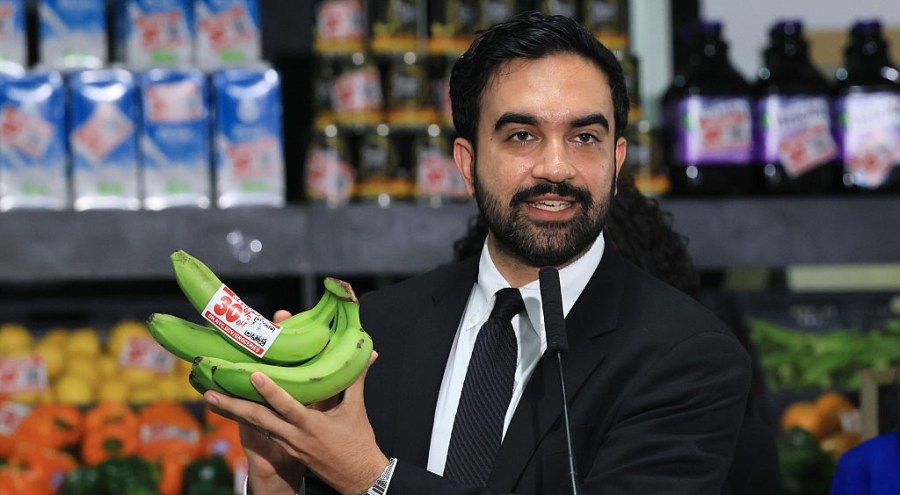
Three bananas cost about $1 from countless fruit vendors across New York City, whether you’re in a wealthy neighborhood or a working-class one. If bananas are supposed to be the poster child for a government-run discount grocery program, it’s hard to see what problem is actually being solved.
Under the proposal, the city would open five taxpayer-backed grocery stores, one in each borough, selling a fixed basket of staple goods at an average of 30% below prevailing retail prices through public subsidies. City Hall estimates households could save roughly $1,000 a year, but it has yet to explain exactly which products would qualify, how the discounts would be calculated, or what the total cost to taxpayers would be. Also, they are referring the “households” getting the discounts, not the ones ultimately paying for the discount via taxation.
Critics argue the plan would unfairly force neighborhood bodegas, fruit stands, and independent grocers, many of which already sell inexpensive staples like bananas, to compete against government-subsidized stores operating below market prices.
Just like many of his taxation-based ideas, the proposal could end up hurting many of the very New Yorkers it claims to help. Across the city, countless neighborhood bodegas, family-owned grocery stores, and fruit vendors (many operated by immigrants who have spent years building small businesses) already compete on razor-thin margins while providing affordable food in their communities.
If the government begins subsidizing its own stores to sell staple goods below market prices, those independent businesses would be forced to compete against an entity backed by taxpayer dollars rather than normal market forces. Instead of strengthening neighborhood commerce and expanding opportunity, the policy risks pushing hardworking entrepreneurs out of business while replacing private enterprise with a government-run alternative.
Questions that have not been answered clearly include: Which products qualify? How much selection will there actually be? How much will taxpayers ultimately spend to keep the stores afloat? And perhaps most importantly, why should privately owned grocery stores have to compete against an opponent with an unlimited line of credit backed by New York taxpayers?
Viewed individually, each proposal can be defended by its supporters. Viewed together, they paint a much more revealing picture. Neither proposal is really about groceries or luxury apartments. They’re about expanding government’s reach into virtually every corner of economic life.
The grocery plan begins with the assumption that high prices aren’t primarily the result of supply constraints, regulation, taxes, labor costs or New York’s notoriously difficult business environment. Instead, the solution is for City Hall to become a supermarket operator. Rather than making it easier for private businesses to compete, government simply decides to compete against them. With your money.
This is the sort of idea that sounds terrific in a campaign speech but becomes considerably less inspiring once someone has to explain where the subsidies come from, how losses are covered and what happens when politically connected interests begin deciding which neighborhoods, products and suppliers deserve preferential treatment.
Markets certainly fail. Governments, however, have assembled a Hall of Fame career in doing exactly the same thing, except with other people’s money. A privately owned grocery store that continually loses money eventually closes its doors. A government grocery store simply requests another appropriation. Failure doesn’t disappear. It just gets moved onto the taxpayer’s balance sheet.
The same governing instinct appears in the handling of the pied-à-terre database. Governments necessarily collect enormous amounts of information. That’s unavoidable. Publicly compiling and spotlighting property owners before determining whether they actually owe a proposed tax is something entirely different.
Just because government can publish information doesn’t mean it should. Property rights and privacy deserve more respect than becoming collateral damage in a political messaging campaign aimed at people wealthy enough to own expensive real estate.
Some have even speculated that Mamdani's decision to publish this information amounts to creating an "enemies list" of wealthy property owners. I don't go that far…at least not yet…but his hostility toward wealth creation and private success has been impossible to miss, and it wouldn't surprise me if his politics eventually drifted in that direction.
Taken together, these proposals reveal a governing philosophy that increasingly views government not as a referee but as a player, a competitor, a retailer, a landlord, a tax collector and an economic planner all rolled into one. Supporters call that activist government. Critics might call it communism with better public relations.
New York unquestionably faces serious affordability problems. Housing costs are staggering. Food prices remain elevated. Young families are struggling. Those are real issues deserving real solutions. But expanding government into yet another industry while handing taxpayers the bill is hardly an original idea. Versions of it have been tried repeatedly across history, usually with the same predictable outcome: larger bureaucracies, higher costs, less competition and a growing dependence on government to solve problems government often helped create in the first place.
These aren’t isolated proposals. They’re pieces of the same ideological puzzle. One expands government’s role as retailer. The other expands its role as tax collector and public scorekeeper.
Taken together, they point in one direction: a city where government occupies an ever larger share of economic life while asking taxpayers to believe this time, unlike every other time in history, bureaucrats will somehow allocate resources more efficiently than markets. That isn’t a debate about groceries.
It’s a debate about whether New York intends to become a laboratory for communism in America or a city that still believes private enterprise deserves the benefit of the doubt.
https://www.zerohedge.com/mark...city-mayors-clothing