I have a built in cabinet for my fridge. Behind the fridge on the wall is an electrical outlet to power the fridge. Above the fridge is a cabinet that holds miscellaneous kitchen items. The top of the cabinet is a shelf.
I have a Sonos surround sound speaker sitting on that shelf and I need to power it. For the time being I have a flat extension cord running from another outlet up to the shelf. The cord is visible and I would like to hide the cord.
I want to run the power from the outlet behind the fridge, up through the cabinet to the shelf. Therefore having a permanently hidden power cord.
Option one - Take a 1" (or slightly larger) wood bore drill bit and put a hole in the back of the cabinet up against the wall and run a regular extension cord.
Option two - Find some sort of power cord / power strip that disconnects from the head with a smaller plug so that I can bore a much smaller hole. Something that looks like this, although this one does not detach. Does something like this exist?
Option three - Find an extension cord that has some sort of connector like this. Some of my Christmas decorations have this type of connection and they are very handy. Again, allowing me to drill a much smaller hole.
Option four - Take a regular extension cord, cut it in half, thread it through the smaller hole, splice it back together and cover it will electrical tape. This would be the option of last resort, as I am fairly leary of doing this.
Does anything like option 2 or 3 even exist? I tried searching the web and came up empty.
1st Edited to add;
Option 5 - I am not hiring an electrician. Rather than that expense I will bore a hole in the cabinet large enough for a regular extension cord.
2nd Edited to add;
Y'all got me curious so I checked the electrical panel and the fridge is not on its own circuit. The outlet next to it on the counter is on the same circuit. That outlet currently powers the coffee maker and has the extension cord powering my speaker.This message has been edited. Last edited by: holdem,
January 17, 2023, 12:31 PM
selogic
If it were me , and I wanted as small a hole as possible , I would cut and splice . I'm sure the naysayers will advise against it for a whole lot of reasons but I've done electrical work for 40 years and confident I could do it safely .
January 17, 2023, 12:35 PM
Skins2881
All of those options violate the electrical code. Spring for a half hour to an hour to have an electrician do it properly.
Jesse
Sic Semper Tyrannis
January 17, 2023, 12:36 PM
MNSIG
I’d cut it and buy a new retrofit plug that’s made for it. Home Depot has them.
January 17, 2023, 12:38 PM
MNSIG
quote:
Originally posted by Skins2881: All of those options violate the electrical code. Spring for a half hour to an hour to have an electrician do it properly.
Maybe I’m misunderstanding, but I don’t think he is burying the cord in the wall. It would be in open air behind the refrigerator.
January 17, 2023, 12:39 PM
radioman
Some people, like me, prefer to have only the refrigerator plugged into the refrigerator outlet, which is often (but not always) on it's own circuit.
But that's just me, and not NEC. I'm just particular about such things.
in particular since, depending on the fridge, the short term startup current can be quite high. YMMV.
.
January 17, 2023, 12:48 PM
architect
Option 5: hire an electrician to extend the refrigerator outlet inside the wall to a new outlet above the shelf. If it is a straight shot without studs in the way, it should be a quick and easy job, maybe even one you could attempt yourself for the cost of a fish tape, 6-8' of Romex, an old-work box (or surface mount box if the location is hidden), a couple of wire nuts, and a duplex outlet.
Alternatively, examine the possibilities of hooking in to what might be located on the other side of the wall from the shelf.
Electricians, please check me on this if code mandates a dedicated appliance outlet.
January 17, 2023, 01:03 PM
holdem
quote:
Originally posted by MNSIG:
quote:
Originally posted by Skins2881: All of those options violate the electrical code. Spring for a half hour to an hour to have an electrician do it properly.
Maybe I’m misunderstanding, but I don’t think he is burying the cord in the wall. It would be in open air behind the refrigerator.
Correct, the cord would be in the open, not buried in the wall. No different than using a power strip or extension cord elsewhere in the house.
January 17, 2023, 01:10 PM
Flash-LB
quote:
Originally posted by radioman: Some people, like me, prefer to have only the refrigerator plugged into the refrigerator outlet, which is often (but not always) on it's own circuit.
But that's just me, and not NEC. I'm just particular about such things.
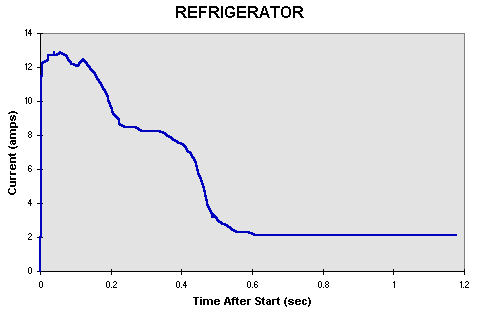
in particular since, depending on the fridge, the short term startup current can be quite high. YMMV.
Yes, it can, but not for long enough to damage any cords or other equipment.
Results of one measurement are shown in the plot below. It shows a maximum inrush current of about 13 amps which lasts only about one-half second.
January 17, 2023, 01:57 PM
architect
Another thing I thought of (if the OP is determined to go the extension cord route), to minimize the hole to be drilled, cut the end off the extension cord, pass the wire through a smaller hole, and attach a new plug/receptacle to the wire. You could also shorten the length of wire appropriately to remove any excess as desired.
I'd select a heavy-duty cord and receptacle to defer abrasion issues.
January 17, 2023, 02:06 PM
Georgeair
quote:
No different than using a power strip or extension cord elsewhere in the house.
I suspect the difference arises when you run it through an unimproved wooden hole.
You only have integrity once. - imprezaguy02
January 17, 2023, 02:48 PM
Skins2881
quote:
Originally posted by holdem:
quote:
Originally posted by MNSIG:
quote:
Originally posted by Skins2881: All of those options violate the electrical code. Spring for a half hour to an hour to have an electrician do it properly.
Maybe I’m misunderstanding, but I don’t think he is burying the cord in the wall. It would be in open air behind the refrigerator.
Correct, the cord would be in the open, not buried in the wall. No different than using a power strip or extension cord elsewhere in the house.
As long as it's removable without damaging drywall or cabinetry then it would be code. So with that out of the way, I'd still add a real outlet instead. I'm also an electrician and in my house and most houses it's more clean up time than actual electrical work to add a new outlet, so I'd add one. Plus I get discounts on materials and the material cost would be similar to that of an extension cord.
That being said the best way without installing an outlet would be to just buy an appliance cord and install a replacement end for female side.
As long as it's removable without damaging drywall or cabinetry then it would be code. So with that out of the way, I'd still add a real outlet instead. I'm also an electrician and in my house and most houses it's more clean up time than actual electrical work to add a new outlet, so I'd add one. Plus I get discounts on materials and the material cost would be similar to that of an extension cord.
That being said the best way without installing an outlet would be to just buy an appliance cord and install a replacement end for female side.
Ahhh, very cool, that type of set up will work. Looks like the cord wires just insert and receptacle screws down on the wires, much like when I replace a household light switch.
I hear you on hiring an electrician. I did it last year when I needed an outlet behind the TV for a clean mounting solution. He ran the wire from another outlet, behind the drywall, nice and clean. But it was $200. And for this purpose, since everything is already completely hidden, I much prefer the $20-$30 solution over the $200 solution. Or short of the $20-$30 solution, I would probably just leave the current extension cord in place. It's flat, white, pressed against the white cabinet and not very noticeable. At least not enough to bother spending $200.
January 17, 2023, 03:44 PM
Skins2881
Just note the cord I linked is 14awg and the plug is 15a. That means the wire range is probably 12-14awg. If you end up cutting the end of an extension cord off instead, if it's 16awg you will need to strip twice the strip gauge on the outlet and fold wire in half to insure a good connection.
Jesse
Sic Semper Tyrannis
January 17, 2023, 03:51 PM
YellowJacket
FWIW, I've done this sort of thing many times wiring AV components into furniture and cabinetry. As long as the hole is hidden, whatever size is necessary is what I drill. It is completely hidden, correct? If so, the size of the hole matters not to me.
If you cut/splice the extension cord, you'll just have to do it again if you ever want to take it out.
What power cord does this sonos speaker use? The figure 8? I know that Echo devices use a plug that is very small and round on the end that plugs into the device, which would allow you to drill a small hole and let the extension cord live completely inside the cavity of the millwork.
There ain't much difference in the man I want to be and the man that I really am.
January 17, 2023, 03:54 PM
RogueJSK
If you do decide to go with the absolute smallest hole possible via Option #4, don't cut the cord and then try to splice the two pieces of cord back together. Cut off the plug on one end, thread it through the cord-sized hole you drilled, and then replace the plug on the end.
Installing a replacement male or female plug on a cord is cheap and simple. I've had to do it a few times over the years when my former stepson had mishaps with the corded electric hedge trimmer...
January 17, 2023, 04:49 PM
holdem
quote:
Originally posted by YellowJacket: FWIW, I've done this sort of thing many times wiring AV components into furniture and cabinetry. As long as the hole is hidden, whatever size is necessary is what I drill. It is completely hidden, correct? If so, the size of the hole matters not to me.
What power cord does this sonos speaker use? The figure 8? I know that Echo devices use a plug that is very small and round on the end that plugs into the device, which would allow you to drill a small hole and let the extension cord live completely inside the cavity of the millwork.
Yeah, you are probably correct, the hole in the cabinet would be completely hidden, so the size of the hole probably does not matter.
Ding, ding, ding, we have a winner. I did not even think to check the other end of the Sonos cord. It uses a little two prong connection, much smaller than a normal plug. I'll have to check to see if it's long enough to run from the edge of the shelf and then down though the cabinet, which is about 18" tall.
January 18, 2023, 06:15 AM
holdem
Ahhh, ok, I gave up and contacted the guy that did my TV work last year. Sent him pics. He said he would put in two outlets (there is another place I could use one) for $260. I will go that route. Thanks all.
January 18, 2023, 09:02 AM
mark60
I'm with radioman and nothing else gets plugged into the fridge outlet. I installed led undercabinet lights and plugged them into the same outlet as the fridge. The first time they were on and the newish fridge kicked on I needed new undercabinet lights.
January 18, 2023, 09:38 AM
Flash-LB
quote:
Originally posted by mark60: I'm with radioman and nothing else gets plugged into the fridge outlet. I installed led undercabinet lights and plugged them into the same outlet as the fridge. The first time they were on and the newish fridge kicked on I needed new undercabinet lights.
I charge both of our cell phones and both of our Kindles on the same outlet the fridge is on and have for 18 years at this point.