SIGforum
Tire pressure for E rated tires
November 14, 2025, 01:12 PM
4MUL8RTire pressure for E rated tires
We are just guessing here, absent vehicle info, but if a Land Cruiser, and knowing that Toyota always picks the strangest tire sizes of anyone, I see on
www.tirerack.com that for a Land Cruiser that the only off road tire is rated E for "everything."
Looks like a 2024 Land Cruiser weight + max payload = 6726 pounds.
The tire max load in that size is 3525 pounds.
There are numerous calculators and threads on the web for your very question. I couldn't make out anything authoritative.
I think the practical answer is two-fold...
1. Try a lower pressure. It can't hurt to try.
2. Don't expect a very heavy tire to ride well regardless of tire pressure. The KO2 is likely 12 pounds heavier than the equivalent P-Matric SUV tire. That's about 28% more than stock. All sorts of assumptions made by the platform engineers could be blasted to smithereens by a 28% heavier tire. Most obvious would be the damping and rebound settings on the shocks.
-------
Trying to simplify my life...
November 14, 2025, 02:08 PM
adorFor us in the RV world, cold PSI is a very debatable topic. But, as a rule of thumb, we go by what the manufacturer information listed that is based on Loaded Weight. PSI is expected to go up as the tire gets hot under load. Then goes back down when the tires cools down.
_______________________
P228 - West German
November 14, 2025, 03:47 PM
reflex/deflex 64I found as I lowered the pressure in search of ride quality the truck handling suffered. I settled on 44psi front and 40psi rear.
All considered I went from surprisingly compliant to a truck. Which is exactly what I expected honestly, but kinda hoped it could get a bit softer.
The tire weight is a serious factor, the truck handling suffered greatly when the heavies were installed. I upgraded to Bilstein 5100 series shocks, which cleaned up the handling while further taking me towards truck status.
I went from a “luxurious” truck experience to a wonderful mid 80’s 3/4t farm truck. It’s what I needed, not changing anything.
----------The weather is here I wish you were beautiful----------
November 14, 2025, 03:50 PM
trapper189quote:
Originally posted by 4MUL8R:
We are just guessing here…
I’m not guessing. I’ve given him all the information he needs to figure it out.

If he posts his current tire size and axle ratings or actual weights on the axles, then I’d be happy to look it up and walk him through it.
November 14, 2025, 03:50 PM
konata88quote:
Originally posted by 4MUL8R:
We are just guessing here, absent vehicle info, but if a Land Cruiser, and knowing that Toyota always picks the strangest tire sizes of anyone, I see on
www.tirerack.com that for a Land Cruiser that the only off road tire is rated E for "everything."
Looks like a 2024 Land Cruiser weight + max payload = 6726 pounds.
The tire max load in that size is 3525 pounds.
There are numerous calculators and threads on the web for your very question. I couldn't make out anything authoritative.
I think the practical answer is two-fold...
1. Try a lower pressure. It can't hurt to try.
2. Don't expect a very heavy tire to ride well regardless of tire pressure. The KO2 is likely 12 pounds heavier than the equivalent P-Matric SUV tire. That's about 28% more than stock. All sorts of assumptions made by the platform engineers could be blasted to smithereens by a 28% heavier tire. Most obvious would be the damping and rebound settings on the shocks.
Yup, you got the conceptual problem statement. And what's been happening is that when I bought the tires and everytime I get the tires rotated / balanced, the shop resets to the table pressure (which for my car and tire is 42psi; value confirmed by me in looking it up in the tables myself as well as others with similar car / tire).
But I'm questioning the value since I'm not using the car per assumed load limit capability (especially not as daily driver). To me, it seems that then I'm leaving some other capability like responsiveness and traction on the table because I don't need to compensate pressure for load. This is coming up now because I'm feeling like the tires are behaving a little less now w/ wear than when new. It's like the tread is harder or something. For daily driving, I want to optimize tire pressure for responsiveness and traction (fr safety), not for load, without compromising other safety (which is the unknown for me).
If I can improve traction, great. If the ride quality improves, perfect; but I'm happy if I only get improved traction.
The weight is another matter that has me looking at the BBK (Tundra parts).
"Wrong does not cease to be wrong because the majority share in it." L.Tolstoy
"A government is just a body of people, usually, notably, ungoverned." Shepherd Book November 14, 2025, 03:59 PM
konata88quote:
Originally posted by trapper189:
quote:
Originally posted by 4MUL8R:
We are just guessing here…
I’m not guessing. I’ve given him all the information he needs to figure it out.
If he posts his current tire size and axle ratings or actual weights on the axles, then I’d be happy to look it up and walk him through it.
Thanks. Tire size is 285/55/20. I need to go look up the weights again but the recommended pressure based on max load limit is already known - 42psi.
What I may need is actual measured weight in daily driver mode (I'm guessing curb weight + 500lbs?) vs the recommended max load capacity. Then maybe find the pressure for that? That may bookend things (not necessarily that I would use that pressure).
So, if the vehicle is driving around with 7000lbs (vehicle + passengers), then seems like a pressure of between 35-40psi would be okay - don't need 42psi.... Whether that would be better or worse for responsiveness and traction is tbd, but at least should be okay from a load safety perspective. right?
"Wrong does not cease to be wrong because the majority share in it." L.Tolstoy
"A government is just a body of people, usually, notably, ungoverned." Shepherd Book November 14, 2025, 04:26 PM
trapper189quote:
Originally posted by konata88:
Thanks. Tire size is 285/55/20. I need to go look up the weights again but the recommended pressure based on max load limit is already known - 42psi.
What I may need is actual measured weight in daily driver mode (I'm guessing curb weight + 500lbs?) vs the recommended max load capacity. Then maybe find the pressure for that? That may bookend things (not necessarily that I would use that pressure).
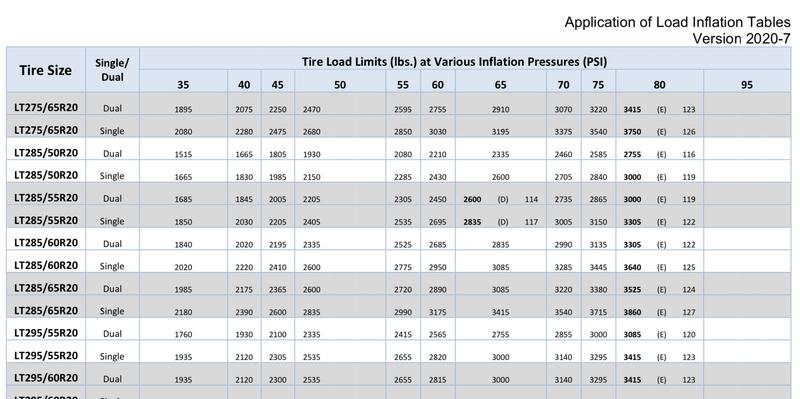
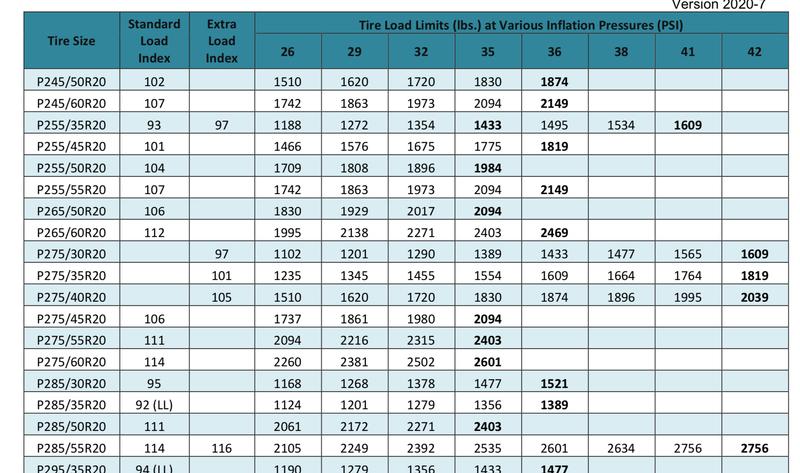
42 does not apply to the tires you have installed. You said you have load range E tires which means your tires are LT285/55R20s with a max cold pressure of 80PSI, not P285/55R20s with a max cold pressure of 42PSI.
Looking at the charts below, you’d need a little over 60PSI in your LT285/55R20s to match the load carrying ability of a P285/55R20.
You can go as low as 35PSI with your tires as long as they are not carrying more than 1,850 pounds each. While that would a total of 7,400 pounds if your tires are evenly loaded, the chances are the front tires carry more than 50% of your vehicles weight when your vehicle is empty.
November 14, 2025, 04:41 PM
konata88Thanks - I'm probably confusing things by referring to "max" load, etc. Which is probably wrong and I shouldn't have done that. Sorry for the confusion. I'm not looking at max bookends here.
I don't have the numbers handy but basically 42psi is the right RCTIP for my car and the LT285/55/20 tires based on the stock p-metric tire pressure of 33psi(I think). This is the number the shop, I and others with the same car independently determined.
42psi is not in question in this context. Again, you're probably right for "max" contexts but I don't think that's my context here. Again, sorry for any confusion.
My context is basically an empty car + full gas + passengers. No cargo, no towing, nothing else the car is capable of doing.
With stock P-metric tires, the shop would fill to 33psi per the tag in the door jam. With LT tires, the shop fills to 42psi (except when they make a mistake and only fill to 33psi).
Or per the tables you have, if stock is P285/55/20 at 33psi, then the load in context is about 2400lbs. Moving to the LT285/55/20 table, then the corresponding pressure would be (2400/1.1 = 2181) roughly around 43psi.
But I'm not carrying around that amount of weight. Hence the question: if I'm only carrying around 6000lbs, what tire pressure can I safely use and what difference, if any, will it make to traction? Seems like 35psi should be safe from a load perspective with headroom to spare, right?
"Wrong does not cease to be wrong because the majority share in it." L.Tolstoy
"A government is just a body of people, usually, notably, ungoverned." Shepherd Book November 14, 2025, 04:48 PM
trapper189The chart shows 50PSI in an LT tire your size will give the same load carrying ability as 33PSI in a P tire your size, about 2,400 pounds. Did you change tire size as well?
35PSI is the minimum you should run on the roads, if the actual weight on the tire does not exceed 1,850 pounds. I don’t know what affect running that low will have on your vehicle. I know that less than 50 in the rears on my F350 makes it feel like it’s floating on marshmallows.
Are you sure your KOs are LT tires? They make those in both an LT tire and a P-metric in that size.
November 14, 2025, 04:59 PM
konata88quote:
Originally posted by trapper189:
The chart shows 50PSI in an LT tire your size will give the same load carrying ability as 33PSI in a P tire your size, about 2,400 pounds. Did you change tire size as well?
35PSI is the minimum you should run on the roads, if the actual weight on the tire does not exceed 1,850 pounds.
I believe there is a 10% conversion / safety factor that needs to be accommodated when converting between Pmetric and LT tables. So a load of 2400 pounds in the Pmetric table is 2400/1.1=2181 when using the LT table.
But don't take my word for it - please verify independently. But I'm pretty sure it's in the documentation that accompanies the tables. If you find something different or doesn't apply to your tables, let me know. But the tables I used indicated this adjustment.
If 35psi is safe from a load perspective then, I'll perhaps experiment w/ handling in 2psi increments, going down from 43psi.
BTW, there seems to be a 10% rule where, if after driving and getting the tires warm (say 30 highway miles), if the pressure by 10%, then the tires may be overinflated. If it goes up more than 10%, probably underinflated. More rough rule of thumb I guess.
But I drive around and my tire pressure is only going up 1psi, maybe 2 (rounding error). If you believe the rule of thumb, then perhaps I have some headroom to let some air out.
"Wrong does not cease to be wrong because the majority share in it." L.Tolstoy
"A government is just a body of people, usually, notably, ungoverned." Shepherd Book November 14, 2025, 05:24 PM
egregorequote:
Tire size is 285/55/20
Those large wheels with low-profile, short sidewalls aren't helping your ride quality. I really dislike this trend.
225/40-18 on a
Toyota Corolla?? (2026 model) Come on.

Freaking stupid. If they keep this up, every car is going to look like a "donk."
"The Almighty, He put some livin' things on this earth so a man can eat." - Festus Haggen, Gunsmoke November 14, 2025, 05:28 PM
konata88I know. It's not my preferred size choice for the car. I would have preferred something like 295/60/18 or something like that. But it's what came stock on the car and I didn't want to dish out $4000-5000 for new wheels. Trying to make the best of what's been given.
"Wrong does not cease to be wrong because the majority share in it." L.Tolstoy
"A government is just a body of people, usually, notably, ungoverned." Shepherd Book November 14, 2025, 06:38 PM
wxlTry 35psì if not running heavy load. Then try 37-38 and see handling you prefer.
I run LT tires on my F150 XLT for the 7 years I've had it and LTs om my previous Lariat.
Do not hayl heavy loads or tow but occasional hunting. My truck (s)
are also 4 X4 s.
Always preferred Light truck tires on my truck and not 2ply passenger tires.
November 14, 2025, 07:17 PM
trapper189quote:
Originally posted by konata88:
I believe there is a 10% conversion / safety factor that needs to be accommodated when converting between Pmetric and LT tables. So a load of 2400 pounds in the Pmetric table is 2400/1.1=2181 when using the LT table.
You are right. When a P-metric tire is installed on an SUV/light truck Federal Motor Vehicle Safety Standards require the derating the tire by 10%. I didn’t know that, so thank you for teaching me something new.

The confusion was all mine. I didn’t understand where you got 42 from as LT table is in 5PSI increments. I’m sorry for muddying the waters.
Yes, you should be fine lowering your pressure as long as the load carrying ability of the tire at the pressure you choose is above the actual weight on the tire which does include passengers and fuel.
One thing about “ply rating”: it’s a really old rating that doesn’t apply anymore. Used to be a load range E was literally a 10-ply tire. There was 10 layers making up the carcass of the tire. Most LT tires have the same number of layers as P-metric tire: 2 ply carcass with 2 steel belts and a layer of nylon around the circumference of the tire. Some LT tires have a 3 ply carcass.
November 14, 2025, 07:21 PM
konata88Good - glad that we're on the same page. Safety first.
I think I'm good to go for now.
Thanks all for your inputs.
"Wrong does not cease to be wrong because the majority share in it." L.Tolstoy
"A government is just a body of people, usually, notably, ungoverned." Shepherd Book November 14, 2025, 07:30 PM
flesheatingvirusPut in stock tire configuration, put in new configuration. Easy.
Going from P265/70R16 SL to LT285/70R17 E tires on my Tacoma made the recommended psi go from 30 (on the door jamb) to 35. I typically run between 35 and 40.
________________________________________
-- Fear is the mind-killer. Fear is the little-death that brings total obliteration. I will face my fear. I will permit it to pass over me and through me. And when it has gone past me I will turn the inner eye to see its path. Where the fear has gone there will be nothing. Only I will remain. --