
Page 1 2
Go | New | Find | Notify | Tools | Reply | |
| Member |
Local coin shops in NH are offering $12-$13 below spot for Silver rounds/bars. Selling for $7-$8 over spot. | |||
|
| Member |
Both my local shops are paying back of spot for silver ($10 & $12). However, an opportunity exists for a trade up to gold since the G/S ratio is down to hovering around 50%. If your silver was bought when the ratio was 85% or 90% or even 100% like mine, most shops will trade at a much more favorable buy back if they're not laying out cash. Converting silver to gold is a pretty good play currently. ____________ Pace | |||
|
safe & sound |
My local dealers are $5 back on spot to buy, $1.50 over to sell on silver, and $100 back on spot to buy, and $62 over to sell on gold. | |||
|
| Member |
Those are really good buy/sell prices. | |||
|
Member |
 | |||
|
| Member |
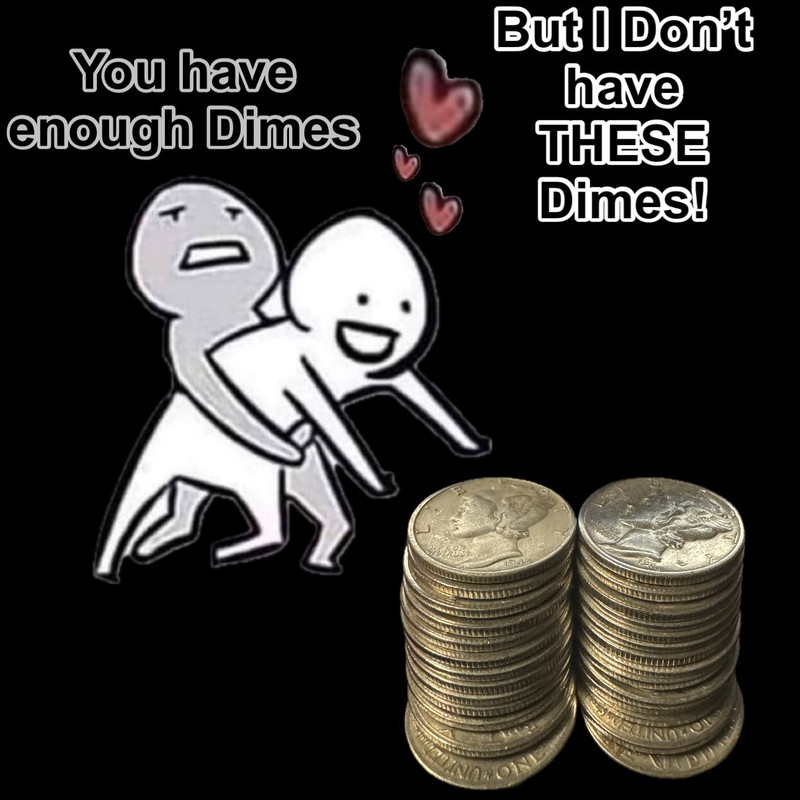
I love dimes too. | |||
|
| Member |
I have a roll of BU Mercury dimes originally coined at the Philadelphia Mint. Sealed and wrapped. It's killing me not to open the roll.  | |||
|
| Member |
^as the price of silver goes up, it catches up with premiums of any numismatic value. I don't have a grasp of any increased value on original mint rolls but at some point the value of each dime could exceed the total of what someone would pay for all 50, especially for BU mercs. Maybe have another tube to put them in before you tear it open though  | |||
|
Member |
Metals closing prices on Friday, 23 January 2026: Gold @ $4985.10/ounce Silver @ $103.30/ounce https://www.zerohedge.com/news...r-100-event-horizons Gold $5,000, Silver $100 Event Horizons The Event Horizon in Precious Metals Authored by GoldFix Gold approaching $5,000 and silver approaching $100 represent more than incremental price advances. These levels function as psychological thresholds where attention concentrates, behavior changes, and market structure briefly dominates narrative. In market terms, these prices act as an event horizon. The concept is borrowed deliberately. In physics, the event horizon marks the point beyond which outcomes are no longer observable in advance. In trading, it marks the price level that forces participation. Opinions polarize, positioning compresses, and conviction gives way to reaction. Goldman Raises Price Target to $5,400 These numbers draw in new participants on both sides of the market. Buyers include momentum participants who believe higher prices are inevitable, as well as short positions forced to cover under pressure. Sellers include long holders who have never experienced these prices and view the opportunity to monetize as both rational and psychologically satisfying. Selling silver at $100 or gold at $5,000 carries narrative weight regardless of future direction. The result is rarely a clean transition. Markets approaching event horizons tend to exhibit choppiness, volatility, and false signals. Order books thicken. Stop orders cluster. Limit orders stack. Liquidity appears and disappears unevenly. What matters in these moments is not the noise at the level itself, but the behavior that emerges after price has tested it. Several broad outcomes tend to repeat. Price may reach the level and reject sharply, signaling that supply overwhelmed demand on first contact. Price may press through as short covering dominates initial flows, often without meaningful fresh demand. In other cases, price spikes through, draws in forced buying, and then meets heavy selling that uses that liquidity to distribute. Less commonly, early rejection gives way to strong dip buying, allowing the market to reclaim and move higher with stability. Despite these permutations, the framework remains simple. After the test, price will exist above the level, below it, or within a range around it. Sustained trade above the level supports a bullish posture until failure. Rejection and persistence below the level support a bearish posture until reclaimed. Extended consolidation near the level can form the base for the next directional move. These dynamics are not symmetric across metals. Gold’s market is deeper, more liquid, and carries more readily available inventory. As a result, selling pressure at psychological thresholds tends to be heavier. Silver’s market is smaller, tighter, and more sensitive to marginal supply. Elevated prices may draw out scrap and secondary supply, but structural tightness limits immediate availability. This distinction matters when interpreting price behavior near shared psychological milestones. At these levels, speculation increases by definition. Participation becomes less about valuation and more about positioning. This does not invalidate the broader trend, but it does raise risk. Professionals tend to reduce exposure or distribute into strength, while less experienced participants are drawn in by the visibility of the number itself. The first test of such levels often fails. Clean acceptance on the first pass is historically rare. The practical implication is discipline. Profit-taking should be driven by capital needs or opportunity cost, not by round numbers alone. New longs above the level should be treated as speculative exposure, not confirmation. The event horizon is not a destination. It is a transition point. What ultimately matters is not that gold reaches $5,000 or silver reaches $100. What matters is how the market behaves after it does. Good Luck --------------------- DJT-45/47 MAGA !!!!! “Quidquid latine dictum sit, altum videtur.” "Sometimes I wonder whether the world is being run by smart people who are putting us on, or by imbeciles who really mean it." — Mark Twain “Democracy is the theory that the common people know what they want, and deserve to get it good and hard.” — H. L. Mencken | |||
|
Not quite right |
People considered me loony toons when only a few short years back I said gold is going to $5,000, then to $10,000 where it should be if its true value hadn't been manipulated to prop up the dollar since Nixon took us off the Gold Standard. https://www.kitco.com/news/art...g-6000oz-spring-2026 Forget $5,000: Bank of America sees gold price hitting $6,000/oz by Spring 2026 (Kitco News) – As markets brace for gold to hit the once-unthinkable $5,000 price level, Bank of America has raised its near-term gold target to $6,000 per ounce – the most aggressive price forecast for the yellow metal from any major institution. “History no guide to future, but avg gold jump past 4 bull markets ≈ 300% in 43 months which would imply gold reaching $6,000 by spring,” wrote BoA analyst Michael Hartnett in a note to clients. is forecasting that the price of gold will reach $6,000 an ounce by the spring. This would put the gold price over 20% above the precious metal’s current all-time high levels. On Jan. 5, Bank of America’s Head of Metals Research Michael Widmer said gold will remain a key asset in investor portfolios this year. “Gold continues to stand out as a hedge and alpha source,” Widmer wrote. Bank of America sees tightening market conditions and strong earnings sensitivity position gold as a key hedge and potential return driver in 2026. BofA’s 2026 outlook is based on their projections of falling supply and rising costs in the gold sector. Widmer expects the 13 major North American gold miners to produce 19.2 million ounces this year, a decline of 2% from 2025, adding that most market forecasts for output are too optimistic. Widmer projects average all-in sustaining costs will rise 3% to about $1,600 per ounce, a level slightly above the market consensus. He also expects a strong increase in profitability for the producers, with total EBITDA projected to rise 41% to around $65 billion in 2026. BofA wrote at the time that they expect gold to average $4,538 per ounce in real terms over 2026, while silver, platinum, and palladium are also expected to see higher prices, reflecting the bank’s positive outlook for precious metals as a whole. Widmer said silver may appeal more to investors willing to take higher risk for extra upside, and noted that the current gold:silver ratio of around 59 suggests silver could still outperform gold. He cited the historical ratio low of 32 in 2011 as implying a silver price high of $135, while the 1980 low of 14 in the ratio suggests a silver price of $309 per ounce. In his annual outlook webinar in December, Widmer said that gold bull rallies typically peak only when the underlying drivers that initially triggered the rally fade, and don’t end simply because prices rise. “I’ve highlighted before that the gold market has been very overbought. But it's actually still underinvested,” he said. “There is still a lot of room for gold as a diversification tool in portfolios.” Widmer added that he doesn’t see the bullish environment ending anytime soon. He noted that it would take only a 14% increase in investment demand to reach that target. Investment demand has roughly averaged that level over the last couple of quarters. Meanwhile, it would take a 55% increase in investment demand to drive gold prices to $8,000 an ounce next year. Investment demand—particularly among retail investors—has surged in recent months, with 2025 inflows into gold-backed exchange-traded funds reaching their highest level since 2020. However, Widmer said there is still a key segment that has largely ignored the gold market, and that could change in the new year. Widmer noted that the precious metal now represents about 4% of the total financial market, but within the professional investment sector, high-net-worth investors hold only 0.5% of their assets in gold. Growing interest in gold comes as many investors continue to question the reliability of the traditional 60/40 portfolio allocation. Widmer said research now shows that holding 20% of a portfolio in gold can be an effective strategy. “When you run the analysis since 2020, you can actually justify that retail investors should have a gold share of well above 20%,” he said. “You can even justify 30% at the moment.” But it's not just retail investors who stand to benefit from further diversification into gold. Widmer said he expects central banks to continue buying gold even as official reserves hit milestone levels in 2025. He noted that central bank gold reserves have surpassed their holdings of U.S. Treasuries. Gold now represents, on average, about 15% of total central bank reserves. However, his modeling indicates that reserves would be fully optimized with an average gold allocation of around 30%. “Whichever portfolio you're looking at, whether it's a central bank portfolio or an institutional portfolio, they can benefit from diversification into gold,” he said. Widmer added that gold’s massive price gain in 2025 means it will be difficult for some portfolio managers to ignore in 2026. “Just looking at benchmarks, gold has been one of the best-performing assets for the past few years,” he said. “What we've heard a lot of the time is that ‘gold is a non-yielding asset; it costs to hold it; you don't make any money from it, so what's the point of actually holding it?’ But just from a pure direction perspective, gold could have actually made a good contribution to a portfolio. I think the numbers speak for themselves.” As for what could ignite another rotation into gold, Widmer said U.S. monetary policy will be an important factor in 2026. He noted that his modeling suggests that during an easing cycle—when inflation is above 2%—gold prices have risen by 13% on average. “You don’t even need to see cuts at every meeting,” he said. “You just need to see that rates are going down.”This message has been edited. Last edited by: P220forever, | |||
|
| Powered by Social Strata | Page 1 2 |
 | Please Wait. Your request is being processed... |
|
© SIGforum 2026