November 30, 2022, 06:57 PM
urbanwarrior238
quote:Originally posted by holdem:
Is it possible to have cooked a bird to 165 internal and to have undercooked it?
quote:Originally posted by dsiets:
When I use a probe, I always double check several areas w/ an instant read to make sure.
quote:Originally posted by TSE:
I almost ruined Thanksgiving three years ago by doing the same thing. I inserted the probe in the breast, when it should have gone in to the transition from breast to leg (according to my BIL chef). He quickly deboned the bird and we cooked the meat before serving.
quote:Originally posted by RogueJSK:
Probe placement can make a difference.
quote:Originally posted by old rugged cross:
if everything is equal I would think cooking it another 20-30 mins. would be preferrable.
quote:Originally posted by bettysnephew:
My first question would be if your friend is using a kamado.
quote:Water pans, drip pans, roasting pans
When setting up for 2-zone cooking, I normally recommend you put a water pan under the meat. It acts as a heat sink, absorbing energy and moderating fluctuations. A water pan also puts humidity in the atmosphere to reduce evaporative cooling and helps keep the meat moist. If you have a small grill, the water pan can actually sit between the flame and the meat, casting a heat shadow above it so the meat doesn’t overheat.
For this grilled turkey recipe or smoked turkey recipe, we replace the water in the pan with the fixins for our special gravy and it will collect dripping further enriching the gravy. This gravy/drip pan should have at least 3.5 quart (4L) capacity and must be large enough to fit under the entire bird. The best choices are stainless steel, ceramic, or CorningWare. Be forewarned, the pan it will get smoky and need serious scrubbing. Don’t use copper because it can react with the salts and acids in the gravy. I have used a disposable aluminum pan and noticed no off flavors, but I now have a stainless steel roasting pan that I use just for outdoor cooking because I got tired of sleeping on the couch.
You never want to put the bird in liquid on the bottom of a roasting pan. If you put it in liquid, you will boil the back and end up with soggy flavorless meat and inedible skin. If you put it in a dry pan, it will stick and the dripping oils will fry the back, usually overcooking it. So you’ll need a grate for holding the bird. You can use one from your grill, or even one from your indoor oven.
The tricky part is arranging everything when getting ready to prepare our grilled turkey recipe or smoked turkey recipe. Because there are so many different grill designs I can’t go through all the options, so grasp the science and adapt it to your own rig. The ideal setup is to place the bird on a rack 2 to 3″ (5 to 7.6cm) above the pan so heat and smoke can travel between them. If the bird is any lower, the mass of the cooler gravy, evaporation from its surface, and the sides of the pan will conspire to block heat, airflow, and smoke and you will end up with a pale, soggy, undercooked bottom.
The traditional turkey roasting configuration is a V-shaped rack that sits in a deep roasting pan with water in the pan to keep the drippings from burning. It is a recipe for skin as pale as a Seattle sunbather on the bottom and sides, and undercooked dark meat. I can see you nodding in recognition from here.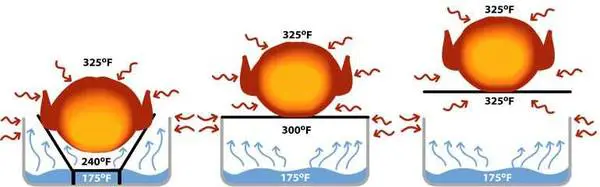
Prof. Greg Blonder, is a physicist, entrepreneur, former Chief Technical Advisor at the legendary Bell Labs, food lover, and the AmazingRibs.com science advisor and mythbuster. To assist in helping create our ideal grilled turkey recipe or smoked turkey recipe, he measured the temps at different levels above the liquid in a 3″ (7.6cm) tall pan of water.
Even though the oven was 325°F (162.8°C), the liquid never reached boiling temp in the time it took to cook a turkey. That’s because air is a lousy conductor of heat. You can put your hand in a 325°F oven (162.8°C), but don’t put it in 325°F (162.8°C) oil. Because the evaporation of water from the surface cools the liquid in the same way sweat cools us on a hot day, the temp of the gravy may never get above 175°F (79.4°C).
As you can see from the illustration, if the bird is below the lip of the pan and about 2″ (5cm) above the gravy, the bottom of the bird is in 240°F (115.6°C) high humidity air, 85°F (47.3°C) cooler than the top of the bird which is chugging away nicely in dry heat. That’s why turkey backs are so often as flabby as an elephant’s.
Even if you place the bird on a grate on the lip of the pan, the bottom will still be much cooler than the top and will almost certainly be undercooked. He did experiments with a shallow pan and got similar results.
In order to heat the bottom of the bird properly when preparing our grilled turkey recipe or smoked turkey recipe, if you are using a 3″ (7.6cm) pan with liquid as I recommend, you need to get the meat 3″ (7.6cm) above the pan for the air temp to be 325°F (162.8°C) all around.
If you can’t get your bird above the pan, you should start it breast side down and turn it over after an hour. Another option is to just remove the drip pan about 20 minutes before the bird is finished and put its back above direct heat. Just be sure to watch it carefully so it doesn’t burn and check the temp in the breast before bringing it in.