
Go | New | Find | Notify | Tools | Reply | |
Member |
2010 Mini [base engine non-turbo] Started with an intermittent misfire, now a lean condition at idle giving a really stumbling idle. Anything over 1k rpm & it runs fine. CEL shows a P2187 [lean at idle] & 2789 [MAF malfunction] codes. When it was the misfire codes [since cleared] I swapped the plug & coil with a spare. Would fix it for a bit. Now it's the new codes & sitting in the car rider line at school is pretty much a no-go. Nothing more expensive than a free car... On the fence with trying to replace it, but can't trade it in, since it's on a bonded title. IIRC I still have 2 years before it's released as a clear title. Just venting in frustration...Not sure if putting a new MAF might do it...Hate to shotgun parts & $$ at it on a whim. The Enemy's gate is down. | ||
|
| His diet consists of black coffee, and sarcasm.  |
That has vacuum leak written all over it. I'd be checking the MAF sensor for contamination or damage - if present, may be accompanied by damage to the air filter - the intake ducting between the MAF and engine for cracks, holes, splits or tears, or a large vacuum line broken or come off, before loading up that parts cannon. "The Almighty, He put some livin' things on this earth so a man can eat." - Festus Haggen, Gunsmoke | |||
|
| Member |
Why not take it to a competent mechanic and have the problem diagnosed and repaired since you're stuck with it for another two years? | |||
|
Member |
I've never been a knowledgeable car guy so this might be BS, but I had a sort of similar thing happen with an older (2000) Tundra. Smallish V8. One day it just started sputtering, hesitating. The shop said one cylinder was misfiring because the coil on it had failed. I didn't even know they'd gone to separate coils for each cylinder, that's how out of date my engine knowledge is. So a new coil fixed the problem but only temporarily. A few months later another one failed. They guy said they have a fixed lifespan and when one goes the others usually aren't far behind. Sort of like headlight bulbs. | |||
|
| Technically Adaptive |
Never been under the hood of a Mini. That being said, when you clear codes you lose the freeze frame. Did a AI overview search and this very accurate. Techs actually go to school to learn this stuff, if you think you can research it yourself, have at it. Quote: Understanding MAF (Mass Air Flow) freeze frame data on a BMW or Mini Cooper is crucial for diagnosing engine performance issues and pinpointing the root cause of a fault code. Here's how to interpret and utilize MAF freeze frame data: 1. What is freeze frame data? Freeze frame data is essentially a snapshot of various sensor readings and parameters recorded by your car's On-Board Diagnostics II (OBD2) system at the exact moment a Diagnostic Trouble Code (DTC) is set. It provides invaluable context to understand the conditions under which the fault occurred, helping you differentiate between problems like a vacuum leak (often causing lean codes at low RPMs) and a faulty MAF (potentially setting codes at higher RPMs). 2. Key MAF-related data points in freeze frame: MAF Sensor Reading: This indicates the amount of air the MAF sensor is detecting entering the engine, typically measured in grams per second (g/s). Engine RPM: The engine speed at the moment the fault occurred. Fuel Trim Readings (Short and Long Term): These values show how the engine's computer is adjusting the fuel delivery to compensate for the air/fuel mixture. Significant deviations from zero (either positive or negative) can point towards issues with the MAF or other related components. Calculated Engine Load: Provides an indication of how much work the engine was performing when the DTC was set. Other Relevant Parameters: Freeze frame data also includes a range of other data points that can be helpful in the overall diagnosis, including throttle position, engine coolant temperature, and oxygen sensor readings. 3. Interpreting MAF freeze frame data Normal MAF Readings: At idle, a healthy MAF sensor should typically register around 0.5 to 1.5 g/s, increasing to 15-25 g/s at 2500 RPMs. Symptoms of a Faulty MAF: If your freeze frame data shows MAF readings significantly outside the normal range, or if the values aren't changing with engine speed, it could indicate a failing or malfunctioning MAF sensor. Differentiating Between MAF and Vacuum Leaks: MAF Sensor Issues: May show fault codes at higher RPMs or when driving. Vacuum Leaks: Typically trigger fuel trim fault codes at idle or low engine RPMs. Fuel Trims as Indicators: High Positive Fuel Trims: Suggest the engine's computer is adding more fuel to compensate for a lean condition (too much air or not enough fuel), potentially pointing to a vacuum leak or a faulty MAF under-reporting airflow. High Negative Fuel Trims: Suggest the engine's computer is reducing fuel delivery to compensate for a rich condition (too much fuel or not enough air). 4. Accessing freeze frame data You can access freeze frame data using an OBD2 scan tool, similar to how you would check for fault codes. Most scan tools allow you to navigate to the trouble codes section and then select the freeze frame data for a specific DTC. 5. Additional considerations Always inspect the intake air ducts for cracks or dry rot, as unmetered air leaks downstream of the MAF sensor can also trigger similar codes. When diagnosing MAF problems, check for related fault codes, such as O2 sensor codes, or "low air volume" messages. Don't jump to conclusions and immediately replace the MAF sensor without proper diagnosis. Live data streaming and specialized BMW/Mini diagnostic tools can provide more definitive answers. If replacing the MAF sensor, ensure you use a high-quality, reputable brand like Siemens or Bosch. By carefully analyzing the freeze frame data and other available information, you can more accurately diagnose and address MAF-related issues in your BMW or Mini Cooper. | |||
|
| Member |
Planning on pulling the MAF to inspect/clean/replace this weekend. Everything upstream of the MAF looks good, will have to get creative to inspect downstream. The Enemy's gate is down. | |||
|
| Member |
Found the problem, I think, large split in the hose between the MAF & throttle body. 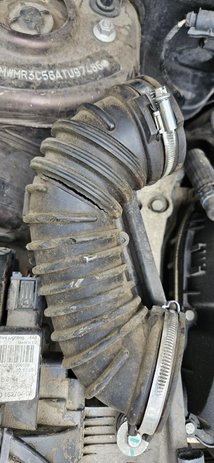 The Enemy's gate is down. | |||
|
| Member |
That would do it- | |||
|
| Member |
So far, the lean condition seems resolved. Temp fixed it to confirm before ordering a replacement tube. Still have an intermittent cyl 1 misfire at idle. Thinking I'm getting some oil past the rings on cyl 1, the plug threads were a bit oily when I changed it for a spare. The Enemy's gate is down. | |||
|
| Get my pies outta the oven!  |
There is a reason why used car lots are full of Mini Coopers... | |||
|
| Member |
Starting to understand that a bit. A few drives in & it seems like it's adjusted the fueling a bit. More stable idle, just a few stumbles. Nothing like it was with the massive intake leak above. The Enemy's gate is down. | |||
|
| Powered by Social Strata |
 | Please Wait. Your request is being processed... |
|
© SIGforum 2026