
SIGforum.com Main Page Disaster & Survival Preparedness So lets talk about limited solar. What, how much etc.
Main Page Disaster & Survival Preparedness So lets talk about limited solar. What, how much etc.Go | New | Find | Notify | Tools | Reply | |
| Green grass and high tides  |
I know we have the emergency generator thread and some discussion in the are you alarmed thread. But I would like to talk about limited solar. Not whole house solar. What type of system/battery storage would it take to run your critical electrical needs. Lights, fridge, freezers. maybe some type of heat. Many of us have wood burning capabilities for several months continuously. Maybe the need to occasionally use a generator to augment. What kind of investment would it take to put something together like this. "Practice like you want to play in the game" | ||
|
| No More Mr. Nice Guy |
You need to know how many continuous watts each item uses plus how many watt hours each uses over time. LED lights are very low power, nearly irrelevant compared to fridge etc if you only run a couple of lamps for a couple of hours. Also, how often you open a fridge or freezer has a big impact on their power usage. I believe Generac has a decent chart on their site that gives good ballpark numbers. Or you can grt an inexpensive meter to plug in each appliance to get an accurate number for your specific appliances. You may want separate power stations for different uses in your home. They are 120v not 240, so you won’t use a portable battery unit to power the whole house (but you might use a transfer switch to power several 120v circuits). A limitation is the watt hour capacity of the battery, and then the wattage of the solar to recharge it. A bigger battery will run longer but also be harder to recharge. If it works for you, a small inverter generator to recharge batteries daily is the ideal solution. You may need 1 or 2 gallons of gas per day. So it’s a good solution for a week or two. For solar recharge, you’ll need several of the portable panels. Then do the math of watts the panels provide and the watt hours of the battery. You won’t get 100% efficiency from the solar. You’re probably looking at something like the Ecoflow 2 kwh or 3 kwh power stations. $1200 to $1600 but they should have a black Friday sale. If you consider an inverter generator, the Honda eu2200i gets universal praise. We have a Generac gp3300i. The Honda is lighter and quieter. The Generac is cheaper and has more power. | |||
|
| No More Mr. Nice Guy |
We have the 2kwh hour EcoFlow power station and one of their portable solar panels. We get strong sun here, and it will recharge the unit during the day. Ideally I’d get at least one more panel. I forget how much they cost. The power station is out of service during recharge from a practical standpoint without very long wires. In a zombie apocalypse situation, the solar would be workable long term. For a week or so, that small generator is much better, ignoring noise. | |||
|
Member |
Note that many smart plugs include power monitoring. I've got some of these and they're about $45 for a 4 pack. Note that these will require a Zigbee hub of some kind. There are others that speak WiFi if you prefer. I run mine via a Home Assistant box, which is also what logs power usage. For a 220V circuit you need a clamp meter, and one for each phase is best. | |||
|
| Member |
I have a couple Ecoflow units with an extra solar panel but I also thought smaller. College dorm style fridge. You won't be stocking it at the supermarket during the apocalypse. Just enough to keep leftovers and a couple trays of ice. Small heater, plastic sheeting to section the house smaller. Think smaller and you don't need as much. ____________ Pace | |||
|
Membership has its privileges |
I will be following this closely. Just bought a Bluetie Elite 300 power station. After buying it, I see the Solar panels for this are quite efficient and I am strongly considering buying them, as another way to charge the Elite 300. Niech Zyje P-220 Steve | |||
|
| Member |
For checking individual amp/watt output on home items we have used this item listed below for the past seven years, as needed, and it still works great. You plug this meter into the wall plug and the item you want to check into the backside of this unit. It provides a continuous digital readout in amps or watts. 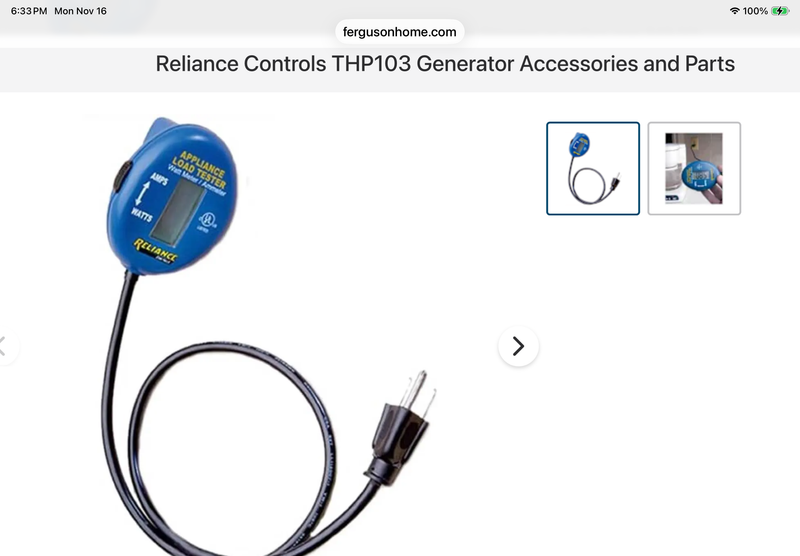 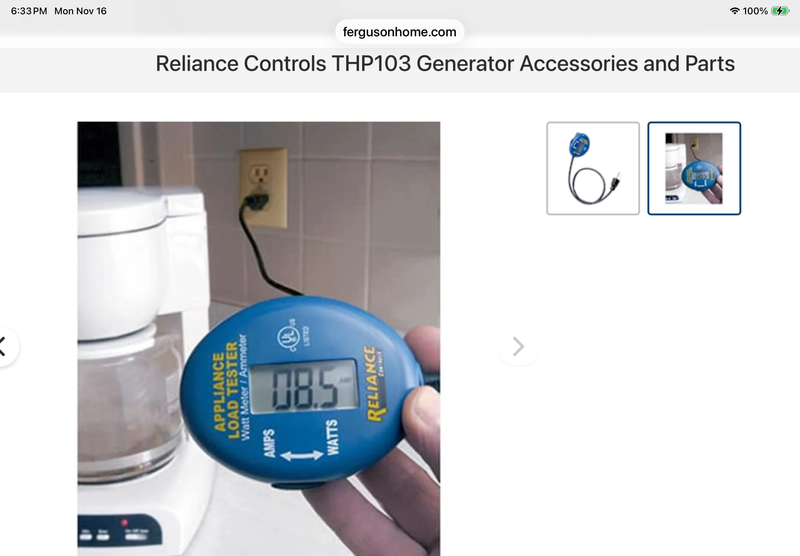 https://www.fergusonhome.com/p...DEAQYCCABEgJo1_D_BwE | |||
|
| Member |
I have an Ecoflow unit and a 200 watt fold-out solar set up. The charge time from 10% to 100% in mid-summer is beyond a day. (16 hours of sunlight). I am in NH so your charge times may be faster in places like FL or AZ. | |||
|
| No More Mr. Nice Guy |
Neither portable solar nor a generator alone will easily and economically solve power needs across time. When the food in your fridge/freezer is gone, your power needs decrease substantially. If the natural gas is still available for your furnace, that will be another immediate need for significant power if the weather is cold. Your water well pump will be critical over the long haul. Lighting will be really comforting over the long haul. If water pressure exists in your home, running the laundry will be very welcome. Municipal water, sewer, and natural gas will only be available for a relatively short time if at all. In a prolonged outage, we will be down to no outside services and a limited supply of gasoline for our generator. Security can become an issue after just a few days, suggesting limited use of a generator. Thinking about how needs change with time can help in deciding what equipment is best for you and how to prioritize purchases. e.g. we live at high elevation in snow country, so heat is a critical need. If you have a lot of frozen meats and refrigerated foods, having more power for a long enough time can be a real money (and life) saver. For the price of a good mid-size power station you can buy a good mid-size inverter generator. For me, that heavily favors first buying the mid-size battery system with solar to at least cover survival minimums. I then added the generator (and gasoline storage) to greatly improve our comfort over a few weeks. As the budget permits, we'll add additional battery power stations and solar. Connectivity to the home is something to consider, and it might affect which devices you decide to purchase. Fridges can be plugged right into the power station or generator. But the furnace needs to either have a device wired onto it or you need to get your breaker box wired to be fed from your generator or power station. | |||
|
| I have a very particular set of skills |
These guys do a lot of reviews and offer guidance on what you might need to suite your individual situation: https://www.thesolarlab.com/ps-quiz Some of the company’s websites offer similar guidance. Long story short, from my limited research, it kinda appears once you get above the ~1000kwh units like the Ecoflow Delta 3 or Bluetti 100 Elite V2, both in the $500-$600 range and probably the minimum you’d want to have to try to get through an outage over a few hours (w/ disciplined/savvy usage), price starts to climb pretty steeply. The next bump is knocking on $1K for the name brands. Like any increase of ‘horsepower,’ the price goes up. A decent ~100W Solar panel runs about a $100, and pretty essential one the power goes out unless you have a generator. Cost goes up with wattage of course. For most folks, outside of winter/heat, the big ticket item is probably going to be fridge/keep the food from spoiling, you probably need about of budget around $1500+ to get a set up where you manage that with diligent, conservative usage (forget watching TV and playing video games). Want a fair amount of power to be relatively comfortable? Probably double that ($3K+) Keep in mind some brands put expansion as one of their main strengths…ecoflow in particular. So you buy the main unit and then add expansion batteries/modules. Bluetti tends to be a bit more robust and prioritizes fast Solar charging with some models (tho they have extra batteries too). Suffice it to say, it’s not necessarily an apples-to-apples comparison. Lots of YT vids. FWIW…a$30 camp stove and a couple solar lights and/or 100 hr.candkes would take a lot of the ‘workload’ off of a solar generator in terms food, water boiling, basic illumination, etc. Pretty much all cooking appliances are significant power consumers. FWIW/YMMV, B A real life Sisyphus... "It's not the critic who counts..." TR Exodus 23.2: Do not follow the crowd in doing wrong... Despite some people's claims to the contrary, 5 lbs. is actually different than 12 lbs. It's never simple/easy. | |||
|
| Green grass and high tides |
Thanks guys, some good thoughts. I appreciate it. I am more interested in a solar system with probably some kind of generator support vs any kind of power station persae. Although adding one would be ok as some kind of emergency stand alone unit. I am looking to be able to generate my own long term power via solar as a significant back to our grid power. I have winter heat covered as I have a wood stove and a virtually unlimited wood supply. Which would also cover winter cooking and summer as well. My biggest power need will fridge/freezer and possibly well water pump. I maybe be able to use a 5000 watt gas powered generator once a week to power the water pump. So it could be outside the solar power system. "Practice like you want to play in the game" | |||
|
Member |
I have a dual compressor fridge/freezer it uses 355 watts, my entire load on my house uses about 700 watts, not counting any heat or hot water. At night with lights on I use about 1100 watts. The small solar inverters are good for overnight outage and maybe keep your cell phone charged and router on but their really not much use for anything else. Plus your limited to 120V and stuff you can literally plug in. Water heater - 4600W 1.5t heat pump - 1600W 3.5t heat pump - 2100W Septic tank aerator - 600W Dryer - 4500W Large burner on stove - 1800W small burner on stove - 1200W Dual element oven - 3000W | |||
|
| I have a very particular set of skills |
If you’re talking like a full system like Solar panels on the roof to batteries, some states have rebate programs…might be worth looking into. One thing to keep in mind…batteries and solar panels have service lives and disposal might be a bit involved ($$). B A real life Sisyphus... "It's not the critic who counts..." TR Exodus 23.2: Do not follow the crowd in doing wrong... Despite some people's claims to the contrary, 5 lbs. is actually different than 12 lbs. It's never simple/easy. | |||
|
| Staring back from the abyss  |
I went with an EcoFlow 4kw unit. It came with a 400W panel and I already had a couple of other panels that I can hook into it if need be. I can also recharge it in a couple hours with my little Honda on "eco-mode", so very little gas. All I need to keep running are the freezers and maybe the fridge. Otherwise, I can get by just fine without power. I won't like it, but I'll live. I need to start reading more anyway.  I've also got several smaller LiFePo batteries to run my ham radio equipment. Keeping in touch with folks and being able to get/pass information will be important in my estimation should the excrement hit the fan. ________________________________________________________ It is long past time for a Convention of States. The Founding Fathers gave us this tool to fix an out of control government and we need to use it. | |||
|
| Powered by Social Strata |
 | Please Wait. Your request is being processed... |
|
SIGforum.com Main Page Disaster & Survival Preparedness So lets talk about limited solar. What, how much etc.
Main Page Disaster & Survival Preparedness So lets talk about limited solar. What, how much etc.© SIGforum 2026